OpenAI launched ChatGPT Wallet so agents can pay without seeing the card number
OpenAI launched ChatGPT Wallet on November 13, a payment layer that lets ChatGPT agents buy things while the real card number stays hidden.
The decision it puts on your desk
Check your agent traffic within 7 days, before ChatGPT Pro users arrive with signed requests. Publish an agent policy by November 30.
OpenAI launched ChatGPT Wallet on November 13, letting ChatGPT Pro agents in the United States pay without seeing card numbers.

Purchase mechanics
A buyer adds a card to the wallet once, then reviews each order before it runs. Items, the total and the card all appear on screen, and a face scan clears the charge. Every approval records the exact charge that the buyer cleared.
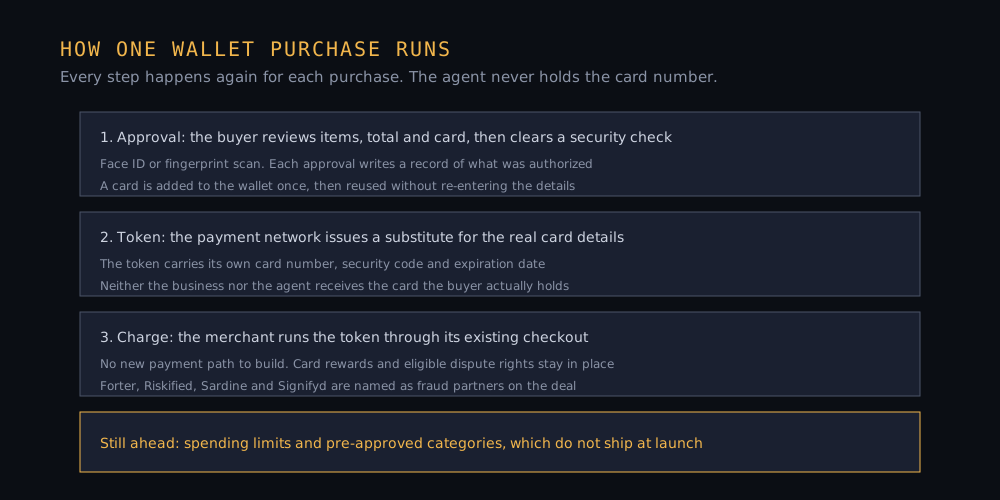
Behind that approval, the payment network issues a token. A token is a stand-in number with its own security code and expiration date. The merchant charges that substitute instead of the real card. The agent stops at the total on screen.
Luke Gebb, executive vice president at American Express, called the launch a first for the network. "We're bringing the trust and control of American Express payments into AI-powered shopping," Gebb said. The other two card networks, Mastercard and Visa, joined the same product.
Rollout scope
"We're introducing ChatGPT Wallet, setting a new bar for secure payments by agents," OpenAI said in a statement. The company built it with American Express, Mastercard and Visa, so the rails are the ones merchants already run.
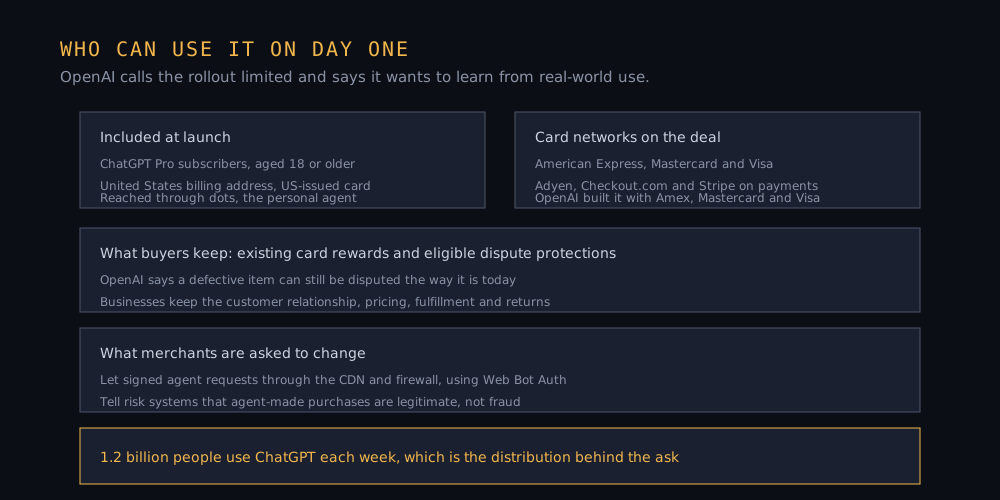
Reach is narrow on day one. ChatGPT Pro subscribers aged 18 or older in the United States get it, with a United States card. OpenAI calls the rollout limited and says it wants to learn from real-world use.
1.2 billion people use ChatGPT every week, and that is the reach behind the gate. OpenAI also published a playbook for businesses, telling them to open their sites to signed agent requests. It asks risk systems to treat agent orders as real money instead of fraud.
Airline pushback
Two days before the launch, United Airlines said it would block personal agents from booking flights. The airline cited security risks and federal rules that cover ticketing. It treated autonomous bookings as a threat to customer accounts.
That split is the story, because merchants now face two paths at once. OpenAI wants agent traffic made legible without any change to the payment flow. Payment networks are building the recognition systems that decide which side a seller lands on.
One piece stays out of the launch. OpenAI expects buyers to hand agents standing permission for spending limits later. Every purchase still needs its own approval for now.
Sources
← Previous
Jensen Huang resigned after 33 years, leaving NVIDIA's finance chief in charge of a $4 trillion company
Next →
LangChain raised $300 million at $3 billion, double its value of a year ago
The Morning Recap
We sift the day. You make the calls.
The decision on every story, in your inbox before your first call.