The United States now needs a license to send AI chips to data centers that serve China
The Commerce Department said Monday that companies need a license to send AI chips to data centers anywhere in the world when those centers may serve China.
The decision it puts on your desk
Check each data center for a license within 7 days. List your chip countries by February 14.
The Commerce Department said on November 16 that any data center serving China now needs a license for AI chips.

The rule
On Monday, the department published an interim final rule. It requires a license to export, reexport or transfer AI chips to a data center. That applies anywhere in the world when the center may serve China or the D:5 group.
Commerce called the measure a logical extension of the controls already in force. "This new control is a logical extension of existing controls," the rule said. It targets firms in those countries that rent advanced chips to train their own models.
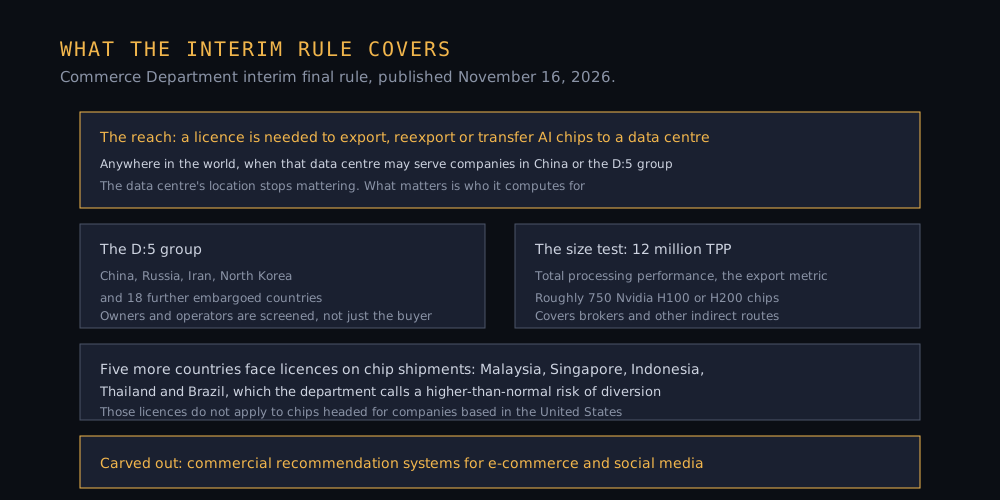
The D:5 group covers China, Russia, Iran and North Korea, plus 18 more countries. The rule reaches those firms through the data centers they rent rather than through direct sales.
Commerce uses one name for it: Super Intelligence (SI). Both the chips and the data centers fall under that name.
The size test sits at 12 million total processing performance, about 750 H100 (Nvidia AI chip) units. Any data center above that line needs a license.
Compliance timeline
Malaysia, Singapore, Indonesia, Thailand and Brazil carry new license rules as well. Commerce says those five pose a higher-than-normal risk of diversion. The rule also covers brokers, along with the ownership of each customer.
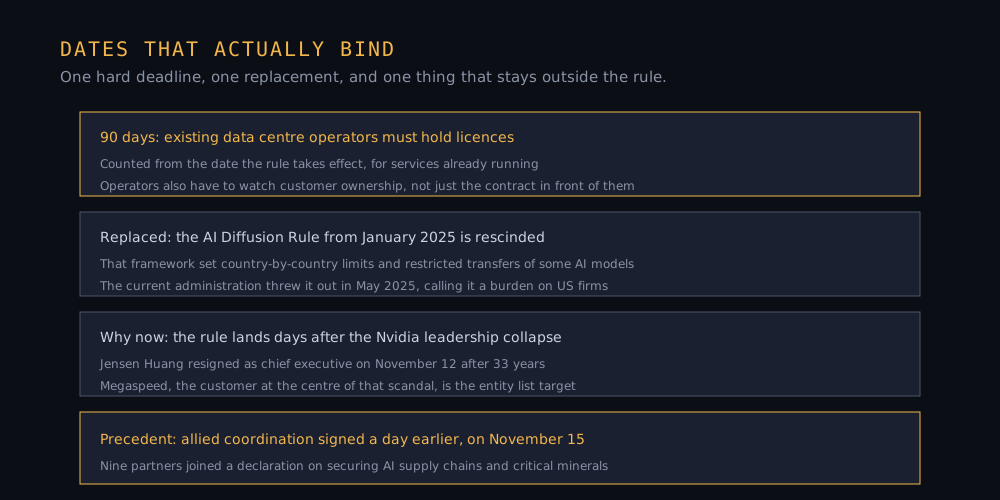
Operators already running these services have 90 days to hold a license. Customers face screening too, since ownership of the buyer now matters. Shipments bound for companies based in the United States stay outside that part.
Commercial recommendation systems for shopping and social feeds are also left out. It does not reach those, which keeps ordinary product rankings clear of it. Everything above the size test stays in scope.
The rule also throws out the AI Diffusion Rule from January 2025. That framework set country limits and restricted transfers of some AI models. That administration had already dropped it in May 2025, calling it a burden on American firms.
Compliance cost
Licenses, legal review and customer screening all land on whoever moves the chips. Chinese buyers have already started renting capacity overseas, Reuters reported on November 12. The rule closes that route on purpose.
Nine allies signed a declaration on securing AI supply chains the day before. Congress is also weighing bills that would tighten chip exports again. OpenAI told congressional offices in November that it supports key export bills.
Nvidia context
The rule lands days after Jensen Huang resigned as Nvidia's chief executive. Megaspeed, the customer at the center of that scandal, is the entity list target. Officials believe it rented thousands of Nvidia chips out to Chinese businesses.
"Access to such computing power can be used to train and run advanced SI models capable of supporting military- and intelligence-related activities that could threaten U.S. national security or foreign policy interests," the rule said.