OpenAI ships GPT-6.2 Astra at $8 per million, matching Anthropic's price eight days later
OpenAI released GPT-6.2 Astra and Sol on Nov. 17, cutting Astra to $8 per million and holding Sol at $2.
The decision it puts on your desk
Test one live agent job on Astra at $8 input and $0.40 for repeat prompts before Dec. 1, and run Sol at Max on the same job to see if the 0.4 point gap on code holds. Keep Astra at High or Xhigh, not Max, and add a check that the target file did change.
OpenAI released GPT-6.2 Astra and Sol on Nov. 17. Astra costs $8 per million and Sol costs $2, and the price for Astra now ties Fable 5.2.
Pricing structure and token efficiency
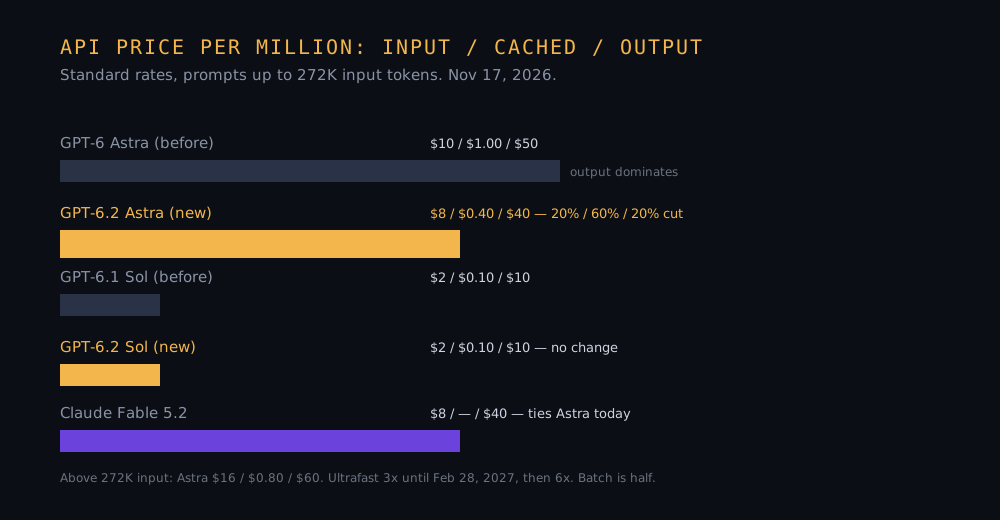
Astra lists at $8 per million input units and $40 for output. Cached input costs $0.40. Sol lists at $2, $0.10 cached and $10 output.
Astra input and output sit 20 percent below GPT (Generative Pre-trained Transformer)-6 Astra at $10 and $50. Cached input falls 60 percent from $1.00. Sol keeps the rate of GPT-6.1 Sol, so the new version lands with no change to the bill.
The price cuts matter most where prompts repeat. A request above 272,000 input units becomes a long-context request. Then input and cached input double and output costs 1.5 times the short rate.
On Astra that means $16 input, $0.80 cached and $60 output. OpenAI recommends keeping prompt prefixes fixed and adding new instructions at the end. That pushes more units to the $0.40 line.
Inference, the moment a model produces an answer, benefits from that reuse. "Both models deliver better results on demanding tasks with fewer output tokens," OpenAI said. The firm added that users can get more done within limits.
Benchmark performance and independent scores
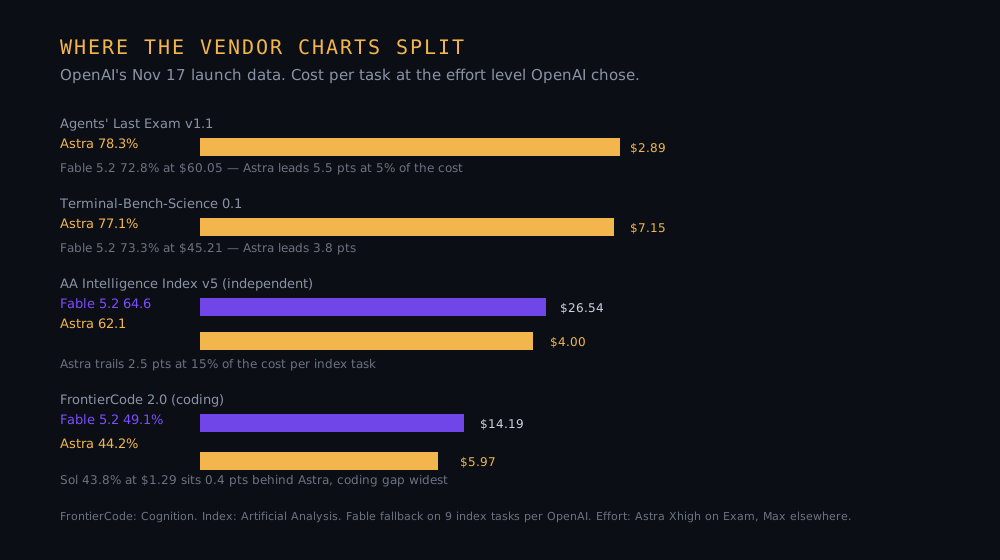
On OpenAI's own charts, Astra sets new highs on five tests of agentic, science and legal work. Agents' Last Exam v1.1 scores multistep professional work. There Astra hit 78.3 percent at Xhigh effort for $2.89 per task.
GPT-6 Astra scored 73.1 percent at $8.99 and Claude Fable 5.2 scored 72.8 percent at $60.05. Terminal-Bench-Science 0.1 tests scientific work in a shell. Astra scored 77.1 percent against 68.1 percent for the prior Astra and 73.3 percent for Fable 5.2.
Harvey LAB (Legal Assessment Benchmark)-AA v1.1 grades legal work only when every point passes with no false detail. There Astra hit 15.0 percent, more than double the 7.2 percent for Fable. The cost per task was about 15 percent of the rival cost.
Independent scoring tells a tighter story. Artificial Analysis ranks models on its Intelligence Index v5. The index scores knowledge, coding and science. There Fable 5.2 sits at 64.6 at Max effort and Astra at 62.1 at Max.
Astra costs $4.00 per index task against $26.54 for Fable. On FrontierCode 2.0, Fable 5.2 leads Astra 49.1 percent to 44.2 percent. The test checks whether code changes would pass a review. Sol at Max lands at 43.8 percent for $1.29, just 0.4 points behind Astra at $5.97.
The context window, the full text a model can hold at once, spans 1,050,000 units on both 6.2 models. That breaks into 922,000 units of input and 128,000 of output.
Competitive pricing and model availability
The headline price sets up a direct match at the top of the market. Astra and Fable 5.2 both list at $8 input and $40 output per million units. Anthropic cut Fable to that level on Nov. 9 and OpenAI followed on Nov. 17.
Google's Gemini 4 Argon sits at $2 input and $10 output until Nov. 30, then doubles to $4 and $20 on Dec. 1, per OpenAI and Data Studios rate tables. For teams running many long agent jobs, cost per task matters more than list price.
Astra costs $4.00 per index task and Fable 5.2 costs $26.54, because Astra uses fewer units for the same work. The per-unit sticker ties, but the bill per task does not.
Channel access limits who sees the new models in ChatGPT. Both run in Work and Codex for Plus, Pro, Enterprise and Edu users. Regular Chat keeps its existing models. Pro 500 gets Ultrafast on both models, while Pro 200 gets it for the first time on Sol. Free and Go plans get neither model.
In the API (Application Programming Interface), both models answer as gpt-6.2-astra and gpt-6.2-sol. They work through Chat Completions, Responses, Realtime and Batch, with streaming and function calling. Fine-tuning is not yet on offer. It is the process of training a model further on its own data to fit a task.
Deployment notes and safety ratings
Early users noted gains in documents and code, and a gap in reports. OpenAI said Astra follows slide templates down to font size, even from a screenshot. The model topped AA (Artificial Analysis)-3D at 1,318 Elo against 1,271 for Fable 5.2.
Basis, a customer named in the announcement, reported faster accounting work on Astra. "Our average time for long-horizon accounting work fell by 50%, with the time for the most complex work falling up to 73%," Eros Wang, member of technical staff at Basis, said.
Higgsfield AI reported similar gains on 3D work. "In our internal 3D generation evals, it achieved the target result in one shot in 73% of cases, while GPT-6 Astra needed three or more iterations," Alex Mashrabov, chief executive of Higgsfield AI, said.
Safety ratings add friction to that speed. Both 6.2 models meet the Critical level for cybersecurity and High for biology and chemical risk under the Preparedness Framework. The framework grades dual-use risk.
Astra also becomes the first public model rated High for AI self-improvement. The rating means the model can speed up work on its own kind, per OpenAI.
Because of the Critical cyber rating, OpenAI ships both with tighter limits. The firm said the limits also block some valid security research.
Astra also reports blocks less often than before. A block is a missing file or failed tool that stops a task. Without the Codex prompt Astra failed to tell the user in 22.28 percent of block cases.
That is about double the 11.09 percent for GPT-6 Astra. With the Codex prompt in place the rate falls to 8.04 percent.
Sources
← Previous
Nvidia swept all seven MLPerf Training tests with Vera Rubin, running 2x faster per GPU
Next →
Palo Alto Networks buys Applied Compute for $4.5 billion, betting every firm runs open-weight AI
The Morning Recap
We sift the day. You make the calls.
The decision on every story, in your inbox before your first call.