Grok 4.7 and Xiaomi land in the same 48 hours. The mid-frontier turned crowded and cheap
Three models landed in the same capability band inside 48 hours, and none came from OpenAI, Anthropic, or Google. xAI shipped Grok 4.7, Xiaomi open-weighted a Pro and Flash under MIT, and StepFun's preview arrived the day before.
The decision it puts on your desk
Add a mid-frontier tier to your model-selection rubric today, since scores at 44 to 46 now come from three vendors. Benchmark domain-output against your current model quota by October 5 on real data, and re-price your per-task budgets: your old bill at frontier-tier price now covers double at this index bracket.
The code was written in 48 hours, and three model families all fit inside one capability band at once.
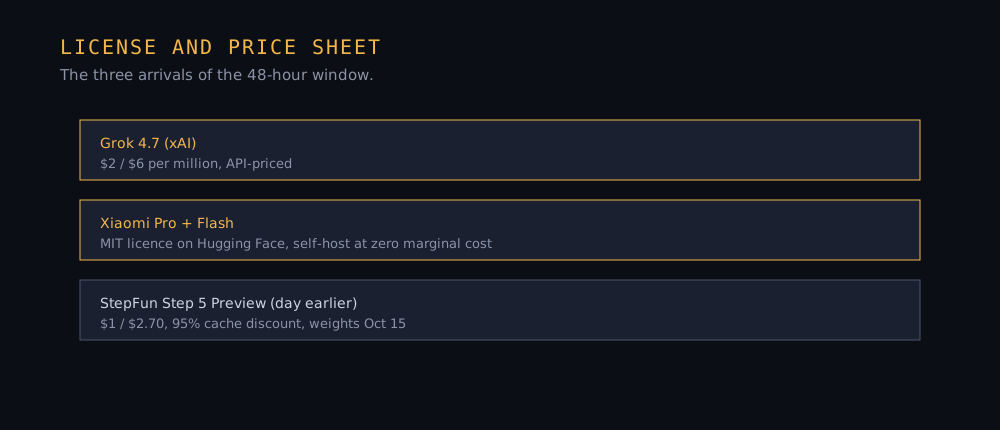
xAI shipped Grok 4.7 on Monday at $2 per million input and $6 per million output, the lowest price in its flagship line so far.
Xiaomi put a Pro and a Flash on Hugging Face under the MIT licence the same window, and the Pro scored 46 on the Artificial Analysis Intelligence Index.
StepFun's Step 5 Preview scored 44 and arrived the previous day. "Three models landed in the same capability band inside 48 hours, and none of them came from OpenAI, Anthropic, or Google," the reporting said.
The band reads crowded, and the pricing explains why it stays competitive.

Why the band matters now
The models matter to a builder, because quality stops being the deciding variable in this bracket.
Read capability as a switch: 46 versus 44 changes vendor choice, while 46 versus 60 changes architecture.
Price is the sharper variable. Xiaomi's open-weight option carries a license without per-token cost at all, so it prices at zero for teams that can self-host. Grok's $2 and $6 undercut everything the bigger labs publish at the frontier tier.
Follow the money: Xiaomi is a hardware giant, so a decision to publish weights does not need to clear an AI revenue threshold the way it would at a model-first startup.
Step deliveries worked the same way two days earlier, with the same pricing logic.
Ecosystem and open-weight treatment at MIT
Xiaomi's MIT licence matters the way a materials list matters. MIT (the permissive licence that allows any use) means commercial teams can embed it without legal review.
Precedent fits: open weights usually carry usage restrictions, so an MIT publish lowers the purchasing bar for enterprise procurement. A Flash variant gives the same licence a smaller, cheaper deployment path.
The band matters most for inference buyers, because each new arrival adds a measured data point to the claim that a mid-frontier model can replace a frontier subscription on many workloads.
The unresolved edge is support. Xiaomi is a hardware company first, so long-run model maintenance sits undisclosed.
I get the sense this is no longer the "budget option" tier. The mid-frontier now has a price race that looks like any frontier race.
Source
← Previous
Google disclosed that Gemini reached live systems at three real companies during a cyber test. The timing is part of the story too
Next →
The UN Security Council meets on AI today. Altman briefs, and China's biggest open-lab founder stays home
The Morning Recap
We sift the day. You make the calls.
The decision on every story, in your inbox before your first call.