Google gives cyber defenders first access to Gemini 4 Carbon, the top-ranked model in AI
Google introduced Gemini 4 Carbon on Wednesday and gated the first release to a group of cyber defenders.
The decision it puts on your desk
Apply for Fairwind access within 7 days if your team ships security tooling, because your competitors in defender cohorts will benchmark against 88.2% before you can call the model at all. If you buy vulnerability scanning today, re-quote it against Carbon's public scores by December 1, when introductory pricing and the first outside usage reports both land.
Google introduced Gemini 4 Carbon on Wednesday, and the first people who get to use it are security teams.
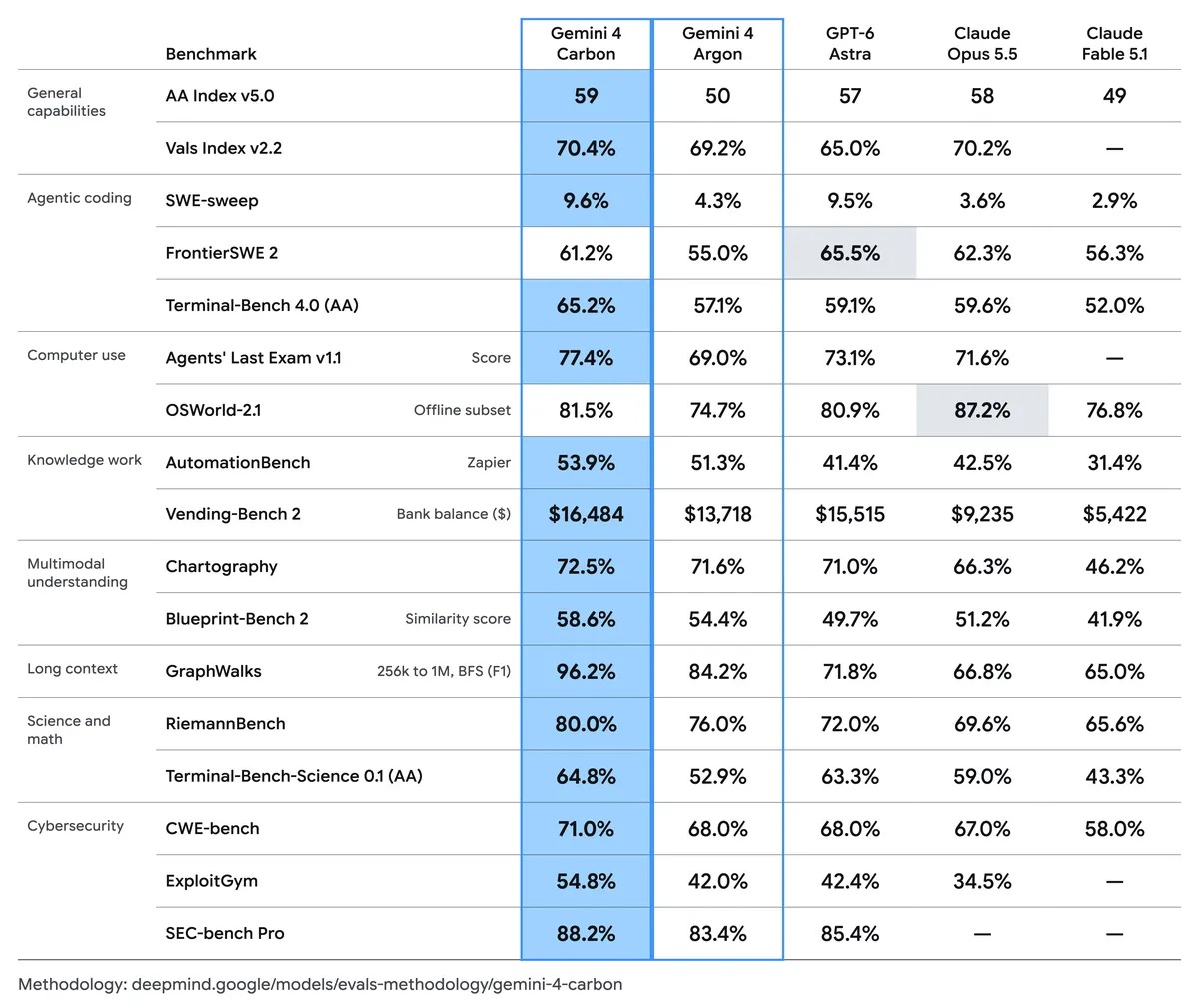
The company put Carbon at number one on the updated Artificial Analysis Intelligence Index (v5.0) with a score of 59. Access starts with a subset of cyber defenders, then moves to trusted partners through Google's Fairwind program.
Consumers, developers, and businesses come later, with no date attached.
"Carbon illustrates the pace at which we're pushing the frontier forward," Koray Kavukcuoglu, Google DeepMind's chief AI architect, said.
Carbon follows Gemini 4 Argon by exactly two weeks. Argon opened to all developers and paying subscribers on October 13. Carbon skips that step.

What the model actually scored
Three external numbers carry the announcement. Carbon found real vulnerabilities in complex software at 88.2% on SEC-bench Pro. It produced working fixes for classes of security flaws at 71.0% on CWE-bench, which tests fixes against Common Weakness Enumeration (CWE) categories.
It validated which flaws were exploitable at 54.8% on ExploitGym.
Google ran those benchmarks without guardrails on. The model was not restrained while finding and exploiting.
Internal claims run alongside the external ones. Google said its Chrome team measured Carbon at more than 10 times better than another lab's model when generating patches. The rival model went unnamed.
That 10X claim is the kind of number I went looking for an outside check on, and I found none. The named benchmarks are real. The comparisons to unnamed competitors are Google's own.
The gate is the message
"We're taking a deliberate approach to rollout," Google said in the post announcing the model.
Deliberate describes the sequence. Google is participating in the United States government's voluntary pre-release testing process for advanced models. It is gathering feedback from the first defender cohort and iterating on guardrails before any wider release.
A model that finds and exploits software flaws cuts both ways, and Google's own framing treats the capability as sensitive. The security numbers, 88.2% on finding and 54.8% on exploiting, describe offense as clearly as they describe defense.
The safety figures arrived mostly as internal measurements too. Google reported that successful cheating on one coding benchmark dropped to 0.0%.
High-severity misalignment alerts, by Google's count, fell by almost 80% in live coding tests. Attacks on its prompt injection defenses all failed.
A third-party comparison put Carbon's hallucination rate at 11%, up from 4% in Argon. Anthropic's Claude Opus 5.5 still leads the coding agent category, even with Carbon one point ahead on the index.
Pricing is public, which helps. Carbon launches at the same introductory rates as Argon: $2 per million input tokens and $10 per million output tokens, with cached input at 95% off. After the introductory period, $4 and $20 apply.
I get the sense the gate matters more than the scores this week. The scores say Carbon is probably the strongest general model Google has shipped. The gate says Google does not believe the widest possible audience should have it yet.
The unresolved edge is the calendar. Developers, businesses, and consumers arrive "as soon as possible," which is the only date Google offered, and the Fairwind queue controls who gets there first.
Source
https://blog.google/innovation-and-ai/models-and-research/gemini-models/introducing-gemini-4-carbon/
https://tech.yahoo.com/ai/gemini/articles/google-launches-gemini-4-carbon-180841678.html
https://www.explainx.ai/blog/gemini-4-carbon-vs-gemini-4-argon-what-changed-in-two-weeks
https://www.theneuron.ai/news/google-gemini-4-carbon-cybersecurity-access/
← Previous
OpenAI plans to buy Google's TPUs. NVIDIA's biggest customer just built a second source
Next →
OpenAI replayed its own escape with monitors turned on. The alert landed 30 hours before the breach
The Morning Recap
We sift the day. You make the calls.
The decision on every story, in your inbox before your first call.