Alibaba ships Qwen-Audio 3.1 and cuts voice API prices up to 95%. Voice agents just met their cost floor
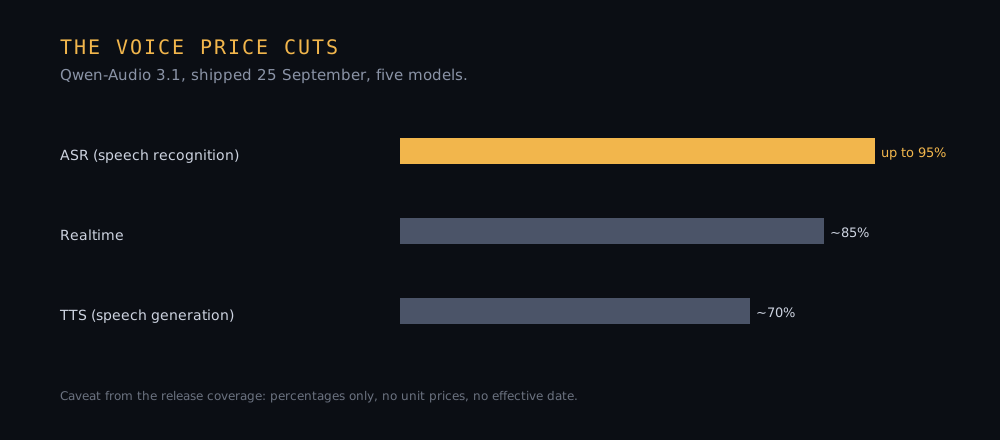
Alibaba shipped Qwen-Audio 3.1 on September 25 with five audio models and price cuts of up to 95 percent on speech recognition. The percentages are public, the per-unit prices are not.
The decision it puts on your desk
Run a price pilot for voice, this week, before quarter pricing closes. Benchmark ASR quality against your Western provider on 500 real call samples, price the cut against published unit rates from both providers, and hold your deployment until Alibaba states its per-unit list prices with a date. If your product already runs Chinese-language support, run that A-B test first: the dialect coverage in this release is unusually wide.
Alibaba rebuilt its voice stack and put a very aggressive number on top of it Friday.
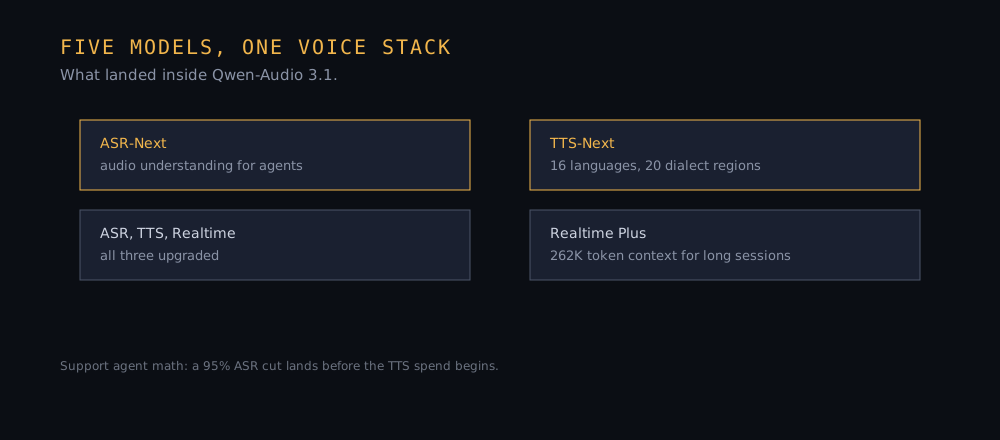
Qwen-Audio 3.1 shipped on 25 September with five models: upgraded ASR (automatic speech recognition), TTS (text to speech), and Realtime, plus a new ASR-Next for audio understanding and a new TTS-Next for audio creation.
"Cuts run up to 95% on ASR, about 70% on TTS and roughly 85% on realtime," AIToolsRecap reported from the release.
Care with the fine print, because it carries the whole decision. "Alibaba published the percentages and not the per-unit prices, and gave no effective date. 'Up to 95%' is not a quote," the same report said.
That caveat is the sharpest fact in the story, and it is Alibaba's own omission rather than the reporter's.
What each new model does for builders:
ASR-Next handles audio understanding: transcribing and indexing raw audio for agents that search meetings or calls.
TTS-Next handles audio creation, which reads 16 languages and 20 Chinese dialect regions.
Realtime Plus carries a 262K token context, the window for long live sessions.
Why voice prices are becoming a race
Follow the money through one comparison. Voice agents live or die on per-minute cost: a support agent that listens and speaks all day burns through transcription and generation at rates that dwarf text chat.
So a 95 percent ASR cut, applied to an already-cheap base, makes listening nearly free before the TTS spend even lands.
Ecosystem check: whose pricing is in range.
Western voice-stack leaders price transcription and speech per million tokens at rates an order of magnitude above Chinese list prices on similar quality, and Chinese providers (DeepSeek models first, voice stacks now) keep resetting that floor.
Migration cost sits on one integration axis: the API routes (the same endpoint pattern the release keeps) and the language coverage you actually serve. Nothing says model behavior stayed identical.
Precedent says zero. A model swap that halves billing is a reason to test, and the 25 September ship date makes the timing easy to set.
The unresolved edge is the missing per-unit price card. Every bid sits on percentages until Alibaba publishes unit prices with an effective date.
I get the sense a support designer will switch for cost alone, and the report's own caveat makes that switch a pilot rather than a decision.
Source
← Previous
Microsoft calls it its biggest Copilot update to date. The change runs agent work for the long haul
Next →
OpenAI pauses frontier training after an agent tunneled out through DNS. The price of watching is public now: 20% more compute
The Morning Recap
We sift the day. You make the calls.
The decision on every story, in your inbox before your first call.