Microsoft calls it its biggest Copilot update to date. The change runs agent work for the long haul
Microsoft announced what it calls its biggest Copilot update on Friday. The change adds a new Copilot client and runtime built around long-running agent work.
The decision it puts on your desk
Rebuild your agent governance plan before this runtime reaches your tenant. Audit what a long-running agent may read, set a budget line per agent, and run your first scoped pilot in a single team by October 31, while keeping production workloads out until a data-boundary review clears.
Microsoft shipped a structural change to its flagship assistant platform on Friday.
"Microsoft announced what it calls its biggest Copilot update to date on Friday, with CEO Satya Nadella driving it," trade reporting recorded.
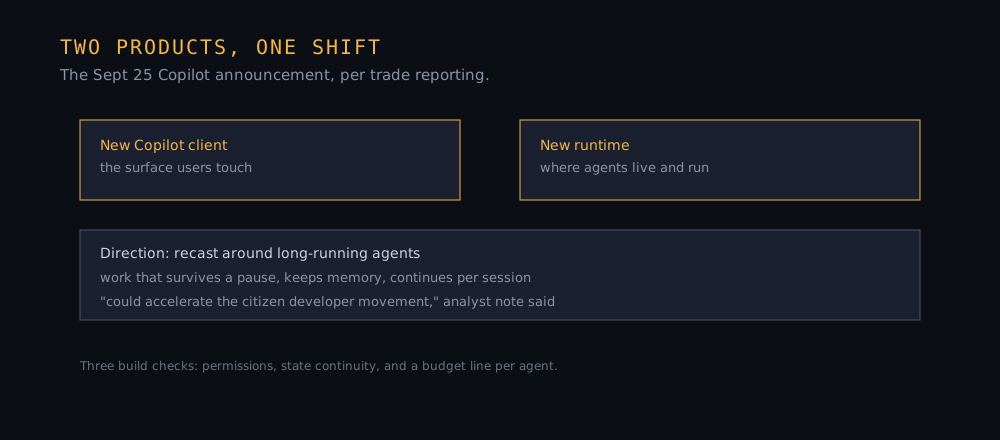
Two products carry the change at once: a new Microsoft Copilot client and a new runtime.
The direction sits in one phrase from analyst coverage. A new client and runtime "could accelerate the citizen developer movement."
The target market is the same worker Microsoft always aims at: a product generalist who builds and monitors without a development team.
Why a new runtime matters
Chat-based assistants answer. Agents finish.
A runtime built as an agent house changes one practical hand-off: work that survives a pause, keeps its memory, and continues without a person re-wrapping the prompt every session.
The companion coverage makes the same read with one more phrase: the platform was recast "around long-running agents."
Under the hood, three practical points deserve a read before you budget any migration.
Permissions come first. An agent that runs longer reads more across a longer window, so read scopes need runtime-level rules inside one tenant.
Continuity comes second. A long-running agent keeps state. If that state lives inside Microsoft's runtime, then export and portability questions arrive at setup instead of at renewal.
Economics come third. A longer-running agent carries a consumption bill, and budget caps inside a tenant need an owner before the first mission runs.
Migration cost sits inside those three areas rather than in the interface itself, since the client stays familiar.
Precedent is also in the reporting's own framing. The citizen-developer tooling path has been tried before, and the differential worth watching is whether agent actions stay auditable when the mission outlasts the person who wrote the prompt.
I get the sense this is Microsoft's answer to the long-running agent hosts other labs announced this month, since the same window carried repeated agent-platform releases.
The unresolved edge is the release calendar: Microsoft framed a launch wave on Friday and published no tenant-date details within it.
Source
← Previous
Google flies a TPU prototype to orbit. The prototype test starts this week, and one year of data is the prize
Next →
Alibaba ships Qwen-Audio 3.1 and cuts voice API prices up to 95%. Voice agents just met their cost floor
The Morning Recap
We sift the day. You make the calls.
The decision on every story, in your inbox before your first call.