Claude Code artifacts: 3 features turn chat output into team infrastructure
Three features landed in Claude Code today: public link sharing, real-time multiplayer editing, and Claude Tag building internal artifacts from a Slack mention. The artifact stops being chat output and starts being infrastructure. The teams that name it that way pull ahead.
The decision it puts on your desk
3 actions by end of next sprint. Adopt public sharing and Claude Tag on Team or Enterprise plans. Pick 1 Slack channel as the artifact request queue. Set the convention: any artifact referenced in a decision doc gets a public link, a multiplayer owner, and a tag-built origin story. Teams on Pro plans adopt public sharing this week and queue the Team plan upgrade for end of month.
Three features shipped in Claude Code in the last 6 hours. Each one is small. Together they change what artifacts are for. We have been using Claude artifacts in our own operations for 4 months, and the constraint that has slowed us down is the same one slowing your team down: artifacts lived in the conversation, then disappeared. We kept copies in Notion. We kept versions in Slack threads. We lost track of which was current. The artifact was disposable.
That ends today.
What shipped
Public sharing is the largest move. Any artifact can now be published to a public URL. Anyone with the link can view it. No login. No Claude subscription. The artifact stops being chat output and starts being a shipping surface. A dashboard, a prototype, a tool for a customer. It lives at a stable URL.
Multiplayer is the second move. Multiple teammates can now edit the same artifact in real time on Team and Enterprise plans. The version-passing workflow is over. The team builds together in a shared space, like a Google Doc. The interaction model moves from "I ask Claude, then I pass the result around" to "the team builds in the artifact."
Claude Tag is the third. The @mention integration for Slack that shipped in June can now build internal artifacts. A teammate types @Claude build me a pipeline dashboard in a thread. Claude returns a working page. The page stays inside your organization. Not public. Not external. Yours.
Why this is the unlock for founder-led teams
The loop we have wanted for a year just became a Slack mention. A product manager types @Claude build a campaign performance dashboard in a thread. Claude returns the page. Engineering edits it in multiplayer. The CEO links the public version in a board update. The artifact is no longer something we build in a private chat and hope survives the meeting. It is something the team ships to itself, and to anyone who needs it.
That is what AI-native operations looks like at the artifact layer. The team does not file tickets for internal tools. They request them in chat. The artifact becomes the durable record of AI-built work, not a transient reply.
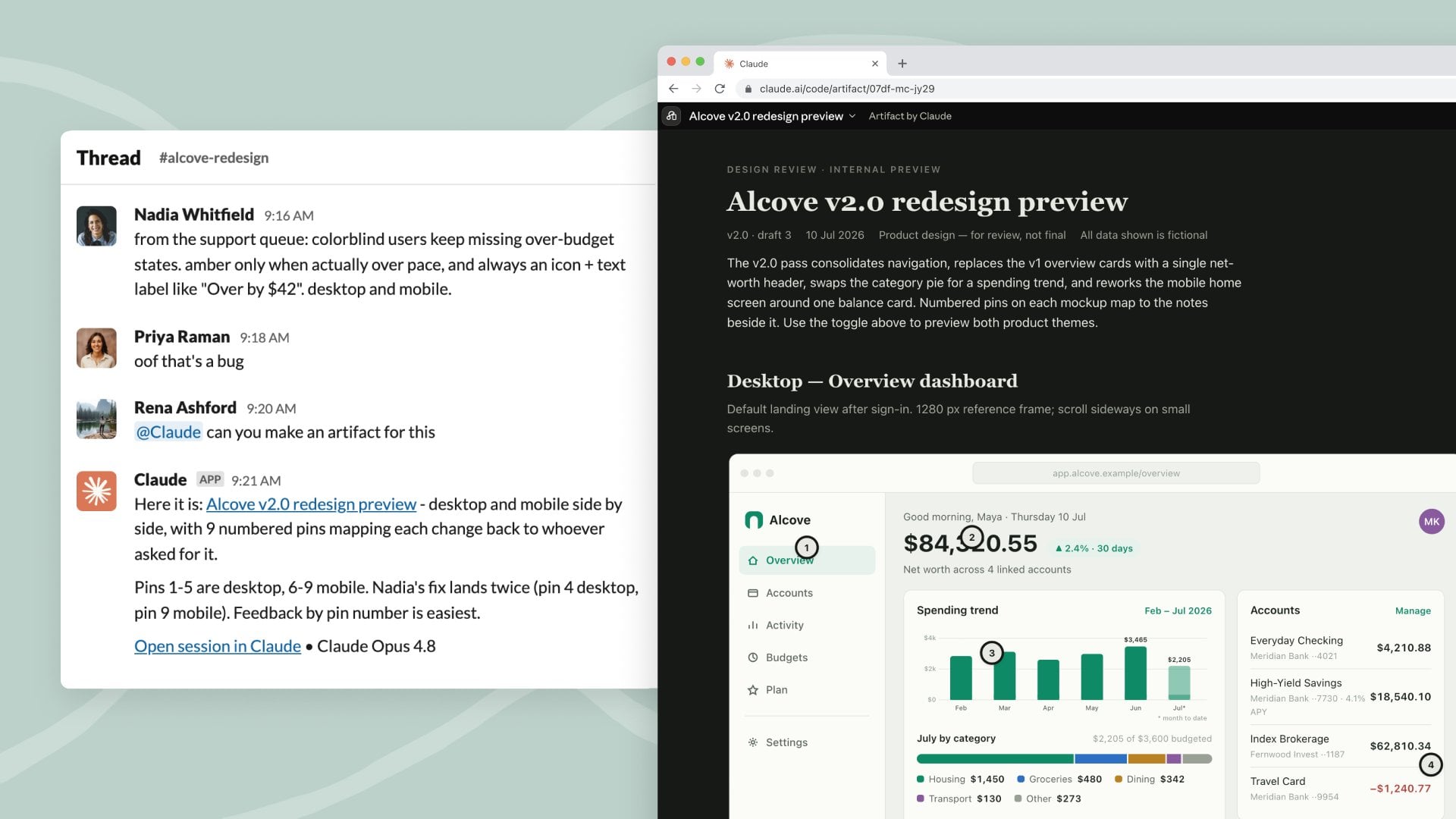
The screenshot is the loop in production, captured this morning. In a Slack channel called #alcove-redesign, a support thread surfaces a colorblind-user bug: amber is the only signal for over-budget states, and colorblind users keep missing them. Rena types @Claude can you make an artifact for this. Two minutes later, Claude returns a working design review page - desktop and mobile side by side, with 9 numbered pins mapping each change back to whoever asked for it. Nadia's fix lands twice: pin 4 on desktop, pin 9 on mobile. The artifact URL sits in the same thread. Feedback by pin number is the convention.
This is what the artifact layer looks like once the convention exists. No ticket. No handoff. No designer in the loop. The artifact is the spec, the review surface, and the shareable link - all in one URL, all visible to the team in the channel where the work started.
For founders, the implication is sharper than for any other role. You are the bottleneck for internal tooling. Every dashboard you need, every prototype for a sales call, every report for an investor, currently goes through engineering, design, or a contractor. Claude Tag plus public artifacts shortens that loop from weeks to minutes. The internal-tools backlog you have been carrying stops being a backlog. It becomes a Slack channel.
The catch
Three things to flag before you flip the switch. Public sharing creates a leak surface. Anyone with the link can view. Treat artifact URLs like staging credentials: do not paste them in customer-facing comms without thinking through the access model. Multiplayer is gated to Team and Enterprise plans. Pro users get public sharing only. Claude Tag artifacts are internal-only, which means the same feature has two permission paths depending on where the request originates. Map the paths before you standardize.
What we are doing this week
We are turning on public sharing and Claude Tag for the YDN workspace today. We are picking one Slack channel - #ydn-artifacts - as the request queue. We are setting a convention: any artifact referenced in a decision document gets a public link, a multiplayer owner, and a tag-built origin story. The standard is not complicated. It just has to exist before the artifacts multiply.
Bottom line
The artifact layer just became infrastructure. The teams that name an owner, pick a channel, and set a convention this week will treat Claude as a teammate, not a tool. The teams that leave artifacts inside private chat will keep doing what they were already doing: badly, slowly, with copies everywhere. The decision is not whether to use the features. It is whether to make them load-bearing for your operations or let them sit.
Source