Moonshot files for IPO in Hong Kong. The China AI comp set gets a public price tag
Moonshot AI, developer of the Kimi models, confidentially filed for a Hong Kong initial public offering. The target raise runs $3 billion to $5 billion near a $50 billion valuation.
The decision it puts on your desk
Update your China AI comp sheet with a Hong Kong tier before the end of 2026. Price Kimi-class models against a $50 billion pre-IPO value and a $3 billion to $5 billion raise. Add the HK listing to your procurement short list, so a year-end filing lands as information rather than surprise.
Moonshot AI went public-market on September 3, in the venue that now matters for Chinese frontier labs.
"China's Moonshot AI has confidentially submitted an application for an initial public offering to Hong Kong's stock exchange," the Wall Street Journal said, citing people familiar with the matter.
The raise target runs $3 billion to $5 billion, with valuation near $50 billion, the reporting said.
"The developer of the Kimi large language model is aiming to raise $3 billion," Reuters said, and RTÉ counted three sources on the filing alone.
The numbers, read against the raise it just closed
Follow the money first.
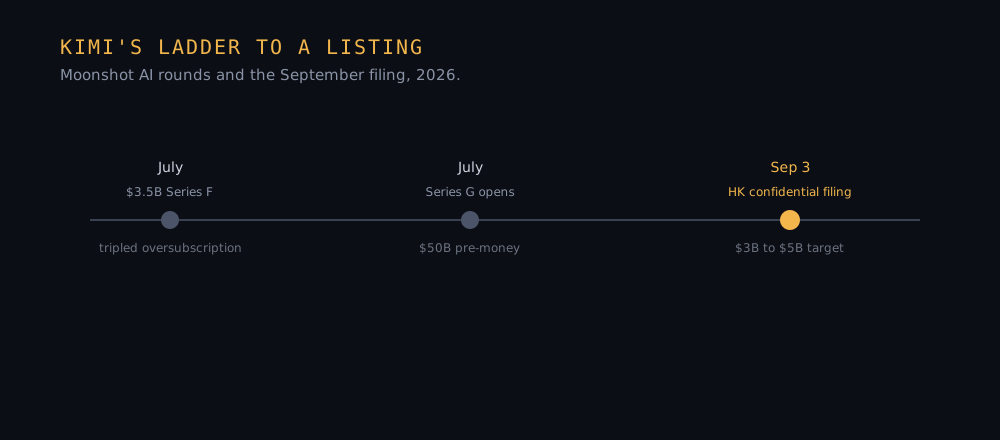
The confidential filing arrived weeks after Moonshot's Series G opened at a $50 billion pre-money valuation, covered in our July reporting. That round followed a $3.5 billion Series F that tripled in oversubscription.
A filing in that sequence does the work a pitch deck no longer can: it converts a private comp into a bid you can price.
The filing rides on demand: strong demand for the Kimi K3 model, the reporting said.
RTÉ's reporting put Moonshot in a queue. It "joined a slew of domestic and global rivals in pursuing a public listing."
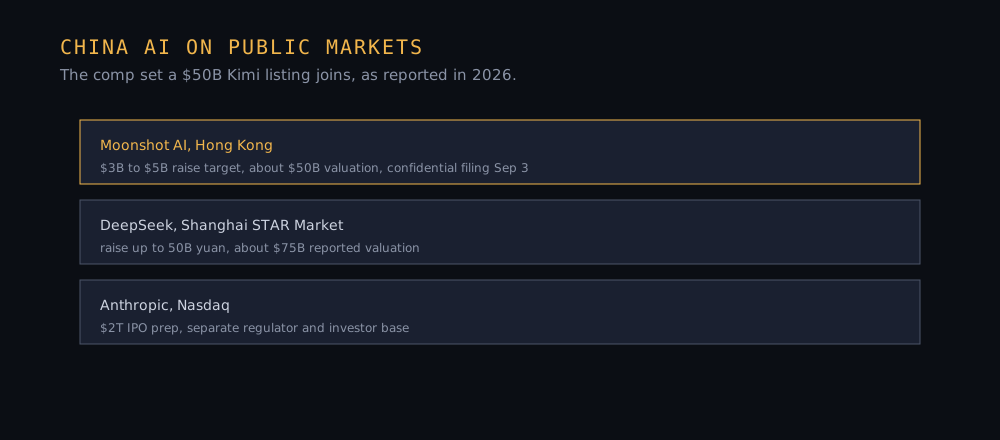
China's AI calendar for public markets now runs DeepSeek on the Shanghai STAR Market, Kimi in Hong Kong, and Anthropic on Nasdaq, each with a different regulator and a different investor base.
What the public price tag buys
A Hong Kong listing also gives the Kimi valuation a market-set comp rather than a comp set by round investors alone.
Every Chinese AI lab still raising privately now shares that price point. A $50 billion valuation on Kimi stands alongside DeepSeek's reported $75 billion.
What nobody signed up to yet is disclosure rules. Public filings expose revenue and cost structure that press releases do not.
I get the sense the HK path won more in speed than valuation, given the year-end window the reporting kept citing.
Teams buying Chinese frontier compute through open-weight models see a change too. A listed Moonshot keeps disclosing what a private round does not.
← Previous
Astra's 99.9% lived on OpenAI's own test setup. The independent rerun says 62.7%, and the AGI claim missed its metric
Next →
DeepSeek books 160,000 Huawei chips for a 1-gigawatt site. Inference is where the Nvidia exit happens first
The Morning Recap
We sift the day. You make the calls.
The decision on every story, in your inbox before your first call.