Google backs $19 billion of Anthropic data center commitments at TeraWulf's Kentucky site
Google will back about $19 billion of Anthropic data center commitments in Kentucky.
The decision it puts on your desk
Review every data center contract by Nov. 19 and model the cost of credit support before 2028 budgets.
TeraWulf secured credit support from Google on Nov. 4 for about $19 billion of Anthropic leases in Kentucky. Fluor signed a contract to build three data center buildings at the site.
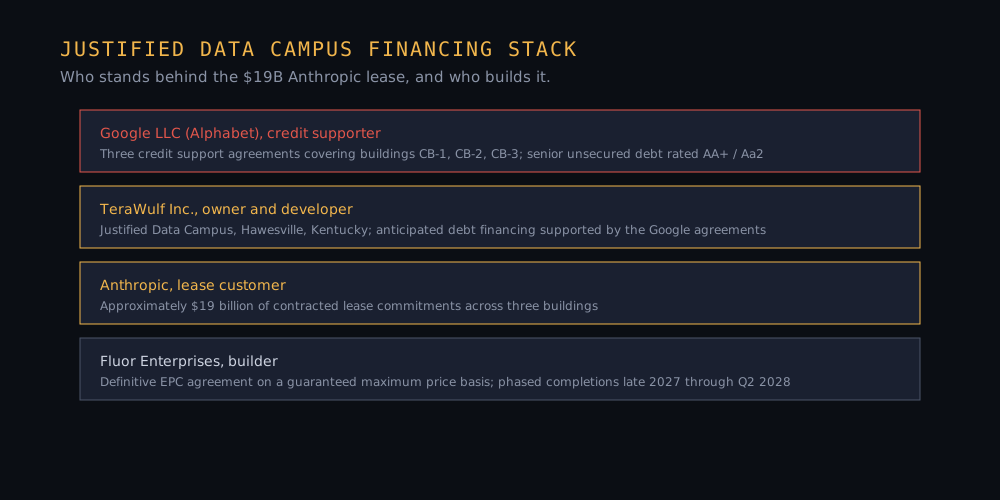
Debt financing for the Justified Data Campus in Hawesville, Kentucky, now has Google behind it. The credit support lowers the cost of the anticipated debt. A model rival now stands behind the debt of a competing lab's data center.
Paul Prager, chairman and chief executive of TeraWulf, said counterparty credit was built into the leases from the start. "We structured our Anthropic leases from the outset to address counterparty credit, financing costs and capital requirements," he said. The terms pair customer commitments with investment-grade support before the company seeks debt.
Google credit support
Alphabet's debt carries top ratings from S&P Global Ratings and Moody's. Those ratings lower the cost of the anticipated debt. Patrick Fleury, chief financial officer of TeraWulf, said the support is what makes competitive long-term financing possible. "Cost of capital is fundamental to infrastructure development," Fleury said.
A commitment this size is unusual for a single site. Fluor will run the full engineering and construction scope for the three buildings. Open-book cost reporting under a guaranteed maximum price format governs the work. Large projects now compete for skilled labor across the United States.
Fluor brings more than a century of infrastructure experience plus a subcontractor network that eases that pressure. TeraWulf keeps its own development team focused on power and interconnection work.
Delivery schedule
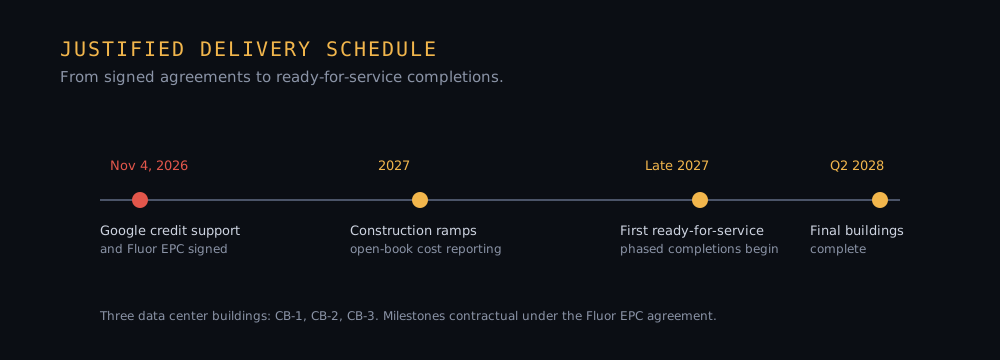
Completions begin in late 2027 and continue through the second quarter of 2028. Milestones are contractual under the Fluor agreement, with defined dates and performance protections. Investors will watch whether power availability holds to that calendar. Campus delivery also depends on interconnection capacity that regional grids are still building out.
Financing implications
This arrangement pairs a model rival with the infrastructure that trains its competitor's models. Google has its own data center pipeline. Credit support also signals that hyperscalers will finance outside capacity when leases lock up supply. Analysts said the structure could repeat at other campuses where power is the binding constraint.
Source