Morgan Stanley put $15 trillion on AI. The fund managers in the same room want the returns first.
Pick said AI needs $10 trillion to $15 trillion over the next decade. The fund managers in the same room want the returns first.
The decision it puts on your desk
Lock your financing terms before November 19. Anthropic is due to price its shares that week, and every bank will read AI risk again on Monday. Model your 2027 budget at $800 billion a year of AI spending and at half that. Then sign the terms you can defend.
Morgan Stanley chief executive Ted Pick said on Tuesday that AI needs $10 trillion to $15 trillion. He spoke in Hong Kong.
Hong Kong hosted the Global Financial Leaders' Investment Summit this week. Pick spoke there on Tuesday. Goldman Sachs chief executive David Solomon spoke after him.

The scale of the number
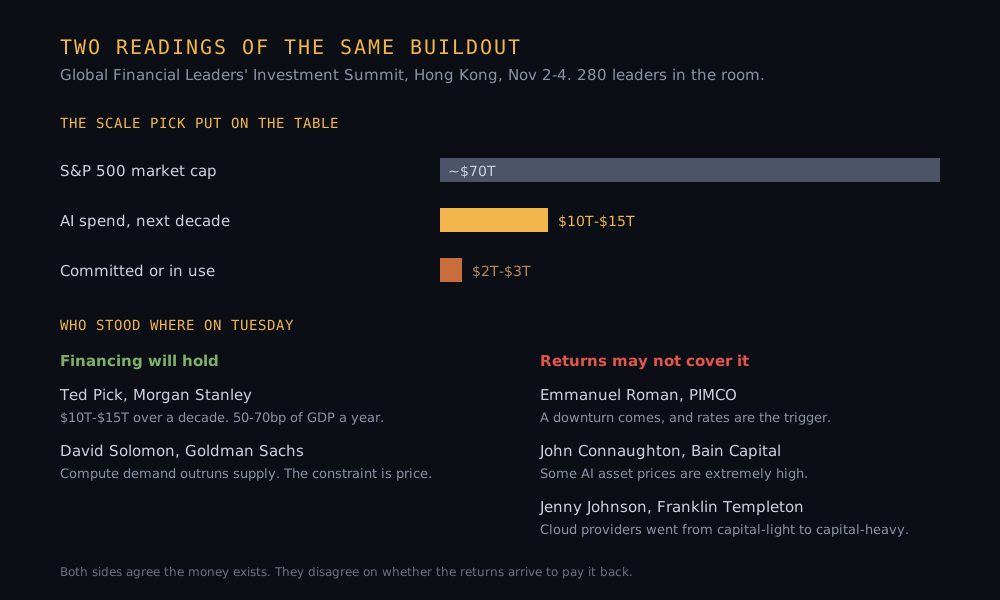
Pick framed the total against the market. The S&P 500 is worth about $70 trillion, he said. Companies have committed $2 trillion to $3 trillion already.
Pick said the largest cloud providers will spend $800 billion to $1 trillion a year. The run lasts seven to twelve years.
Pick said the spending would add 50 to 70 basis points a year to US economic growth. A basis point is one hundredth of a percentage point.
That spending buys chips, buildings, and power. It also funds the labs training the models.
The room split
The asset managers in the room read the same numbers differently.
Emmanuel Roman runs the Pacific Investment Management Company (PIMCO).
He said a downturn will come, and rising rates will trigger it. John Connaughton chairs Bain Capital. He said some AI asset prices have become extremely high.
Jenny Johnson runs Franklin Templeton. She said the big cloud providers went from capital-light to capital-heavy.
Jon Gray, Blackstone's president, questioned whether global credit markets can absorb the spending.
What the banks said
David Solomon took the other side.
Goldman Sachs' chief executive said capital markets can absorb the financing needs. Money is available, he said.
The limit on deal size is the price of money, Solomon said. Demand for compute outruns supply today.
Solomon also said long-term value will shift to the application layer. Teams that build the applications will capture it.
What Pick warned about
Pick compared the moment to the technology cycles of 1999 and 2008. He said periodic corrections are "very healthy" and create "a wall of worry."
He also said some projects carry poor capital structures. Those projects "will not pass the test of time," he said.
The part nobody agreed on
Two accounts of Pick's remark disagree on the inning. One quoted him at the second of nine. Another put him at the third.
I read both reports twice. I still cannot tell which one is right.
The gap matters when you time a raise, probably more than people think. I get the sense the second-inning version is the one Pick's team wants in print.
Why this lands on your desk
Money at this scale changes who gets funded. Pick said the spending may also draw capital away from businesses outside AI.
Your borrowing costs sit inside that number. When the largest buyers of compute compete for the same loans, the price of money moves for everyone.
I would plan around Solomon's application-layer comment, because the banks will fund the infrastructure either way and what you own on top decides what you earn.