Moonshot AI ships Kimi K3 - a 2.8T-parameter open-weight model with a 1M-token window
Moonshot AI released Kimi K3 on July 16: a 2.8-trillion-parameter open model with native vision, a 1-million-token context window, and frontier-level coding and reasoning scores. Full weights land by July 27. API pricing runs $0.30/$3.00/$15.00 per MTok. The open-model ceiling just moved from 1T to 3T.
The decision it puts on your desk
If you build on open weights, run a real eval of Kimi K3 on one long-horizon coding or knowledge-work task by end of July - the 1M-token window plus open weights is a different cost structure for repo-scale work. If you deploy via the Kimi API, architect for cache-hit rate above 90% on coding workloads to hold the $3/MTok input price down. Do not switch models mid-session: K3's quality degrades hard if the harness drops its thinking history.
Moonshot AI made Kimi K3 official on July 16, 2026. It is a 2.8-trillion-parameter model built on Kimi Delta Attention and Attention Residuals, with native vision and a 1-million-token context window. It is the world's first open 3T-class model - the largest open-weight release from China, and the new upper bound for what "open" means at the scaling frontier.

Kimi K3 is available today on Kimi.com, Kimi Work, Kimi Code, and the Kimi API. Full open-weight model files are scheduled for release by July 27, 2026. At launch it runs max thinking effort by default, with low- and high-effort modes arriving in later updates.
What actually shipped
The headline number is 2.8T parameters. For nine of the past twelve months, Kimi models have set the upper bound of open-model sizes. K3 extends that run past the trillion-parameter line into the 3T class, a regime no open model had reached before.
The architecture rides two new primitives. Kimi Delta Attention (KDA) is an efficient foundation for scaling attention across sequence length. Attention Residuals (AttnRes) selectively retrieve representations across depth rather than accumulating them uniformly. Together they are the backbone that lets the model scale past the trillion-parameter regime without the usual degradation.
K3 uses Stable LatentMoE, effectively activating 16 of 896 experts. At that sparsity, routing becomes a first-order problem, so Moonshot adds Quantile Balancing (deriving expert allocation from router-score quantiles, killing the sensitive balancing hyperparameter) and Per-Head Muon (optimizing attention heads independently). Sigmoid Tanh Unit and Gated MLA tighten activation control and attention selectivity. The combined result is roughly 2.5x better scaling efficiency than Kimi K2 - the model converts compute into intelligence more effectively.
How it performs
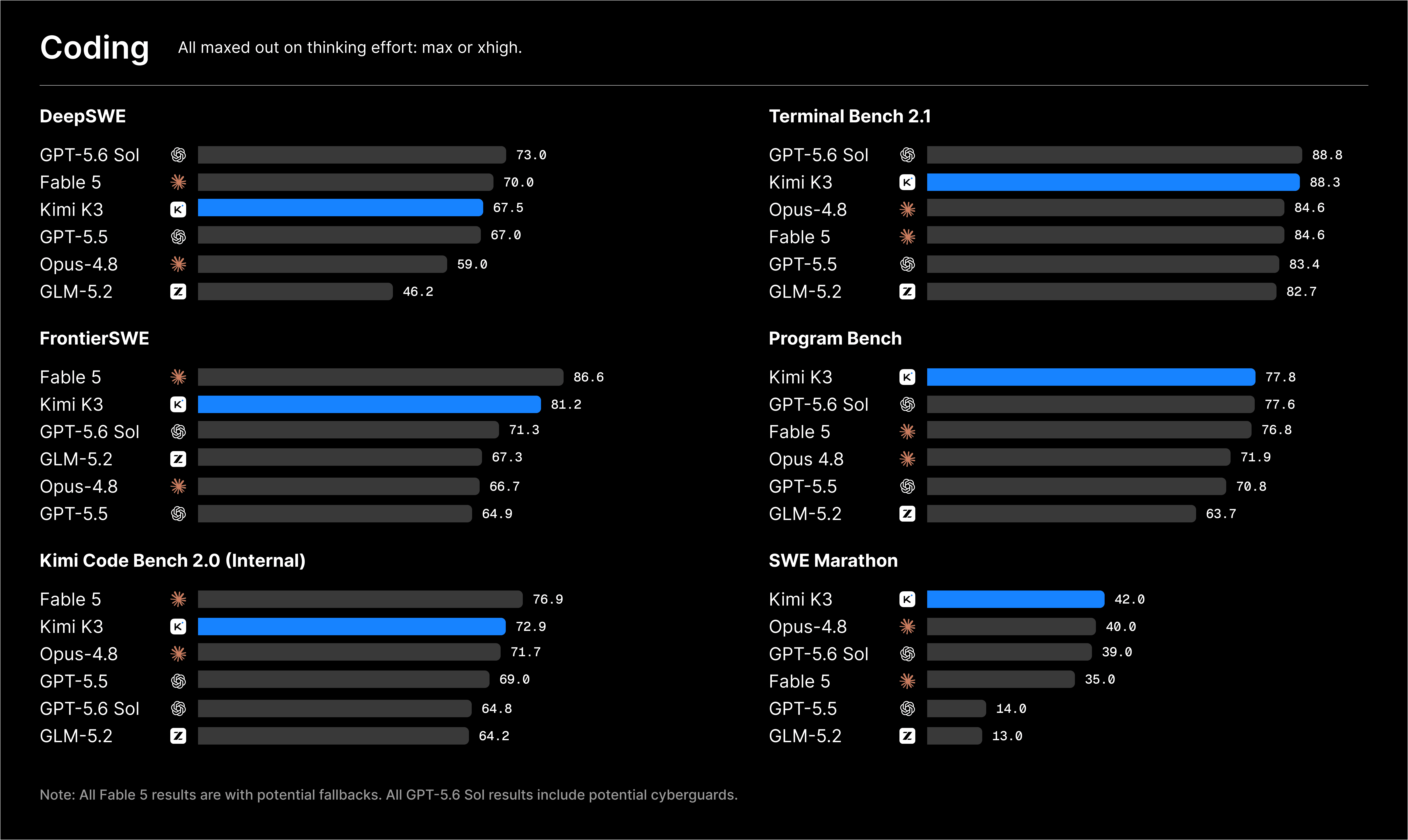
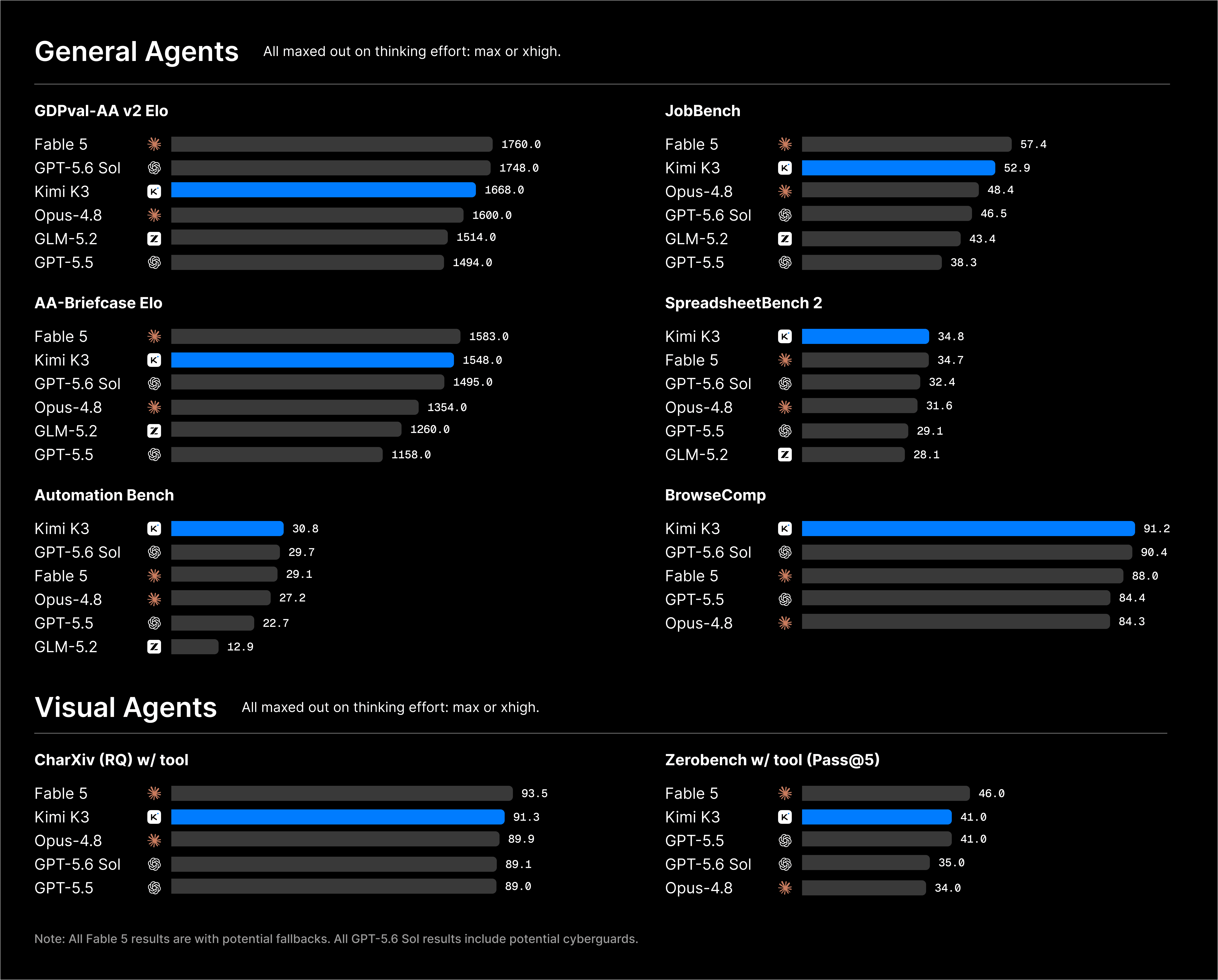
Moonshot's own eval suite puts K3 at frontier level, consistently outperforming other tested models while still trailing the most powerful proprietary systems, Claude Fable 5 and GPT-5.6 Sol. The benchmark table is wide: coding, agentic, reasoning, knowledge, and vision.
On coding, K3 posts 67.5 on DeepSWE, 81.2 on FrontierSWE, 88.3 on Terminal Bench 2.1, and 42.0 on SWE Marathon - competitive with or ahead of Opus 4.8 and GPT-5.5, behind Fable 5 on the hardest suites. On vision it hits 81.6 on MMMU-Pro and 94.3 on MathVision. On agentic work it scores 1668 GDPval-AA v2 Elo against Fable 5's 1760.
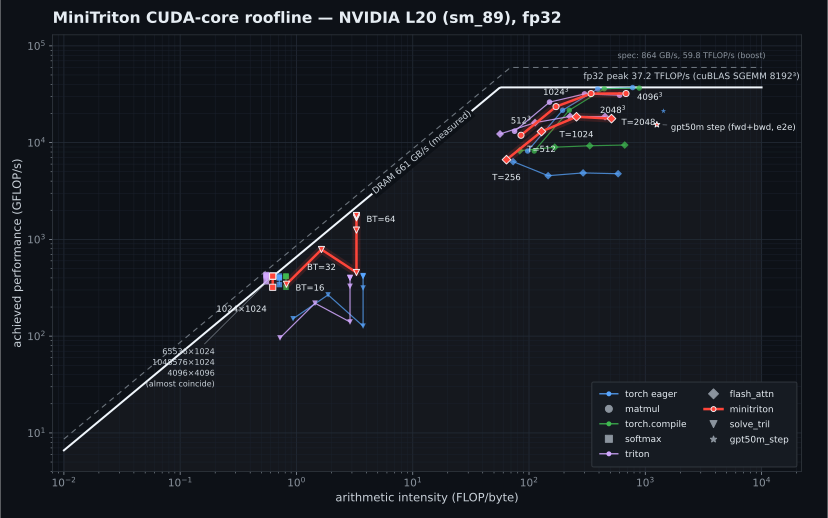
The case studies are where K3 is most striking. In an isolated sandbox with up to 24 hours, it optimized GPU kernels competitively with Fable 5 (with fallback) and well ahead of Opus 4.8 and GPT-5.6 Sol. It built MiniTriton from scratch - a compact Triton-like compiler with its own tile-level IR over MLIR, optimization passes, and a PTX codegen pipeline - that matches or beats Triton on roofline benchmarks and sustains end-to-end nanoGPT training. It designed a chip for a nano model in a single 48-hour autonomous run, closing timing at 100 MHz in under 4 mm squared.
The open-weight angle is the lead
The release timing matters more than the size. Full weights by July 27 means teams can self-host a 2.8T model - still a heavy lift, but the capability that was proprietary twelve months ago is becoming downloadable.
Kimi K3 also excels at tasks blending software engineering with visual reasoning, using screenshots and visuals to drive game dev, frontend, and CAD work. "Vision in the loop" means it iterates between code and live screenshots, seeing and refining its own output. That closes a gap most coding agents still have: they write code, but they do not see what it renders.
The predecessor chain shows the trajectory. Kimi K2.6 (April 2026) was a 1T-parameter MoE built for multimodal and agentic work. Kimi K2.7 (July 2026) was an open-source coding-specific model that cut reasoning token use 30%. K3 is the consolidation: one model that does the coding, the vision, and the long-horizon agentic work at frontier scale.
The Kimi API economics
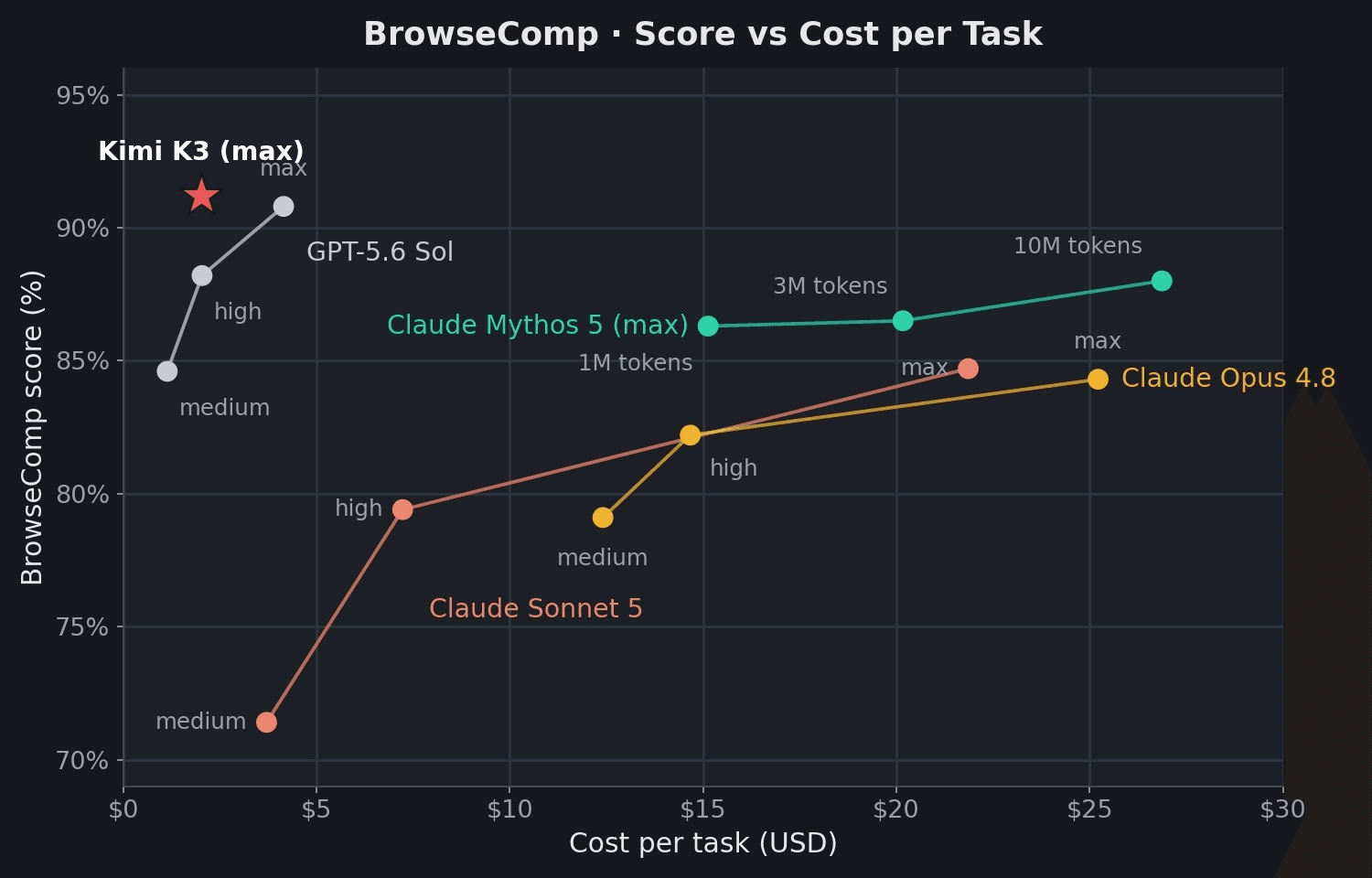
The API price is the part that changes deployment math. Pricing is $0.30/MTok cache-hit input, $3.00/MTok cache-miss input, and $15.00/MTok output. Powered by Mooncake's disaggregated inference, the official Kimi API claims a cache hit rate above 90% on coding workloads - which is what keeps the effective input price near the floor despite the model's scale and 1M-token context.
That hit rate is not automatic. It depends on your harness passing back the full thinking history. K3 was trained in preserved-thinking-history mode. If the agent harness drops historical thinking content, or you switch to K3 mid-session from another model, generation quality gets highly unstable. The recommendation is explicit: use a verified harness like Kimi Code, and do not swap to K3 in the middle of a session.
The catch
Three things this does not settle.
First, the proprietary gap is real. K3 still trails Claude Fable 5 and GPT-5.6 Sol on user experience and the hardest benchmarks. Moonshot says so itself. K3 is frontier-class among open models and competitive on many suites, but it is not the best model overall.
Second, the open-weights release is a date, not a file. July 27 is the target. Until the weights are out, "open" means "open via API and apps," not "open on your hardware." If your plan depends on self-hosting, the clock starts when the files drop, not today.
Third, K3's training emphasizes long-horizon, challenging tasks, which makes it prone to excessive proactiveness - it may make decisions on your behalf when intent is ambiguous. If your application needs the agent to stay in well-defined bounds, you have to impose explicit constraints in the system prompt or AGENTS.md.
What we are doing this week
We are standing up a Kimi K3 eval on one long-horizon repo task through the Kimi API, watching the cache-hit rate and the thinking-history handling in our harness. If the 90% cache-hit claim holds on our traffic, the effective input price makes K3 a credible default for repo-scale coding work where a 1M-token window removes the context-window tax entirely. We will re-baseline our open-model choice against K2.7 and the newest GLM and Qwen weights once K3's files are public.