Kimi K3 takes #1 on the Frontend Code Arena - 1679 pts, 17-place jump from K2.6
Kimi K3 is now the top model on the Frontend Code Arena with 1679 points, a 17-place jump from Kimi K2.6 (#18 to #1) and a pass on Claude Fable 5. It ranks #1 in six of seven frontend domains - Brand & Marketing, Reference-Based Design, Data & Analytics, Consumer Product, Simulations, and Content Creation Tools - and lands #2 only in Gaming. Full weights drop by July 27.
The decision it puts on your desk
If you ship frontends, run a K3 eval on one reference-matched design task and one dashboard task this week. K3 leads the public Frontend Arena on six of seven domains and the score moves 17 places from K2.6 - this is the highest-impact single upgrade available on the open-model side right now. For gaming, animation, or WebGL-heavy work, stay on Fable 5 until the next K3 update.
Kimi K3 is now the top model on the Frontend Code Arena with 1679 points, surpassing Claude Fable 5. The score is a 17-place jump from Kimi K2.6, which sat at #18. K3 ranks #1 in six of seven frontend domains: Brand & Marketing, Reference-Based Design, Data & Analytics, Consumer Product, Simulations, and Content Creation Tools. The only domain where it does not lead is Gaming, where Fable 5 still holds #1.
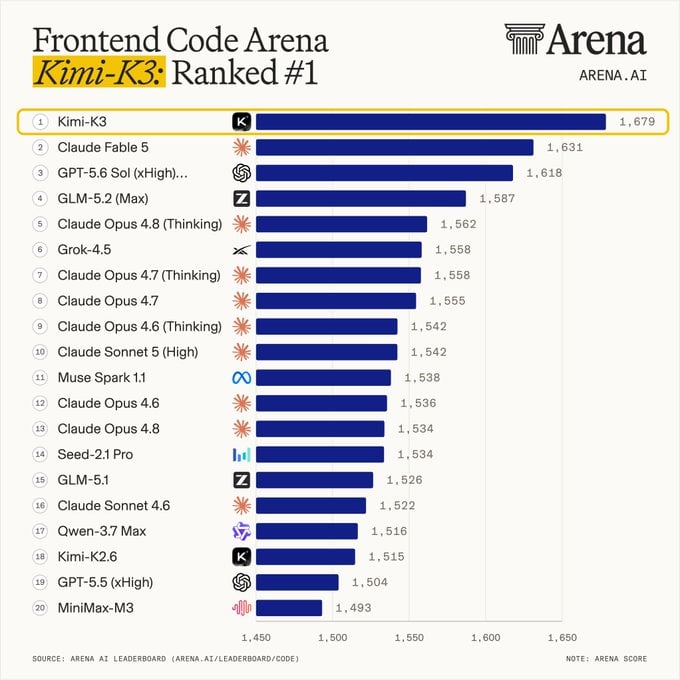
The Frontend Code Arena is the most-watched public benchmark for code that has to render - the suites where models produce working frontends from specs, references, and screenshots, then get judged on the output a human would actually ship. K3 leading six of seven is the clearest signal yet that the open-model frontier has crossed into design territory, not just text coding.
What the jump actually means
K2.6 to K3 is not a normal model bump. It is a 17-place move in a single release, against a leaderboard that had Claude Fable 5 sitting at the top. In the public AI Sift tracker, no other frontier model has moved that far on a single arena in 2026. The closest comparable moves are single-digit climbs after a major capability release, not an open-weights candidate taking the crown.
The domain breakdown tells the harder story. K3 leads on Brand & Marketing, where the work is producing landing pages, ad creative, and campaign assets with consistent visual language. It leads on Reference-Based Design, where the prompt includes a screenshot or Figma and the model has to match. It leads on Data & Analytics, where dashboards and chart-heavy UIs dominate. Consumer Product, Simulations, and Content Creation Tools round out the sweep. Gaming - the most synthetic of the seven, with heavy 3D, shaders, and animation work - is the only holdout for Fable 5.
The architecture behind it
K3 is the same 2.8T-parameter open model we covered in the flagship piece, built on Kimi Delta Attention and Attention Residuals with Stable LatentMoE. The frontend win is downstream of three specific design choices.
First, native vision in the loop. K3 was trained to iterate between code and the rendered screenshot, which means it can see what its own output looks like and refine it. Most coding agents write code and stop. K3 reads the screenshot back and decides whether the result matches the spec, then re-rolls. That is why it leads on Reference-Based Design: the model is doing closed-loop verification on the visual target, not just guessing at CSS.
Second, the 1M-token context window. A full Figma export, a multi-page spec, and the surrounding copy all fit in one prompt. The model does not have to compress the reference down to a few hundred tokens and hope. The reference stays high-fidelity in the context, and the output tracks it.
Third, 2.5x scaling efficiency over K2.6. The same compute buys substantially more capability. The 17-place jump is the scoreboard expression of that efficiency curve landing in the most compute-sensitive arena on the public list.
Where it does not win
Gaming. Fable 5 still takes the gaming domain. The work in that bucket is closer to engine-level: shader-heavy, animation-heavy, and most often requires a runtime loop rather than a static page. K3 is the better choice for a marketing site, a dashboard, a creative tool, or a content UI. For a browser game with WebGL, physics, and an asset pipeline, Fable 5 still wins.
Second caveat is the usual one. The benchmark is open-weights pending. Full K3 weights drop by July 27, 2026. Until then the lead is over the Kimi API and the Kimi apps, not on your own hardware. Self-hosting the 2.8T model is a real lift, and the score shown is the hosted score.
Third caveat - and this is the one that bites in production. K3's training emphasizes long-horizon tasks, which makes it prone to overreach on ambiguous intent. On a frontend spec with a clear brief it ships; on an open-ended "make me a landing page" prompt it adds sections you did not ask for. Constrain it in the system prompt or AGENTS.md, especially for brand work where scope creep is the worst kind of bug.
What we are doing this week
We are rerunning our frontend eval suite - landing page, dashboard, and reference-matched design - against K3 via the Kimi API, watching the cache-hit rate and the vision-in-the-loop behavior on rendering tasks. If the Frontend Arena score holds on our internal prompts, K3 becomes the default for design-led work where the reference and the spec both fit in context. We will rerun once the K3 weights drop on July 27 and check whether the self-hosted path matches the API path within margin.
← Previous
Moonshot AI ships Kimi K3 - a 2.8T-parameter open-weight model with a 1M-token window
Next →
CuspAI raises $450M at $2.6B, launches AI Materials Foundry with NVIDIA, Meta, and 46 more
The Morning Recap
We sift the day. You make the calls.
The decision on every story, in your inbox before your first call.