Meta and Sierra published the Personal Agent Protocol. Payments rails and retailers just joined an agentic standard
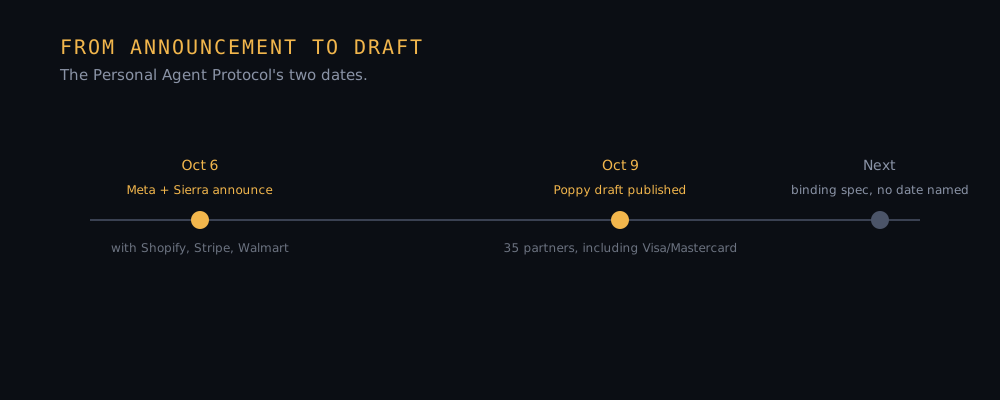
Meta and Sierra introduced the Personal Agent Protocol on October 6, an open standard for how AI agents act on a consumer's behalf, with a draft published October 9 and 35 design partners on the list.
The decision it puts on your desk
Nominate your commerce stack for this draft before it becomes standard, because late identity has a price internally. Run one scoped agent-payment test against the Poppy draft by November 15, and if you sell agent tooling, price a compliance product line against personal agents transacting under the same contract.
Two companies landed inside the commerce rails with a standard, and the guaranteed names behind it sit across payments.
"Meta and AI customer experience company Sierra announced the Personal Agent Protocol," an open standard for AI agents that interact securely with businesses, Tech Startups reported from the announcement.
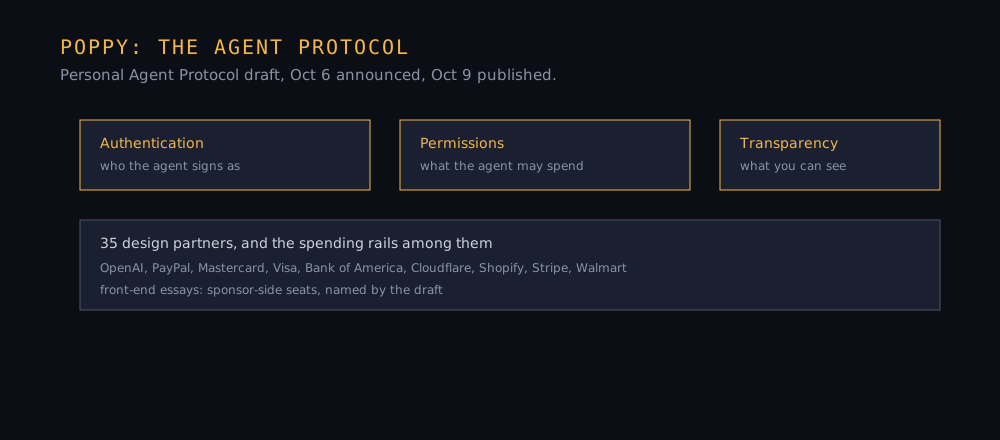
The draft (named Poppy) landed October 9, and Sierra expanded the design-partner list to 35 at the same time, per the reporting. The group spans OpenAI, PayPal, Mastercard, Visa, Bank of America, and Cloudflare.
The scope matters more than the logo wall. Authentication, permission scoping, and transparency respond to the three failure modes a consumer agent faces when spending someone else's money.
What the standard prices
Follow the money on one layer above the deal.
Payment flows are the steps where an agent carries real capability, and authorization is the close. An open draft with Visa, Mastercard, PayPal, Stripe, and Shopify named inside the same voting body implies a standard for agent spending rather than a proprietary one.
The design work sits inside three functions the protocol's own summary outlines: authentication (who is signing), permissions (what the agent may spend on), and transparency (what the customer can see).
Migration cost is one factor worth noting. Standards live because identity at the source matters, and the front-end list in the draft includes Walmart.
Precedent check: commerce APIs have standardized before, with card-network mandates setting the pace.
The unresolved edge is weight. A draft with 35 design partners carries no enforcement until adoption, and the binding spec has no date named.
I get the sense the partner list did the real work here. A wide consortium at standard-draft stage is how agentic payments finds its default.
Source
← Previous
Trump creates the Super Intelligence Force. The AI czar seat now has an occupant: Jay Clayton
Next →
Mistral ships Large 4: a trillion-parameter open-weight model trained entirely in the EU
The Morning Recap
We sift the day. You make the calls.
The decision on every story, in your inbox before your first call.