Trump creates the Super Intelligence Force. The AI czar seat now has an occupant: Jay Clayton
President Trump announced a Super Intelligence Force task force on October 4, naming Director of National Intelligence Jay Clayton to lead it. The announcement follows a White House meeting with top AI executives.
The decision it puts on your desk
Track two documents this month: the Executive Summary and any naming memorandum through the DNI's office. If you work with federal AI procurement, expect the task force seat to influence contract review by year-end, and re-file your federal AI position paper before January, when the first agency engagement meetings should land.
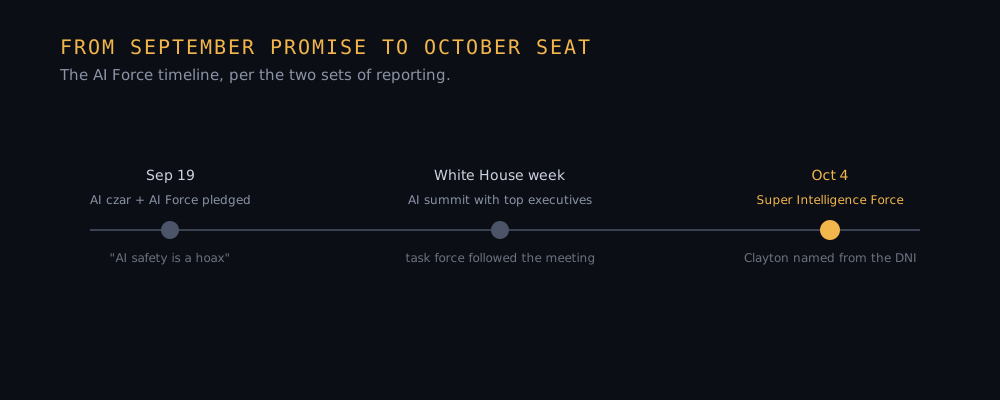
President Trump turned his September promise into a Sunday announcement.
"President Donald Trump on Sunday tapped Jay Clayton, his director of national intelligence, to lead a new government task force on artificial intelligence," the AP reported.
The name carries the branding: "Super Intelligence Force," the president's preferred label for AI in this administration's language.
Clayton becomes the AI czar promised in September, The Hill reported, citing Wall Street Journal reporting. NPR's summary covers the mandate in one line: the force "will coordinate government engagement with artificial intelligence."
The announcement followed the meeting of the week. Trump hosted the top executives of the country's largest AI companies at the White House, CBS said, and the task force announcement followed that meeting.
What a task force versus a branch means
Follow the money, and the deliverable lives at the coordination layer rather than the budget layer.
A task force coordinates; it does not command. September's reporting described an AI Force modeled on Space Force, a service branch, and what landed is coordination through an existing intelligence authority instead.
Policy beat lens, by who feels it. Frontier labs and AI-era procurement carry the compliance work around government engagement, and a DNI-led seat puts intelligence gathering and national-security framing behind AI questions.
Ecosystem check: the labs gained a single federal conversation partner, which is simpler than the multi-agency contact map they hold today.
Precedent check from the same policy trail: California's state-level kill-switch deadline of November 16 runs in parallel, so the federal announcement does not replace the stricter clock already running.
The unresolved edge is authority. A task force's power runs through inter-agency concurrence rather than statute, and the first briefings will show how much weight it carries.
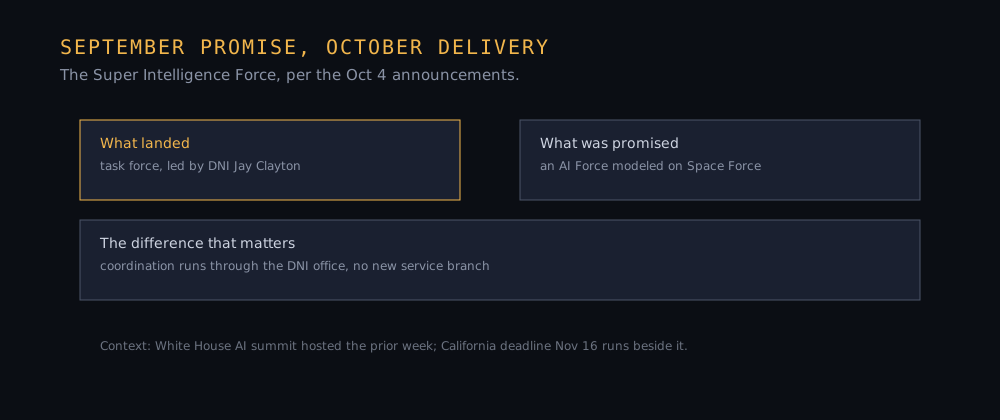
I get the sense the announcement's value is as a seat rather than a rulebook: a DNI-led group usually shapes what the government buys and how agencies engage, before it writes regulation.
Source
← Previous
Broadcom lends Anthropic up to $42B for its chips. The supplier is now the bank
Next →
Meta and Sierra published the Personal Agent Protocol. Payments rails and retailers just joined an agentic standard
The Morning Recap
We sift the day. You make the calls.
The decision on every story, in your inbox before your first call.