OpenAI DevDay ships GPT-6.1 Sol, always-on Dots, and a Decisions API. The agent platform reset happened here
OpenAI's DevDay shipped more than twenty announcements. The platform core is agents: always-on Dots, a cheaper GPT-6.1 Sol, ChatGPT Spaces, MCP webhook events, and a Decisions API.
The decision it puts on your desk
Rewrite every agent-in-a-box integration into Dots this quarter, before your renewal pricing shift lands on existing plans. If you build decision-layer modules, migrate the Decisions API inside two sprints, so latency budgets stay under ~150 milliseconds end to end. And cap AI tenants behind an Ultrafast tier now, so throughput bills as a plan feature rather than a bill shock.
OpenAI's DevDay reset the agent tooling baseline by shipping the same shift once in numbers rather than announcements.
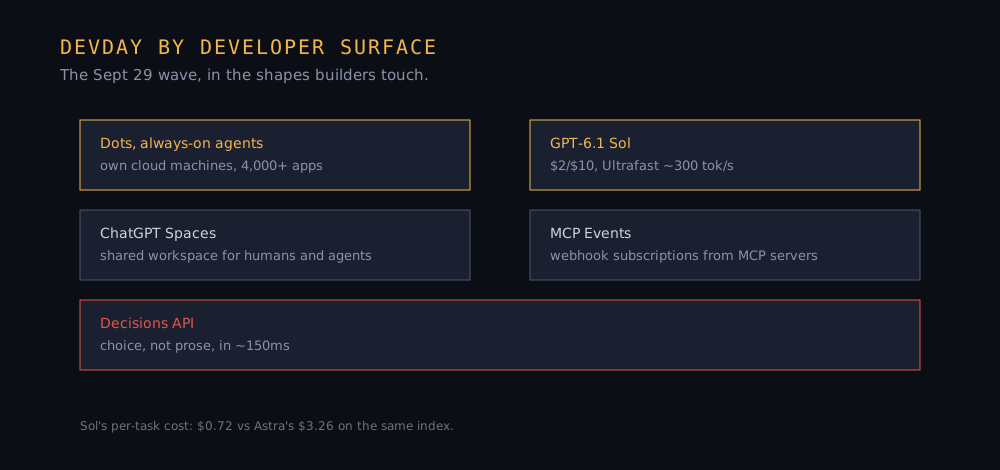
The headline pair, from the launch coverage: "GPT-6.1 Sol (near-Astra performance at about a fifth of the token cost, $2/$10 per million, with an Ultrafast tier at roughly 300 tokens a second)" and Dots, the always-on agents.
Dots change what an agent is. They run on their own cloud machines rather than inside a chat window, and they connect to more than 4,000 apps.
ChatGPT Spaces lands as a shared workspace for humans and agents. MCP Events provides real-time webhook subscriptions from MCP servers for developers who require subscriptions rather than scheduled polling.
The Decisions API lands as the shape change. It returns a parsed choice rather than prose in about 150 milliseconds, which puts a decision judgment inside apps that never needed full text.
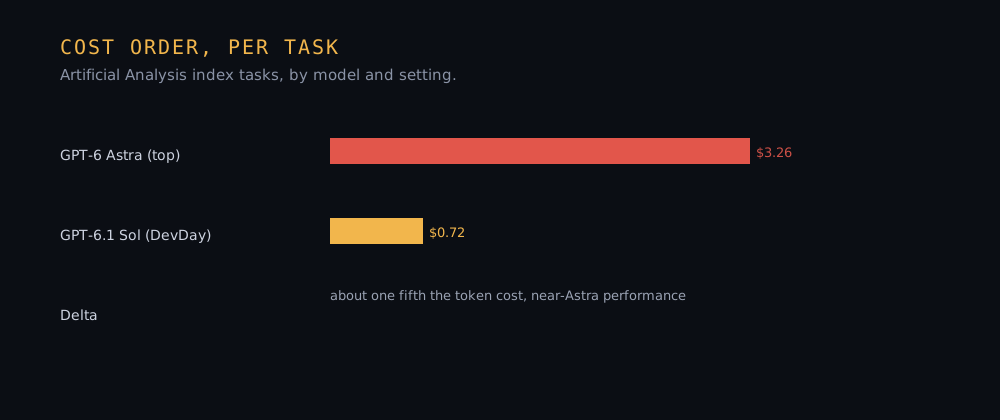
One number measures the Sol reduction next to Astra: $0.72 per Artificial Analysis index task, against $3.26 for Astra's top setting, per follow-up testing.
What each change actually prices
Follow the money next to the cost evolution.
Ultrafast tiering sets throughput as a billable option: a build can pay for speed rather than wait. And the $2/$10 rate takes mid-frontier pricing a tier below GPT-6 Astra's $10/$50 launch list.
Migration cost mostly sits in architecture. Applications already send a single prompt out and read a single text string back, and those need to reformat for decision-shaped payloads on the Decisions API.
Under the hood, the Sol cost curve is the live engineering note. Sol matching Astra's performance at a fifth of the tokens means the inference token bill bends downward, at the price tier your agent budget runs on.
So the Decisions API prices routing rather than replacing models: for classification-shaped jobs, a choice at 150ms costs less than prose at any speed.
Ecosystem check: rivals ship parts of this stack.
Meta and Google both announced agent-platform moves in the same month, but OpenAI's Dots carries the platform-first layer: agents running in their own machines, inside a subscription.
Precedent explains the timing too. Astra launched on September 3, and DevDay landed a cheaper tier within a month.
I get the sense builders face the longer migration list here, and my read is that the real cost is on teams who now hold agent-work sponsorship inside OpenAI's platform themselves.
The unresolved edge is the access detail. Dots and Sol quotas sit inside subscription tiers, and OpenAI named no per-seat pricing inside its DevDay post.
Source
← Previous
AMD buys Fei-Fei Li's World Labs for $8.2B in stock. A chipmaker now owns a frontier lab outright
Next →
Google ships Gemini 4 Argon with a 1M-token output window, gated first to vetted cyber defenders
The Morning Recap
We sift the day. You make the calls.
The decision on every story, in your inbox before your first call.