Google ships Gemini 4 Argon with a 1M-token output window, gated first to vetted cyber defenders
Google shipped Gemini 4 Argon on September 30, the first frontier model with a one million token output limit. Access opens inside its Fairwind program for vetted cyber defenders first.
The decision it puts on your desk
Price your next long-output use case against Argon's $2/$10 tier before November 30, when the intro window ends at $4 and $20. If your workload writes beyond 64,000 tokens in one pass, decide by October 15 whether one Argon run replaces your current multi-call chain.
Google's fall frontier release arrived with a different shape on Wednesday.
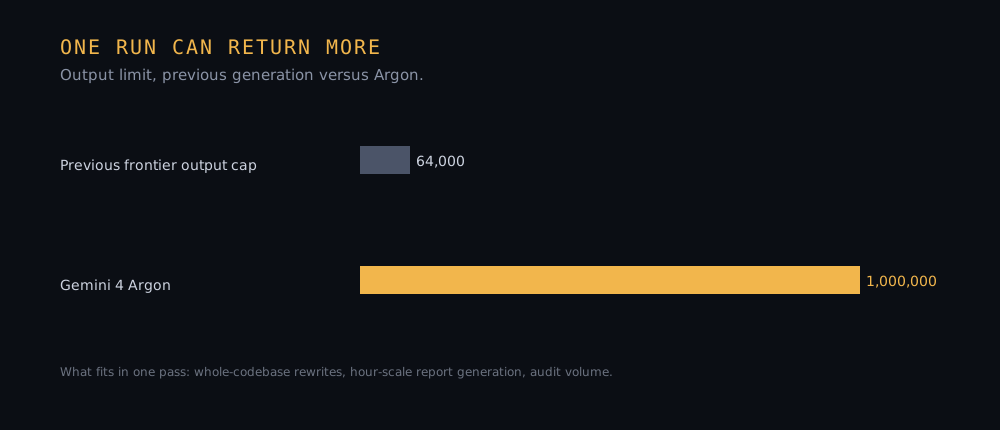
The model: Gemini 4 Argon, carrying a one million token output limit, up from 64,000 tokens on the previous generation.
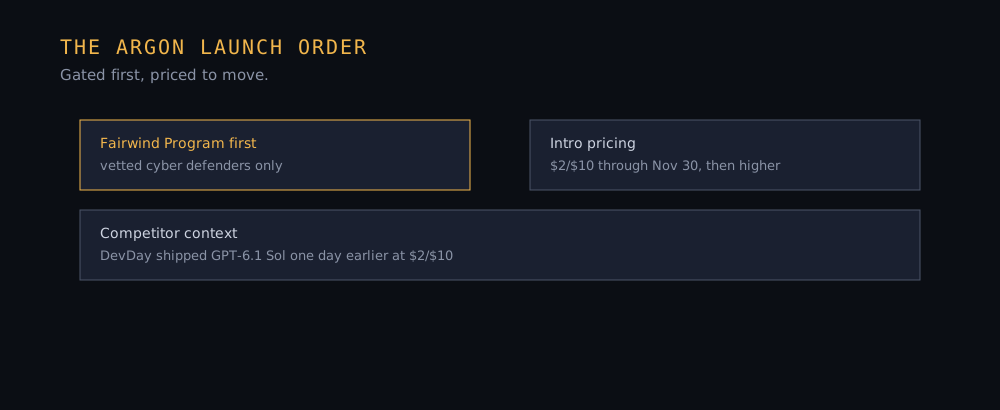
Pricing sits at $2 per million input and $10 per million output, the launch coverage said, near the tier OpenAI's DevDay had just set a day earlier.
Access opens first to vetted cyber defenders. Google gates the model inside its Fairwind Program, and the coverage credited Argon with topping Text Arena in that set of results.
Why a million-token output matters
Follow the money into capacity. An output limit decides the maximum scale of what one model run can return, and the number moved from 64,000 tokens to 1,000,000, roughly fifteen times higher.
Under the hood, large outputs change agent design.
A process that rewrites a legacy codebase fits in one pass now, and multi-hour report generation stops grinding through repeated calls to stitch a document together.
For cyber defense, the wide output has a practical reason: audit generations and incident reviews produce their value in volume, and the model returns that volume in one run.
The gating explains the launch order. Fairwind lets the model prove itself with auditors before the general tier, and "vetted cyber defenders" is the audience whose workloads generate those results first.
Ecosystem check, inside the frontier set.
OpenAI shipped Astra's math-gap advances earlier in the month, and DevDay landed GPT-6.1 Sol one day before this launch. Argon competes on the output dimension, where no rival had claimed a million.
Migration cost is mostly a question of the intro window. A writeup of the launch says the $2 and $10 rates hold through November 30, with terms rising after.
The unresolved edge is the benchmark picture. The early coverage is richer on spec than on full benchmark tables, so independent numbers are the thing to wait for.
I get the sense Argon's competitive design is the point. The tier work arrives in two places: the output window, and the intro pricing attached to it.
Source
← Previous
OpenAI DevDay ships GPT-6.1 Sol, always-on Dots, and a Decisions API. The agent platform reset happened here
Next →
OpenAI fires three safety researchers over confidential information. The dispute is about where safety reporting goes, in writing
The Morning Recap
We sift the day. You make the calls.
The decision on every story, in your inbox before your first call.