OpenAI plans to buy Google's TPUs. NVIDIA's biggest customer just built a second source
The Information reported Tuesday that OpenAI plans to buy Google's AI chips, adding a second chip supplier.
The decision it puts on your desk
Price a second accelerator into your next procurement round before Q1 budgets lock. If your workloads are mostly inference, ask your provider for its multi-vendor roadmap by December 15, because porting work takes months and the largest GPU buyer in the market just told everyone it wants an alternative.
OpenAI, long one of NVIDIA's biggest customers, plans to buy Google's AI chips, The Information reported Tuesday.
Neither company has confirmed a purchase. Terms, chip volumes, and the delivery schedule all stayed out of the report. It cited one person familiar with the matter.
The supporting detail is a job listing. OpenAI is hiring an engineer to "lead the optimization" of its models on the Tensor Processing Unit (TPU). Google designs that custom accelerator for its own data centers.
Read the verb, then read the supply chain
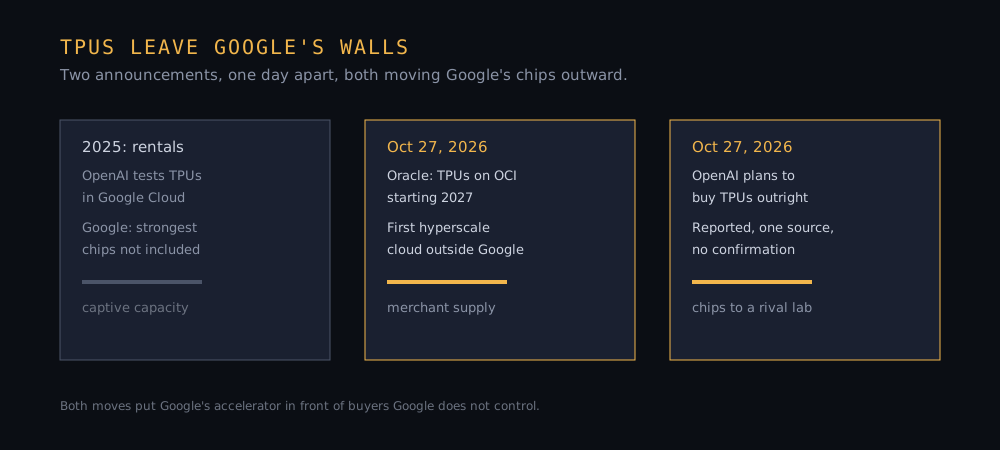
"Buy" is the word carrying the weight here. OpenAI rented TPUs through Google Cloud back in 2025. A Google spokesperson said at the time that its strongest chips were not part of the rental.
That history makes the current verb worth something. A purchase would sit on top of OpenAI's existing mix. NVIDIA GPUs (graphics processing units) cover most of its work today, and custom silicon sits in development with Broadcom. A fast inference tier already runs on Cerebras wafers.
Google has mostly kept TPUs inside its own cloud. Selling the chips themselves, rather than access to them, would move Google from captive capacity toward merchant supply, and it would do so for a company that competes with Google in chatbots, coding agents, and models.
Nobody has confirmed anything.
The confirmations, on both sides: zero.
The port is the real price of entry
"Compute is the constraint for OpenAI and labs like it," Matt Kimball, vice president at Moor Insights & Strategy, said. "It's all about how fast it trains, what it can afford to serve."
Kimball puts a second price on the deal, and it is measured in months. "Getting a frontier model to run on a TPU is one thing," Kimball said, "getting it to run with tuned kernels for attention, mixture-of-experts routing and long-context inference is months of specialized work."
OpenAI builds most of its software on PyTorch, an open machine learning framework, and on NVIDIA's CUDA (Compute Unified Device Architecture) platform. Google's accelerator stack leans on JAX, a numerical computing library, and XLA (accelerated linear algebra), its compiler.
I would want the porting estimate itemized in writing before I trusted a savings number, and the months figure seemed low for a stack this size.
If the purchase is real, OpenAI gains a supplier to negotiate with, Google gains its first merchant customer for chips it mostly keeps internal, and NVIDIA keeps its biggest buyer.
The competitor check reads the same way. Kimball does not see the move as a threat to NVIDIA, whose software ecosystem runs from startups to sovereign programs, and he said demand keeps growing faster than any single supplier can support.
I read every write-up looking for the volume number and found none. What the reporting does show is timing: Oracle announced a day earlier that Google TPUs arrive on Oracle Cloud Infrastructure (OCI) in 2027, the first hyperscale cloud outside Google to carry them.
I get the sense this lands as a negotiating posture before it lands as a purchase order. A credible second quote changes the first conversation, even if the volumes stay small.
The unresolved edge sits with Google itself. Selling accelerators to a direct rival, on which the rival's cost curve depends, is a strategic decision nobody at either company has publicly made, and neither side denied the report.
Source
https://www.theinformation.com/articles/openai-longtime-nvidia-customer-plans-buy-googles-ai-chips
https://www.reuters.com/business/openai-plans-buy-googles-ai-chips-information-reports-2026-10-28/
https://www.techtarget.com/news/openais-reported-google-tpu-deal-tests-ai-chip-economics/873139/
https://explainx.ai/blog/openai-google-tpu-purchase-the-information-claimed-vs-verified-2026
← Previous
Anthropic files to go public: $16.3B revenue, an $80.7B net loss, one share keeps 50.1% of the vote
Next →
Google gives cyber defenders first access to Gemini 4 Carbon, the top-ranked model in AI
The Morning Recap
We sift the day. You make the calls.
The decision on every story, in your inbox before your first call.