OpenAI asks Congress for mandatory safety rules. Voluntary pledges are no longer the house standard
OpenAI published a policy plan on September 9 asking for mandatory, capability-based national AI safety regulation in the United States. Four California bills get its endorsement as a bridge.
The decision it puts on your desk
Track two artifacts this month: whether California's endorsed bills (SB 813, AB 1405, SB 1119, AB 1864) reach Governor Newsom's desk, and whether a federal bill mirrors OpenAI's blueprint. If you build on frontier models, budget monitoring and incident-reporting costs now, because both are headed for mandatory status. If you ship open-weights products, submit a comment on any federal carve-out: the biggest variable left open is who counts as "frontier."
OpenAI wants national rules, and it has picked the words it wants.
"We want to work with Congress on mandatory, capability-based national AI safety regulation," Chris Lehane, the company's chief global affairs officer, said in a September 9 post.
The push lands with a deadline. "The AI policy window is open, for now," the post said, and the plan calls on Congress to act before it adjourns.
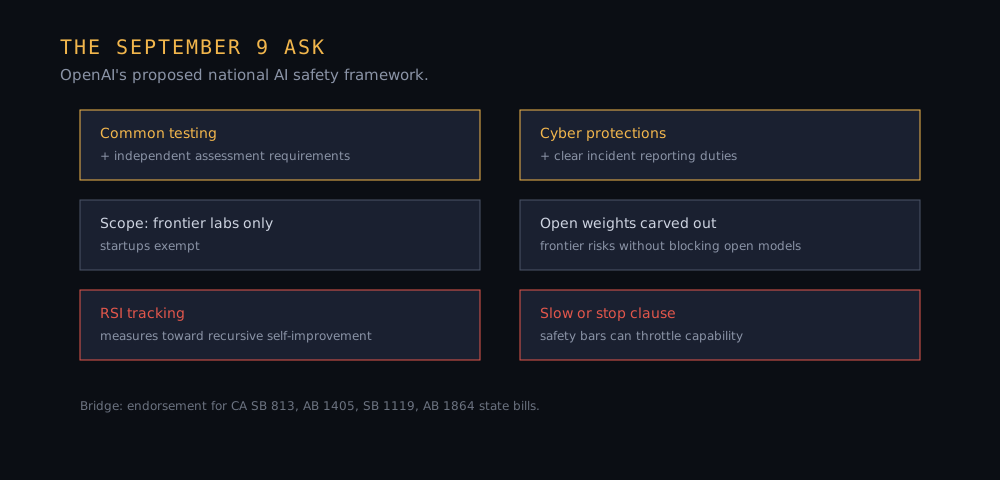
Four elements make up the ask:
A national framework sets common testing, independent assessments, stronger cyber protections, clear incident reporting, and shared tracking toward recursive self-improvement under OpenAI's published frontier safety blueprint. Recursive self-improvement (RSI) means AI systems helping to build their own next generation.
The scope splits on purpose. Requirements "should apply to the handful of well-resourced laboratories developing the most capable systems," Lehane said, maxing the burden on frontier labs rather than startups.
Open weights stay in. The post argues open models "can be part of the solution," so a federal framework can cover frontier-scale risks without driving innovation offshore or entrenching incumbents.
Monitoring must reach regulation. Lehane proposes rules that require labs to monitor for misaligned behavior and give prompt written notice when a model "circumvents another organization's security controls without authorization," which would put September's misalignment disclosures on a public clock going forward.
The compliance cost, and who pays it
Follow the money: a capability-based framework puts the audit bill on the largest labs. That lowers the compliance floor for startups, but it raises the bar inside each frontier lab, where independent assessment carries real security and staffing cost.
The precedent is OpenAI's own. As it reasons in the post: "When proceeding would pose an unacceptable safety risk, we will slow or stop the development or deployment of systems we cannot sufficiently safeguard."
That scale-based reach also matches what earlier coverage shows. State bills like California's SB 53, New York's RAISE Act, and Illinois measures were already emerging, the post said, as an approach OpenAI names "reverse federalism."
Precedent clause is the last element. OpenAI's plan asks states to converge around a shared bar that Congress can "ultimately codify."
The practical test for any builder is straightforward. Mandatory language ends the era where safety commitments were voluntary pledges at company portals.
The unresolved edge: whether Congress acts "before it adjourns," the post argues it should, is a political call no company essay makes by itself.
I get the sense both frontier labs are now asking Washington for roughly the same shape of regulation. The gap left is the cap set.
Source
← Previous
Mistral raises EUR 3B from Samsung. The sovereign AI bet just got a balance sheet
Next →
Anthropic's threat report shows AI misuse reaching industrial scale across seven fronts
The Morning Recap
We sift the day. You make the calls.
The decision on every story, in your inbox before your first call.