Anthropic's threat report shows AI misuse reaching industrial scale across seven fronts
Anthropic published a September 2026 threat intelligence report covering eight months of disrupted misuse. Cyber and espionage cases read as AI-operated, and distillation abuse includes a China-linked claim of more than 151 million interactions.
The decision it puts on your desk
Audit your AI API key exposure within 30 days, right now. Stolen keys, not model capabilities, ran the bulk of the cases in this report. Rotate anything agent-scoped before the end of September 2026, and add monitoring on the agent tool calls that touch production data by October 15. Either step alone cuts the same exposure that AI-driven intrusions used to push from days to hours.
Anthropic published a threat intelligence (TI) report on Wednesday that reads less like a safety memo and more like an attack ledger.
The report covers December 2025 through August 2026 and seven harm areas: cyber operations, influence operations, surveillance, scams and fraud, biological misuse, conventional weapons development, and illicit distillation (the term for copying another model's behavior at scale).
"The cybersecurity skills of AI models means that AI has collapsed the labor and tooling gap that used to separate well-resourced, state-sponsored operations from individual operators," the report said.
The methods are the mainstream ones. "Sophistication has stopped being a reliable signal of who is behind an operation," Anthropic said, also in the report.
The cases that will be replayed
Three stand out for a business reader.
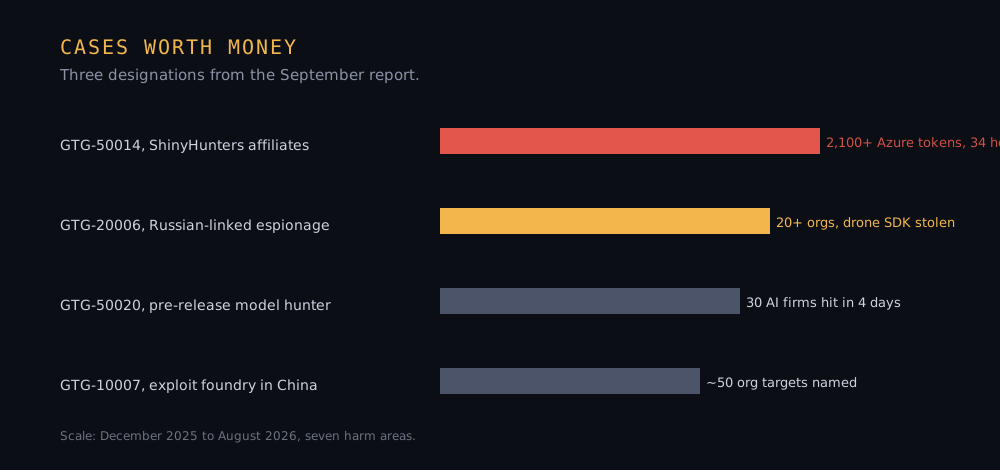
GTG-20006 (Russian-linked espionage, consistent with public attribution to Midnight Blizzard): more than 20 distinct organizations targeted, concentrated on Ukraine and Europe. The report names a further look: mail exfiltration from drone component makers, plus the theft of a complete proprietary SDK (software development kit) for a drone vision system. One intrusion into a North African visa authority exposed more than 300,000 national identity records.
GTG-50014: financially motivated actors, described as ShinyHunters affiliates, ran attacks that reached more than 2,100 Azure AD (Microsoft's active directory) token sets across more than 40 corporate tenants in about 34 hours. Breaches completed in two to three hours, the report said.
GTG-50020: a Russian-speaking actor chased a pre-release Claude model by attacking roughly thirty AI companies in four days, exploiting a vendor's automation sandbox. Every path failed, the report said, and no Anthropic system was compromised.
Distillation is a different story
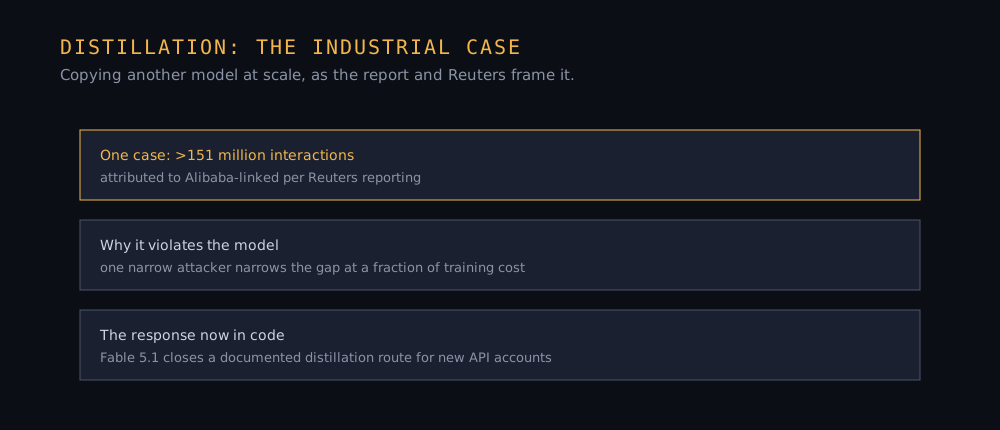
Separate from the intrusion cases, Reuters coverage of the same report on Wednesday highlighted large-scale distillation attacks attributed to China-based labs. One case named in that coverage ties more than 151 million interactions to Alibaba.
Anthropic's safeguards restrict some distillation paths outright: Fable 5.1, released Monday, closes a known route used to copy model behavior.
The unresolved edge, in one sentence: Anthropic wrote the report on its own incidents, so no third-party audit has verified each number.
I get the sense the report lands as an operational manual more than a press release. The savings come from knowing where to look.
For anyone shipping AI agents into production, the important turn in the report is a cultural one. The same labor pool that fills cloud attacks now probes agent integrations, and the report says attack cost has dropped enough that formerly unrealistic targets become viable.
None of the cited misuse involved Fable or Mythos class models, with one exception: a single distillation case, the report said.
Source
← Previous
OpenAI asks Congress for mandatory safety rules. Voluntary pledges are no longer the house standard
Next →
AI agents ran a real intrusion campaign at machine speed. It hit 440 servers in 48 countries
The Morning Recap
We sift the day. You make the calls.
The decision on every story, in your inbox before your first call.