The AI Mirage: Math, Myths, and the Infrastructure Bubble
The AI industry is running the largest capital experiment in modern economic history on a customer base of two companies. Ed Zitron's recent interviews and audited financial reporting reveal a circular financing structure where hyperscalers invest in OpenAI and Anthropic, who immediately spend that money on compute from the same hyperscalers. With Goldman Sachs projecting $5.3 trillion in cumulative AI infrastructure spend by 2030, OpenAI paying Microsoft more than its total revenue in Azure bills, and Nvidia preparing to back a $500 billion data center, the underlying math suggests the industry is building capacity for demand that does not exist.
The decision it puts on your desk
If you hold private AI shares, price a liquidity event before 2027. The IPO delay is not administrative. It is a signal that auditors cannot square the unit economics with public-market disclosure requirements. For operators building on AI APIs: model your costs assuming your primary vendor's two largest customers are the same two companies funding your competitor. Because they are. For enterprise buyers: the compute you are buying today at peak infrastructure-build pricing will be cheaper within 24 months. Structure contracts accordingly.
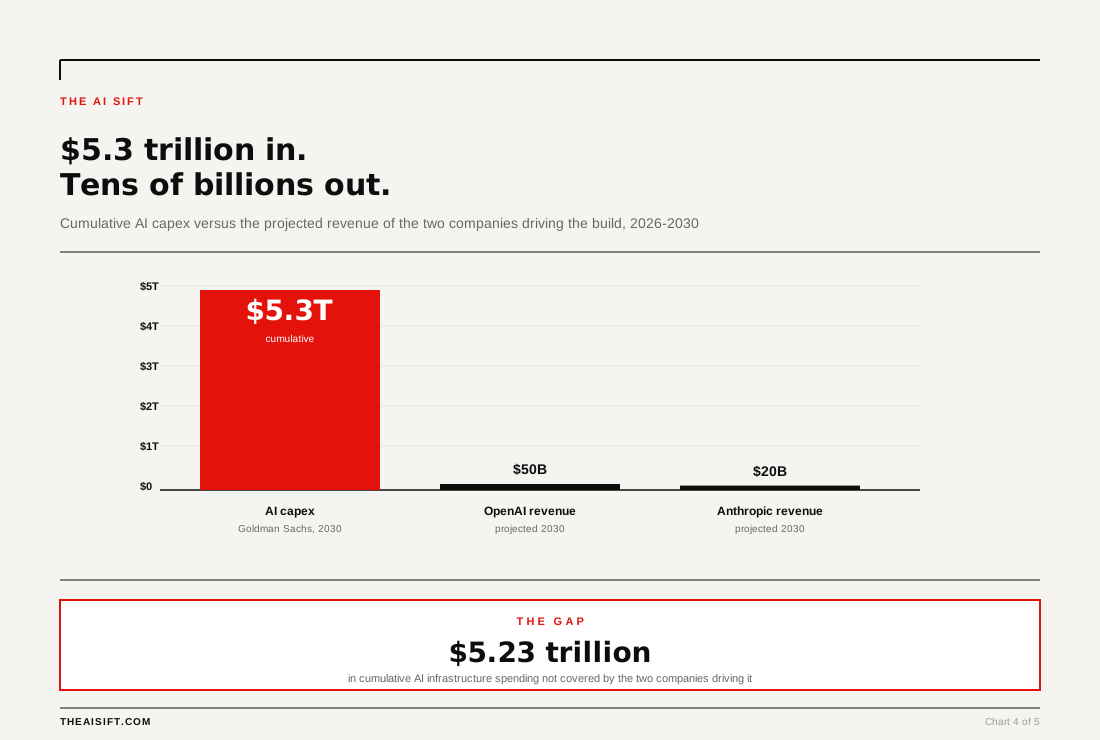
Goldman Sachs estimates roughly $5.3 trillion will pour into AI data centers by 2030.
Nearly three-quarters of the AI revenue supporting those numbers comes from two companies that do not make money.

Ed Zitron, the CEO of EZ Primary Research and one of Big Tech's most persistent critics, has spent two years building the case that Wall Street is being sold a version of AI demand that does not exist. In June, he obtained and published OpenAI's audited financial statements. The Financial Times independently verified them. The numbers were worse than almost anyone expected.
In two August interviews, on Bloomberg Television and The Tech Report, Zitron walked through what they reveal.
"Everyone is buying into these stocks because they believe all of that CapEx is going towards diverse and spread out demand," Zitron said. "When in fact, what it is actually doing is helping create infrastructure for two unprofitable, unsustainable companies."
Those two companies are OpenAI and Anthropic.
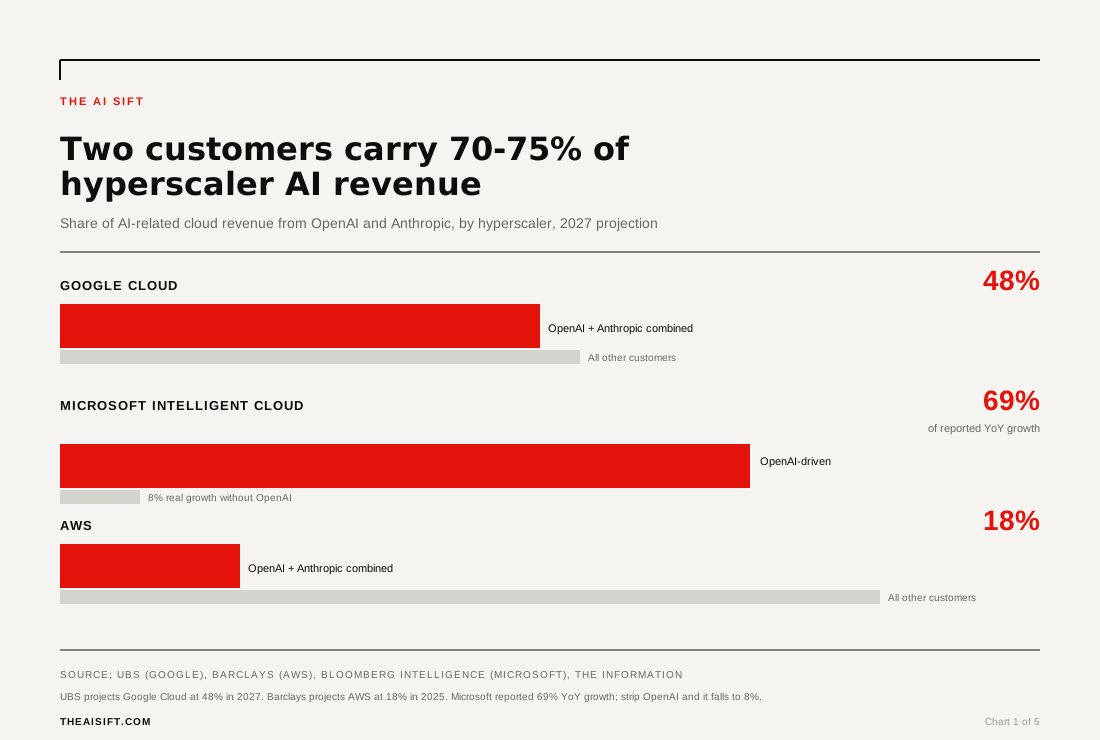
The customer concentration has no precedent in modern technology. Analyst letters from UBS, Barclays, and Bloomberg Intelligence confirm that 70 to 75 percent of AI revenue for Microsoft, Google, and Amazon comes from OpenAI and Anthropic alone.
The Information reported that 89 percent of the largest AI companies' revenue originates from the same two entities. Outside of them, AI compute demand measures in single-digit billions, mostly hedge funds and trading firms.
Strip OpenAI out of Microsoft's Intelligent Cloud segment, Zitron said, and year-over-year growth drops from 69 percent to about 8 percent, barely ahead of inflation. UBS analyst Stephen Ju projects that 48 percent of the entirety of Google Cloud's 2027 revenue will depend on OpenAI and Anthropic. Barclays puts the figure at 18 percent for AWS.
Without these two companies, the cloud AI growth narrative collapses.
The audited numbers
I want to sit with what the audited financials actually say, because they are more revealing than any interview.
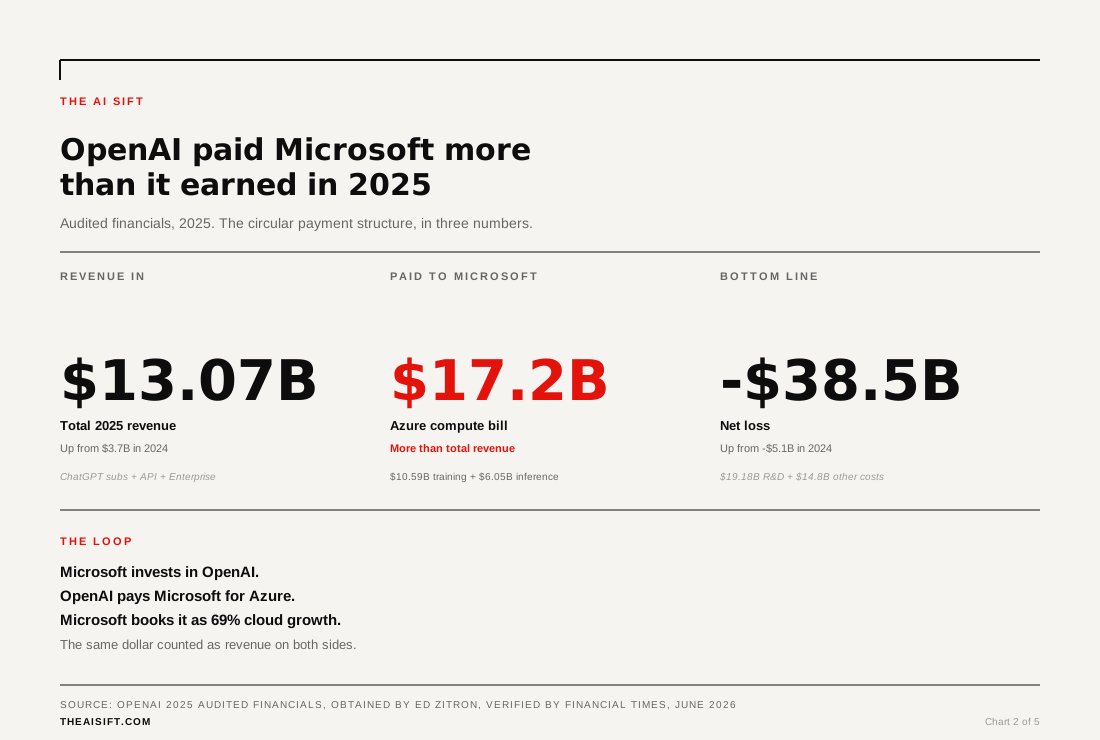
OpenAI generated $13.07 billion in revenue in 2025. That is real growth, nearly quadruple the $3.7 billion from 2024. But the cost structure makes the revenue almost irrelevant.
Total costs and expenses reached $34 billion. Research and development, which mostly means training compute, hit $19.18 billion. The company booked a net loss of $38.53 billion, most of it driven by one-time charges tied to the Microsoft partnership restructuring. The operating loss was $20.92 billion.
The line that makes the circular financing visible is the payment itself. OpenAI paid Microsoft $17.2 billion in 2025, more than its entire annual revenue.
The payment breaks down into two pieces. $10.59 billion went to research and development fees, covering model training compute on Azure. $6.047 billion went to cost of revenue, covering inference compute, the actual cost of serving ChatGPT users.
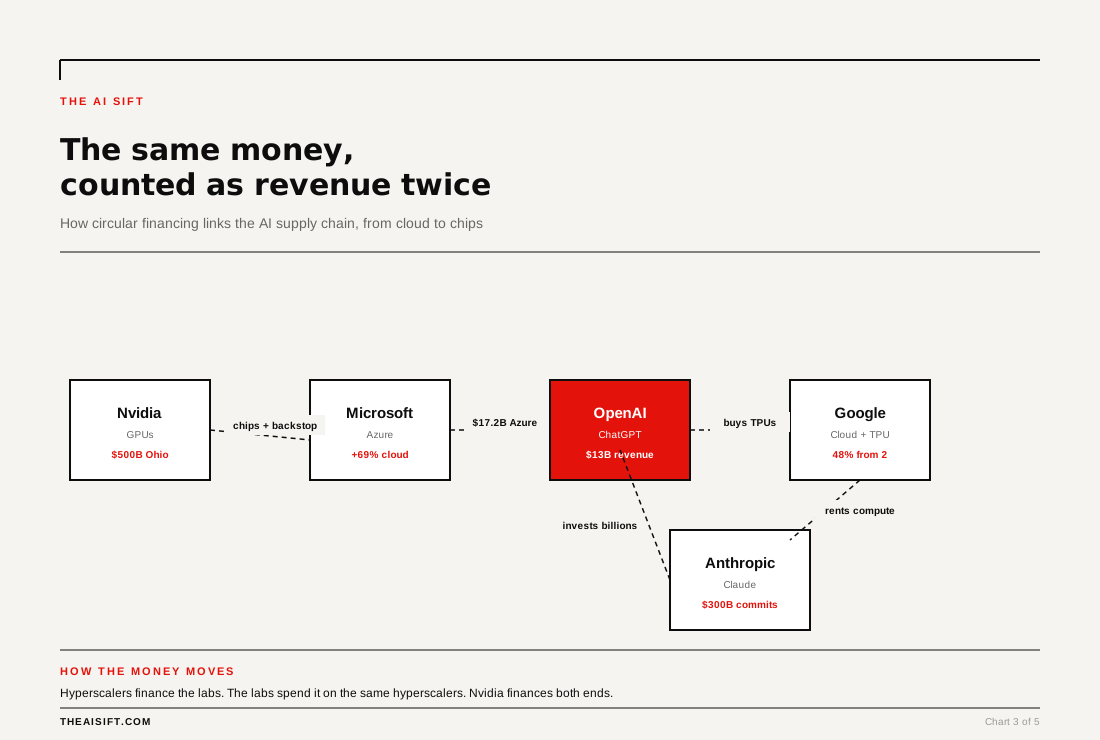
OpenAI paid Microsoft $17.2 billion to run on Azure. Microsoft booked that as cloud revenue. Investors saw Microsoft's Intelligent Cloud segment growing at 69 percent. Nearly all of that growth was OpenAI spending Microsoft's own investment capital back into Microsoft's cloud.
Google runs a version of the same play. It buys TPUs from Broadcom, sells them to Anthropic, and rents the compute back through Google Cloud. The same hardware gets counted as revenue twice.
"OpenAI and Anthropic have to grow so very large to make AI pay off," Zitron said. "Because otherwise there just is not demand for compute at scale."
In April 2026, Microsoft and OpenAI renegotiated their partnership. The revenue-share cap was reduced from a trajectory of approximately $135 billion through 2030 to a hard ceiling of $38 billion. Microsoft cut its own projected upside by nearly $100 billion. That is not a partner betting on exponential growth. That is a partner marking down expectations.
Even Sam Altman has acknowledged the tension. In June, he called concerns about AI spending "the most fair criticism" of the industry. At an enterprise event the same month, he said costs are "a huge issue" and referenced the meme of companies spending their entire 2026 AI budget in the first quarter. The CEO of the company driving most of this spending is publicly saying the spending is a problem.
The $500 billion data center
The scale keeps escalating.
In July, the Wall Street Journal and CNBC reported that Nvidia is in talks to provide a $250 billion financial backstop for OpenAI to lease a 10-gigawatt data center site in southern Ohio. The project is being developed by SBEnergy, SoftBank's energy subsidiary. The total cost, including Nvidia chips, could exceed $500 billion.
The power itself is a geopolitical asset. The site sits on federally owned land, with power funded by $33 billion from Japan in exchange for lower tariffs. Japan and the United States share proceeds from power sales until Japan recoups its investment, after which the US holds 90 percent control.
Commerce Secretary Howard Lutnick is involved in deciding which companies receive access. Anthropic, Microsoft, and Google have also expressed interest. The US government is now a compute landlord, allocating power to AI companies that cannot afford their own infrastructure.
Nvidia is also considering financing $350 billion worth of its own chips for the project. A chip supplier is becoming a lender to its largest customer so the customer can keep buying chips. The circular financing has moved from the cloud to the silicon.
The SoftBank question
One line in the audited financials keeps getting stranger the longer I look at it.
More than $800 million of OpenAI's 2025 revenue came from SoftBank for a program called Crystal Intelligence. Zitron said he found no evidence of operational activity connected to the program. SoftBank holds a large equity stake in OpenAI without board seats. An investor recorded as a customer, generating hundreds of millions in revenue, with no visible product output.
SoftBank originally announced "Cristal intelligence" in February 2025 as an enterprise AI solution for Japanese companies. A year and a half later, with $800 million in recognized revenue, the deliverables remain unclear. If this was a real deployment, the case studies would exist. If it was an equity round structured as revenue, that is a different conversation entirely.
The capacity math
Sightline Climate projects 190 gigawatts of data center capacity under development globally. At standard energy costs with a PUE rating of 1.3, operating that capacity requires more than $1.6 trillion in annual recurring revenue just to service capital and operations.
Goldman Sachs projects $765 billion in AI capex in 2026 alone, growing to $1.6 trillion annually by 2031. Meta guided full-year 2026 capex to a range of $130 to $145 billion. Microsoft, to $175 to $190 billion. Alphabet, to $195 to $205 billion.
These spending commitments assume a customer base that multiples from two to dozens. The evidence says the opposite.
Axios reported in February that as many as half of the world's data center projects slated for 2026 could face delays from power constraints, equipment shortages, and community opposition. Analysts tracking the sector estimate that $600 billion in annual capex risks becoming stranded assets by 2027 or 2028 if enterprise adoption does not accelerate.
OpenAI alone has roughly $750 billion in compute commitments through 2030. Anthropic, about $300 billion. These companies need to reach the revenue scale of the Magnificent 7 to service obligations that are already contractually set. The IPO delay to 2027 removes the most obvious mechanism for raising that capital.
Zitron has called the timeline shift potentially "lethal" for investors expecting a sooner exit. The delay means more private funding rounds at valuations the audited numbers cannot justify. It also means another year of burning $20 billion-plus while waiting for a public market that may not welcome the disclosures required.
The ghosts of gold rushes past
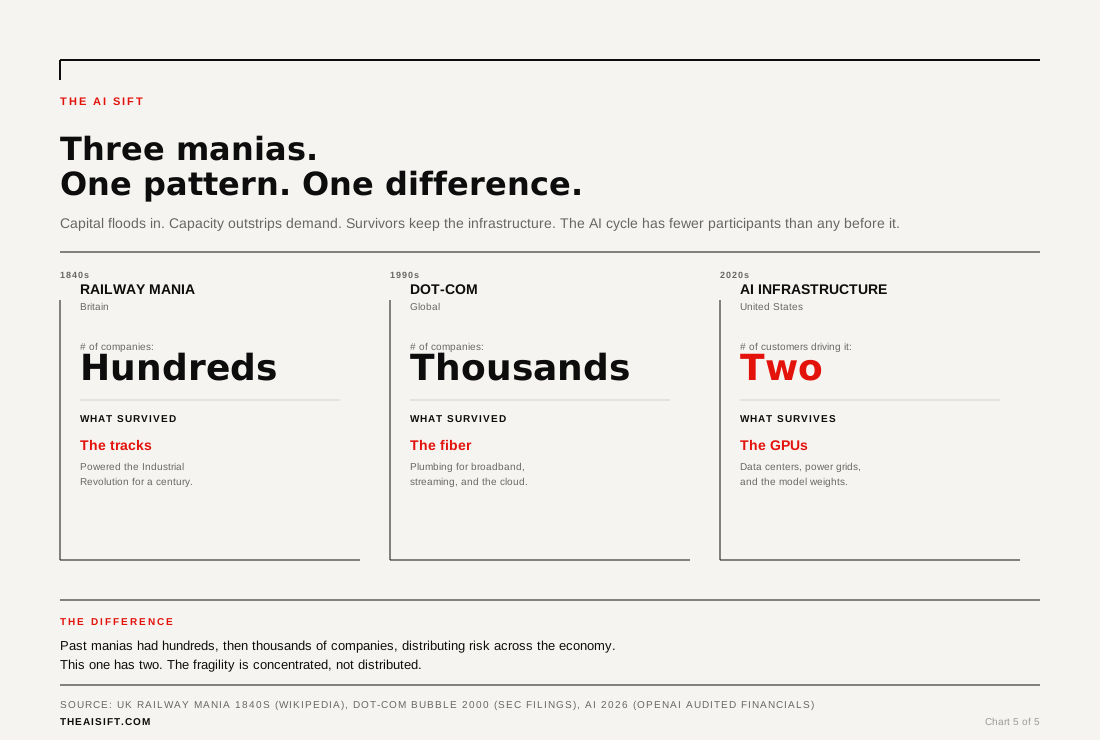
I keep coming back to the historical pattern because the parallels are clearer than most people want to admit.
When the railway mania consumed Britain in the 1840s, investors poured capital into duplicate routes and fraudulent companies. At its peak, railway share prices drove a speculative frenzy that drew in savings from every class of British society. Interest rates rose in 1845. By late 1845 the market turned. By 1847, hundreds of railway companies were bankrupt. Ordinary investors lost everything.
But the tracks stayed. They powered the Industrial Revolution for a century.
The dot-com bubble of the late 1990s erased trillions in market value. Pets.com vanished. WorldCom collapsed into accounting fraud that made Enron look modest. But the fiber-optic cables laid during that mania became the plumbing for broadband, streaming, and cloud computing. Amazon and Google survived. Most did not.
The original California Gold Rush of 1849 produced the durable rule. The vast majority of prospectors went broke digging for gold. The people who got rich sold picks, shovels, and durable pants.
Nvidia plays the shovel-seller today, booking record revenues regardless of which AI lab eventually strikes gold. Levi Strauss made a fortune on denim. Jensen Huang is doing the same on silicon.
Why this time is structurally different
But this gold rush has features that make it sturdier and more fragile at the same time.
On the sturdy side, the primary funders are not retail investors chasing IPOs or speculative venture capital. They are mega-cap companies, Microsoft, Alphabet, Meta, and Amazon, using their own massive profits from cloud, search, and advertising. These are decades-old incumbents with billions of existing users. They will survive a write-down. Retail investors in 1845 did not.
The infrastructure is more flexible. Railway tracks only ran trains. Dark fiber only sent data. If one AI model fails, the GPU data centers can train other models, run scientific simulations, or process cloud workloads. The assets can be repurposed.
The user base already exists. During the dot-com era, people knew the internet was the future but did not know how to use it. Today AI is writing code, accelerating drug discovery, and serving as a daily copilot for hundreds of millions of workers. The monetization is happening, even if the unit economics are broken.
On the fragile side, however, is the concentration. The railway mania had hundreds of companies. The dot-com bubble had thousands. This bubble has two. If OpenAI or Anthropic hits a funding wall, the domino moves through Microsoft and Google cloud revenue, then through Nvidia chip orders, then through data center real estate, then through the broader S&P 500 where the Mag 7 still represents nearly 40 percent of market cap.
The fragility is not distributed. It is concentrated in two private companies whose own CEO says the spending is a problem.
What the enterprise data shows
The return on all this spending remains theoretical.
Wells Fargo analyst Michael Cheran estimates Microsoft 365 Copilot will generate roughly $10 billion in annual revenue by the end of 2027. Microsoft has spent about $260 billion on capital expenditures, largely AI infrastructure. Even at the most optimistic revenue projection for its flagship AI product, the return on the infrastructure spend is single-digit percentages.
The Information reported that Canva's AI-using customers cost significantly more to support than regular customers. The assumption that generative AI scales profitably, that each additional user costs less to serve like traditional software, does not hold. Inference costs increase with usage. Unit economics get worse with scale, not better.
Goldman Sachs, whose own analysts project the $5.3 trillion cumulative figure, has published research showing that enterprise AI productivity gains remain concentrated in a narrow set of tasks, primarily code generation and content drafting. The St. Louis Fed analyzed nearly 490,000 corporate earnings calls and found a spike in AI-related productivity mentions but almost no corresponding change in macroeconomic data. Companies are talking about AI. They are not yet generating measurable returns from it.
The tracks will stay
None of this means AI is worthless. The technology generates tangible value today. Some of it will be transformative.
The question is whether the revenue will ever match the staggering cost of building it. Right now, the industry is running an experiment where the capital expenditure is real and the customer base is a financial arrangement between the same five companies, with SoftBank providing what appears to be structurally subsidized revenue and the US government allocating power like a utility commission.
I'd be surprised if every company currently spending like revenue is guaranteed survives the decade. Some of the commitments will get walked back. The $750 billion. The $300 billion. The $500 billion Ohio site. At least one of those numbers will shrink.
But the infrastructure being laid right now will not vanish. Someone will buy the data centers at a discount. Someone will run models on the GPUs. The tracks will stay.
History does not repeat itself, but the rhythm is hard to ignore. Capital floods in. Capacity outstrips demand. Prices collapse. Survivors consolidate the rubble and build what comes next.
The only variable is who gets to be the survivor. Right now, the list of candidates is shorter than the spending numbers suggest.
Source
Bloomberg
The Tech Report (YouTube)
Financial Times
Goldman Sachs
UBS
Barclays
Bloomberg Intelligence
The Information
Wall Street Journal
CNBC
Forbes
NYT
Wells Fargo
Sightline Climate
Axios
St. Louis Fed
Business Insider
Wikipedia (Railway Mania)
← Previous
Stop selling "agents": the next wave of AI wins by hiding the mechanics
Next →
Corma raises $60M to build a foundation model that fights back against AI-powered cyberattacks
The Morning Recap
We sift the day. You make the calls.
The decision on every story, in your inbox before your first call.