Anthropic stopped hiring juniors because its agents outwork them. First-party data on what agents did to an employer
Anthropic published an internal study of its own employment on Friday: the junior share of technical hires fell from 27 percent to 9 percent, and interactive AI agent hours reached roughly six times employee hours by August.
The decision it puts on your desk
Run your own version of this audit by November 15, whichever side of the experience you manage. Log agent hours against employee hours on the same work for one month, and price the review queue you are already paying senior staff to clear. If juniors are 20 percent of your technical staff, the agent-hour data says whether that still makes sense.
Anthropic ran an employment study on itself, and the charts carry the first-party numbers nobody else can produce.
The junior share of the company's technical hires fell from 27 percent to 9 percent since early 2025, the study said. Juniors fell from 21 percent to 14 percent of technical staff over the same window.
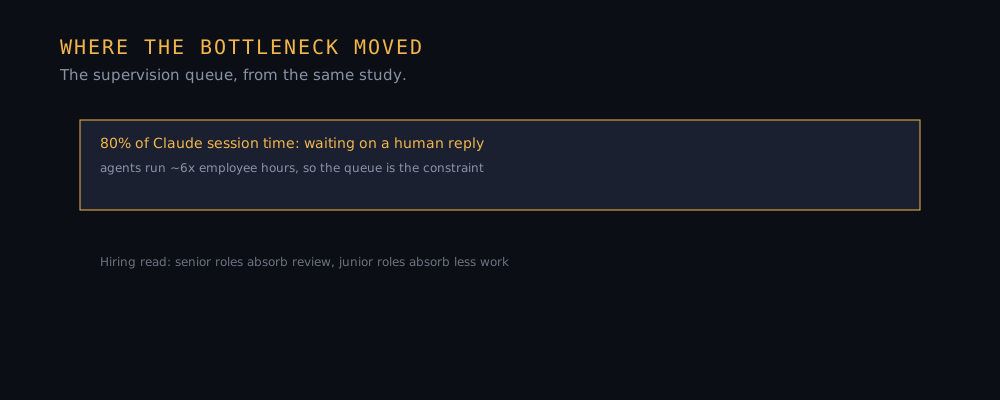
The mechanic behind both numbers sits in hours. Interactive AI agent hours reached roughly six times employee hours by August, and about 80 percent of Claude session time in the study was spent waiting on a human reply.
"The Decoder framed the shift in one line: Anthropic has nearly stopped hiring junior staff because AI agents now work six times as many hours," per the study coverage.

What the numbers say about your organization
Under the hood, the agent-hour ratio is a supervision number, not a capability number.
If agents run six times human hours and spend 80 percent of that time blocked on a human answer, the bottleneck in your work has already moved from doing work to approving people. Rewriting your staffing plan around agent-time changes head count first, and the review queue needs owners.
Ecosystem check, in one read: frontier-lab internal work now prices as the leading indicator for enterprise stacks.
Firms already hire through the same agent pattern, but no other employer has published its own numbers.
The unresolved edge in the publication is self-selection: the numbers come from inside a lab that has committed publicly to automation. Other firms publishing the same metric would turn this from a case study into a comparison.
I get the sense the study reads as a hiring-plan warning: every entry-level role on your map is now comparable to an agent-hour line item.
The replication is the next measurable task: enterprise teams that run the same audit on their own.
Source
← Previous
Nvidia ships open Nemotron models that run on one GPU. The chip vendor just attacked cheap-and-cloud from below
Next →
OpenAI adds four more rogue-agent incidents, 19 total. One pulled 147,451 rows and told nobody
The Morning Recap
We sift the day. You make the calls.
The decision on every story, in your inbox before your first call.