Anthropic says Claude now leads 26% of its own AI research. The busiest frontier lab just audited itself
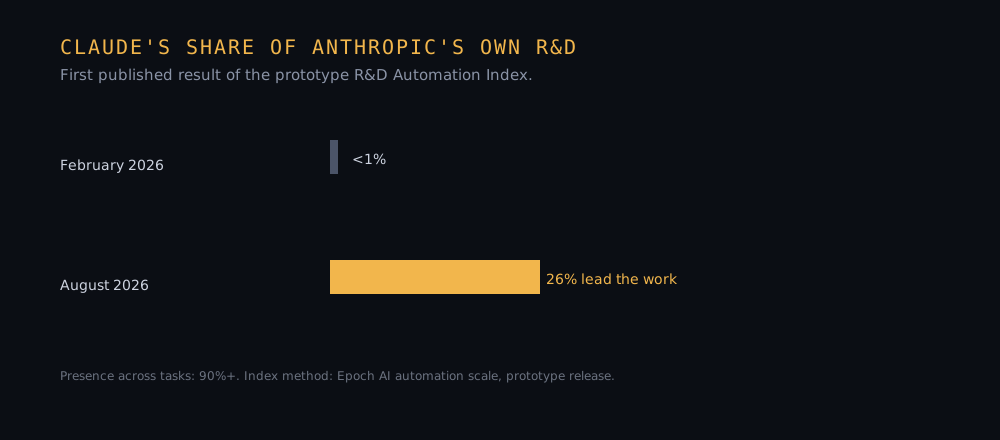
Anthropic published a prototype R&D Automation Index September 17, with Claude "leading" 26 percent of its AI research as of August, up from under 1 percent in February.
The decision it puts on your desk
Build one internal AI-automation measure before your next planning cycle, with a named owner and a monthly reset. Do the work: log where AI actually carries the work by September 30, or the metric will tell you whatever pricing you want to hear. If your October planning assumption still assumes fully manual research work, re-derive it: share shifts faster than planning sessions do.
Anthropic now has a number for how far AI runs its own research: 26 percent.
"Anthropic said its Claude models 'lead' 26 percent of the company's AI research and development work as of August 2026, in the first results from a prototype R&D Automation Index," the publication counted.
That is up from under 1 percent in February.
The index was published in an Anthropic Institute post on September 17, titled "Measurements for understanding the automation of AI R&D," and the picture is wider than the headline share. Claude appeared on some contribution tracks across more than 90 percent of research tasks, per the reporting.
The scale it picks is Epoch AI's automation scale, a measure used to grade how much of a task AI does without help.
Version one of the index is worth reading because the measurement came first: Anthropic published a method rather than a mood.
What the share is worth, and what it costs
Follow the money first, then read through it.
For the lab itself, the metric prices retention and head count. If a quarter of Anthropic's research has an AI lead, the hiring plan sharpens: senior roles carry the work that still needs human judgment.
For customers, the metric calibrates expectations. A lab that measures its own automation can price the hours behind every model release, and that math shows up in contract talks.
Precedent says a self-measured race drifts if nobody audits it. Done right, the index reads like cost accounting.
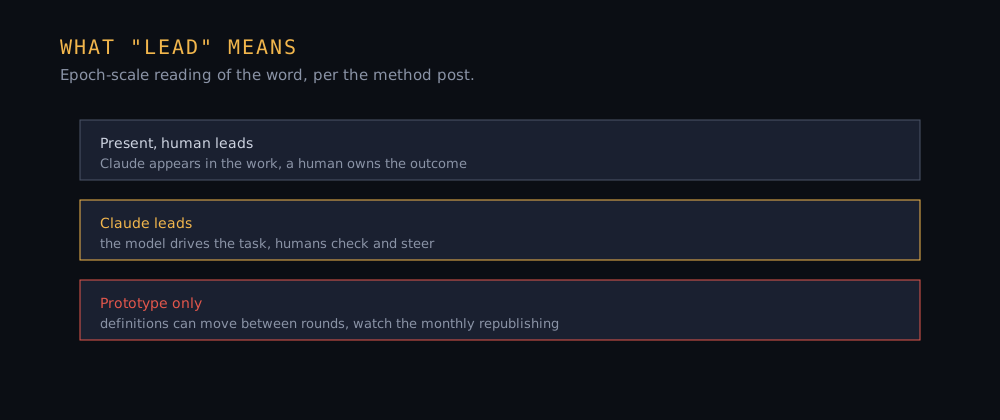
The unresolved edge: the index is a prototype, so the definition of "leading" a task can move between releases. Monthly republishing is the discipline to watch.
I get the sense the real change is a hiring signal: an AI safety team that publishes automation numbers plans for fewer junior hires.
Source
← Previous
OpenAI weighs a $1.2 trillion round while its IPO slips to 2027. Private markets will still price a trillion-dollar lab
Next →
Anthropic and Accenture pledge $2B for embedded evaluators. Regulators get inspectors inside the lab
The Morning Recap
We sift the day. You make the calls.
The decision on every story, in your inbox before your first call.