OpenAI weighs a $1.2 trillion round while its IPO slips to 2027. Private markets will still price a trillion-dollar lab
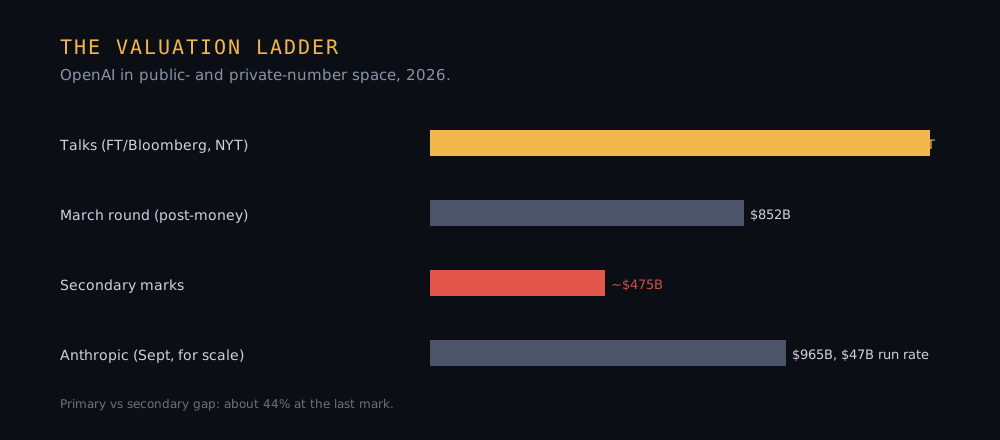
OpenAI is in early talks for a fresh private round at $1.2 trillion to $1.5 trillion, up from $852 billion in March. The reporting also says annualized revenue crossed $40 billion.
The decision it puts on your desk
Update your valuation comps for both frontier labs by September 30. If you buy from OpenAI, use the talks to negotiate: a company raising $1.2 trillion prices service commitments differently when every contract influences its IPO narrative. If you invest privately, price the secondary discount, roughly 44 percent at the last mark, as a real cost rather than a rounding error.
OpenAI's new funding talks landed on September 16, and the number in them doubles the company's March valuation.
"OpenAI Considers New Financing at a $1.5 Trillion Valuation. The funding round would double the value of the start-up behind ChatGPT and establish it as the world's most valuable private company," the New York Times reported, citing people familiar with the matter.
The Financial Times and Bloomberg put the working figure above $1.2 trillion. "OpenAI has recently held discussions with large investors about a fresh capital raise that would increase the ChatGPT maker's valuation to about $1.2 trillion before it goes public," Reuters said.
March's round closed at $852 billion post-money on $122 billion raised, so the new range implies roughly 41 percent growth in about five months.
Revenue backs part of it. OpenAI's annualized run rate crossed $40 billion last month, the Financial Times reported, and the company spent about $34 billion last year.
Investors floated the round partly as a way for employees to sell stock, CNBC reported.
Read the two number counters, not one
Follow the money, and read the spread rather than the headline.
Primary investors price the company on private terms worth roughly 30 to 35 times the run rate, and secondary trading marks imply much less. By September, secondary composites sat near $475 billion, a 44 percent discount to the March round, third-party analysis said.
That gap is the decision, not the valuation. Primary money buys a company that may not trade publicly for quarters, while secondary sellers discount for the lockup and the uncertainty of whether the multiple survives public scrutiny.
A $1.2 trillion round would widen the gap, the analysis noted.
The competing clock: Anthropic
Precedent sits with the closest rival.
Anthropic's valuation reached about $965 billion with a $47 billion run rate, both higher than OpenAI's, and Anthropic was preparing to market an IPO as early as mid-October, business reporting said. Nvidia has weighed a stake worth up to $10 billion in Anthropic.
Sam Altman set his own timing against an IPO.
The chief executive said OpenAI will not go public in 2026, citing safety concerns, the reporting said, pushing a public debut toward 2027. OpenAI confidentially filed IPO paperwork in June 2026.
A round at $1.2 trillion funds that choice: private money lets the lab delay public scrutiny without ordering its expansion around it.
The unresolved edge sits in size. No raise amount, price range, or closing date is confirmed, so both counters can flex until the round is set.
I get the sense the real competition is not for a valuation but for the definition of the significant trade before a listing. A buyer weighing both companies now gets one audited, one private.
Source
← Previous
Google opens Claude Opus 5 to every engineer. The largest model builder just gave official quota to a rival's model
Next →
Anthropic says Claude now leads 26% of its own AI research. The busiest frontier lab just audited itself
The Morning Recap
We sift the day. You make the calls.
The decision on every story, in your inbox before your first call.