Cisco released Antares, 350M and 1B parameter models that beat frontier LLMs at finding vulnerabilities in code
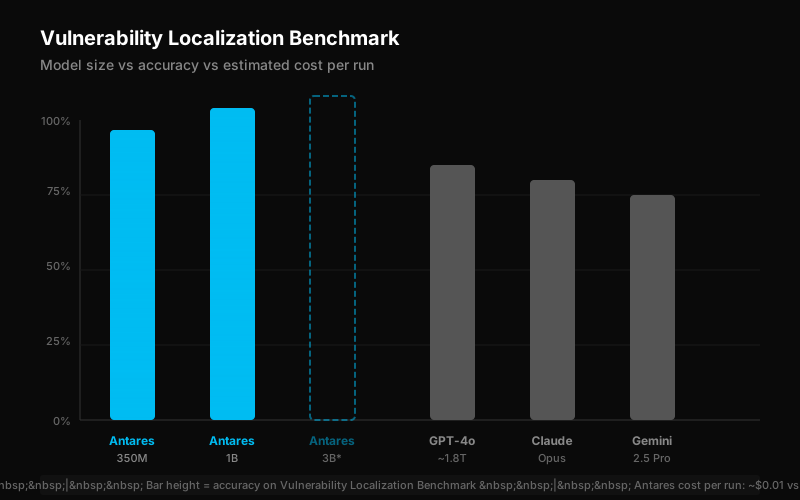
Cisco released Antares, a family of security small language models that outperform GPT-4o, Claude, and Gemini at vulnerability localization, pinpointing where known CWE-class bugs live in a codebase. The open-weight 350M and 1B models run locally on commodity hardware at roughly $0.01 per scan versus $3 to $15 for frontier API calls. Antares-3B is coming next.
The decision it puts on your desk
Benchmark your vulnerability scanning cost per commit by end of week. If you pay per-token for a frontier model to scan code, run the same repo through Antares-1B and compare precision at 1/300th the cost. For teams that avoid cloud-based code scanning for compliance reasons, Antares changes the math: it runs locally, on-prem, with no code leaving your environment. The open-weight license means you can fine-tune it on your own vulnerability taxonomy. For founders building dev-tool or security companies, Cisco's broader move (open-weight models plus Foundry Security Spec plus CodeGuard) signals a shift toward composable, auditable AI security infrastructure that can be integrated directly into CI/CD pipelines. The integration window is open.
Cisco released two open-weight security models Tuesday that beat GPT-4o, Claude, and Gemini at the $0.01 level on a task that normally costs $3 to $15 per scan.
The Antares family includes a 350M and a 1B parameter model purpose-built for vulnerability localization: pinpointing exactly which files in a repository contain a known CWE-class vulnerability. Both outperform frontier models on a new 500-task benchmark Cisco published alongside the release. Antares-3B is coming next.
A 350-million-parameter model beating roughly 1.8-trillion-parameter frontier systems at a specific security task is the kind of efficiency gap that changes deployment economics. Antares runs locally on commodity hardware.
What Antares actually does
Static analysis tools are rule-heavy and noisy, catching about 15% of real vulnerabilities while flooding analysts with thousands of false positives. General-purpose coding models can reason about code but are not optimized for security investigation. Antares sits in the middle.
It follows an iterative search pattern that mirrors how a human investigator works through a repository. The model starts from a vulnerability description, searches for relevant code patterns, reads candidate files, and incorporates new evidence.
When a path is unhelpful, Antares changes direction. It navigates a terminal, follows call paths, compares candidate locations, and narrows toward the files most likely to contain the vulnerability.
The output is a ranked list of source files likely containing a relevant vulnerability, plus the terminal exploration trace that led there. Security teams can review the reasoning, not just the result.
Antares is not a replacement for the broader application security toolchain. Dependency scanning, secret detection, dynamic testing, infrastructure checks, and threat modeling still belong in the pipeline. But Antares addresses a specific bottleneck: the hours analysts spend hunting through unfamiliar codebases to localize a vulnerability they already know exists.
Why small models win here
Vulnerability localization is expensive for three reasons. The codebases are large, often millions of lines. The security signals are noisy since CWE descriptions map imprecisely to actual code patterns.
The relevant evidence is rarely in one obvious file. Analysts follow trails across call sites, interfaces, and configuration.
Frontier models are overqualified. They bring general reasoning, world knowledge, and broad code generation capability to a task that needs focused pattern recognition and systematic repository exploration. You pay for billions of parameters you do not use.
Antares was trained specifically for this workflow. Cisco's Foundation AI research showed that compact models can learn to search, reflect, revise their strategy, and backtrack when a path is unproductive. The retrieval behavior is learned, not a function of scale.
This matters for deployment. Organizations with strict data residency requirements cannot send proprietary codebases to a cloud-hosted frontier API.
Antares runs on-prem. No code leaves the environment. Universities, public-sector teams, defense contractors, and healthcare organizations can now deploy vulnerability localization without breaking compliance.
The benchmark problem Cisco had to solve
Building Antares forced Cisco to confront a measurement problem. General coding benchmarks like SWE-Bench measure whether a model can find code relevant to a software issue. They do not measure whether a model can localize vulnerable files from CWE-style security descriptions or advisory text.
Cisco published the Vulnerability Localization Benchmark: 500 tasks requiring models to simultaneously navigate unfamiliar codebases and recognize vulnerability patterns tied to specific CWE categories. The closest prior work is CodeScout, which evaluates terminal-based code-search agents, but CodeScout targets software engineering tasks, not security localization.
The benchmark is open-access and hosted at the Cisco Foundation AI page. Reza Shokri of NUS and Amin Saberi of Stanford both endorsed the release.
Shokri called small models compelling for real-time code gating. Saberi framed Antares as solving the access problem: "Security can't be a luxury good, yet advanced AI-based detection has largely belonged to organizations with frontier-scale budgets."
The broader Cisco security play
Antares is not a standalone release. It is the third piece of Cisco's AI security infrastructure stack.
Foundry Security Spec, released earlier, is a model-agnostic blueprint for building agentic security evaluation systems with defined roles, guardrails, and reviewable outputs. It is the harness around agentic security work.
CodeGuard, released recently, is a corpus of secure-by-default rules and skills that guide AI coding agents toward safer software development. It is the prevention layer.
Antares is the detection layer: compact deployable models that narrow vulnerability intelligence into source files human reviewers can inspect.
The three are designed to compose. The spec defines the evaluation harness. CodeGuard prevents errors.
Antares finds what slips through.
For founders building developer tools or security products, this stack model is worth paying attention to. Cisco is not selling a monolithic security AI platform. It is releasing composable, open-weight components that can be integrated directly into CI/CD pipelines, code review workflows, and internal security tooling.
What to expect next
Antares-3B is flagged as coming soon in the benchmark. The 3B model would extend the capability range while presumably staying within the local-inference envelope. The Hugging Face collection also includes tooling: a CLI that packages the model into a practical scanning workflow with commands for navigating repos, inspecting findings, and integrating into automated pipelines.
The models are available now on Hugging Face under the fdtn-ai organization. The technical paper and benchmark are available at the Cisco Foundation AI site.
For teams that avoid cloud-based code scanning for compliance reasons, Antares changes the math: it runs locally, on-prem, with no code leaving your environment.
The open-weight license means you can fine-tune it on your own vulnerability taxonomy. For founders building dev-tool or security companies, Cisco's broader move (open-weight models plus Foundry Security Spec plus CodeGuard) signals a shift toward composable, auditable AI security infrastructure that can be integrated directly into CI/CD pipelines. The integration window is open.
Source
← Previous
Inkling debuts at #9 open-model in Agent Arena - the best US open model for long-running agentic tasks
Next →
AMD invests $5 billion in Anthropic, signs multi-billion-dollar chip deal to challenge Nvidia's AI training monopoly
The Morning Recap
We sift the day. You make the calls.
The decision on every story, in your inbox before your first call.