Inkling debuts at #9 open-model in Agent Arena - the best US open model for long-running agentic tasks
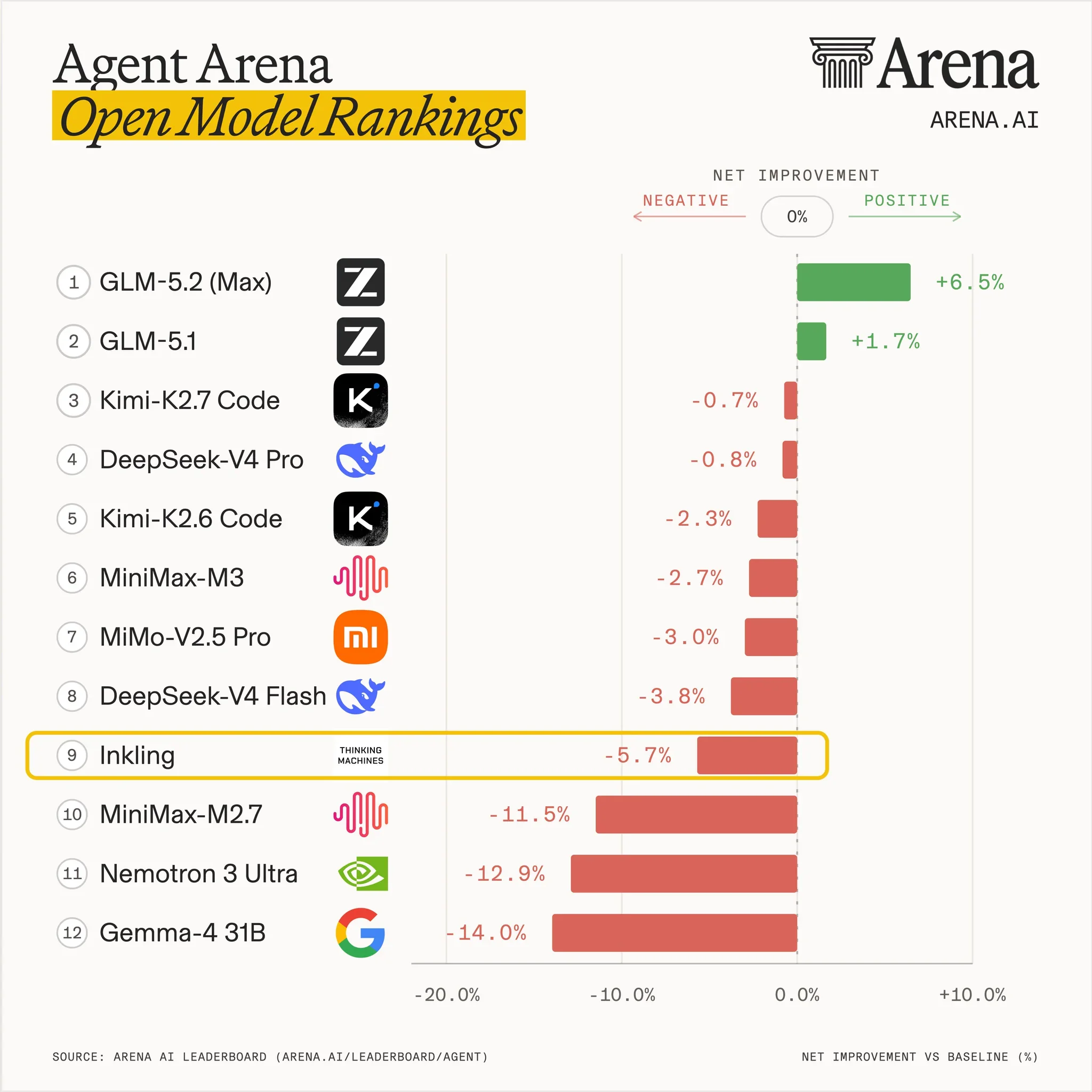
Thinking Machines Lab's first model Inkling entered the Agent Arena at #9 among open-weight models and #30 overall, making it the highest-ranked US open model for long-running agentic tasks. It is the only US model in the top 10 open-model field. Strengths are error recovery and task resilience. Weak spots are user sentiment, steerability, and confirmed task completion.
The decision it puts on your desk
If you are evaluating open-weight models for agentic workflows that involve sustained terminal use, Inkling's error recovery profile makes it worth benchmarking, but allocate budget for fine-tuning the steerability gap. The model's strengths are in the parts of the stack that are hard to fix. Its weaknesses are in the parts fine-tuning can address. For organisations with ML talent and a specific use case, this is the right trade-off. For teams that need an out-of-the-box agent that follows instructions reliably, wait. Run your own eval on your own task distribution, not on Arena's aggregate, and measure steerability and completion rate specifically. If Kimi K3 weights drop on July 27 as scheduled, re-benchmark everything against K3 before committing to any open-weight stack.
Thinking Machines Lab released Inkling - its first model - on July 15, 2026. A week later, it entered the Agent Arena at #9 among open-weight models and #30 overall with a score of +9.6%. This makes it the best open model from the US for agentic, long-running tasks, and the only US model in the top 10 open-model field.
The ranking is from Arena, a platform that measures models on millions of real-world, long-horizon agentic tasks. Models get web search, filesystem, and terminal tools to complete complex workflows: writing code, creating slide decks, researching the web, building apps, and analysing documents. It is the most comprehensive independent eval of how models perform as agents - not in single-turn benchmarks, but in sustained, multi-step work that fails or succeeds on the model's ability to recover from its own mistakes.
If Kimi K3's weights are released on schedule by July 27, it will become the #1 open-weight model, shifting all others down by one rank. But for this week, Inkling holds the position as the top US open model in agentic performance.
Who is Thinking Machines Lab
Thinking Machines Lab was founded in February 2025 by Mira Murati, the former CTO of OpenAI. Murati left OpenAI in September 2024 after six and a half years, including two as CTO during the period that produced GPT-4, GPT-4V, and the initial agent platform. She was also briefly interim CEO during the November 2023 board crisis.
The company is structured as a public benefit corporation. Its mission, stated in a blog post released alongside Inkling, is to build AI that "extends human will and judgment" rather than replaces or automates it. The company has grown to roughly 200 people.
The central bet is that AI organisations can adapt for themselves will outperform the one-size-fits-all models the biggest labs sell. Inkling is designed as a foundation for customisation: the model weights are open (Apache 2.0 license), and fine-tuning is available through Tinker, the company's model-customisation platform. The model is not being sold as a finished product. It is being sold as a starting point for organisations to shape into their own tool.
The company trained Inkling from scratch on NVIDIA GB300 NVL72 systems, using 45 trillion tokens of text, images, audio, and video. The model is a Mixture-of-Experts transformer with 975 billion total parameters, 41 billion active, and a context window of up to 1 million tokens. A smaller companion model, Inkling-Small (12B active), was also previewed.
What Inkling does well in the Arena
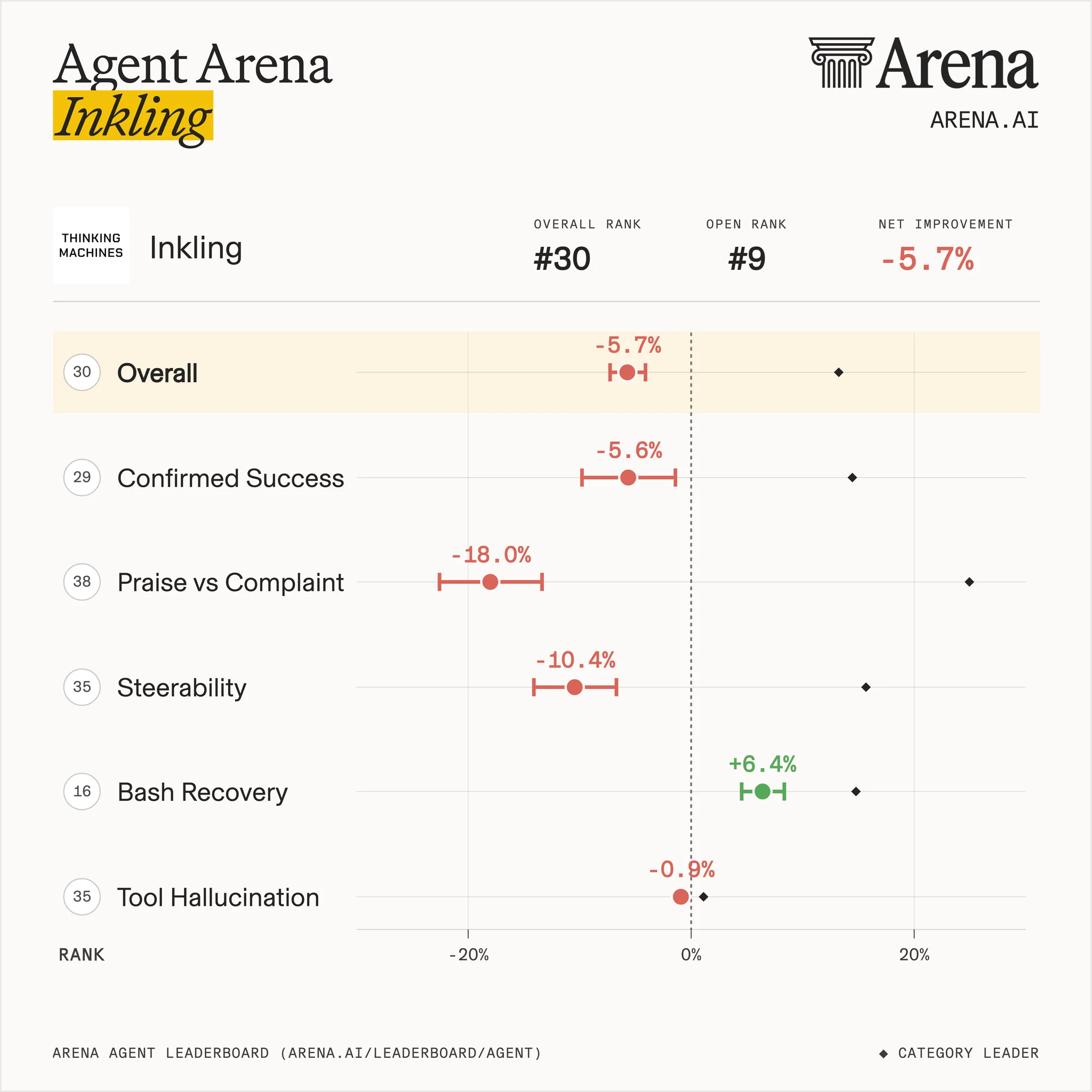
The Agent Arena breaks performance into five dimensions, and Inkling's profile is uneven in a revealing way.
Bash Recovery (#18, +6.4%) is the standout. Inkling recovers from command-line errors better than its overall ranking would suggest. In practical terms, this means when the model runs a terminal command that fails - a wrong flag, a missing dependency, a permission error - it reads the error output and tries a corrected approach rather than spinning or abandoning the task. For long-running agentic workflows, error recovery is more predictive of real-world usefulness than raw coding skill, because every non-trivial task hits unexpected errors.
Task Success (#29, -5.6%) is below average. The model does not confirm task completion as reliably as its competitors. Combined with the Bash Recovery strength, the picture is of a model that keeps trying when things go wrong but does not always finish.
Tool Hallucination (#35, -0.9%) is slightly negative. Inkling calls tools that do not exist at a rate marginally above the field. The score is not catastrophic, but it is below the midpoint for its tier.
Steerability (#35, -10.4%) is the largest negative signal. Users report that Inkling does not take feedback well: when corrected mid-task, it is less likely to adjust its approach than similarly-ranked models. For an agentic model meant to work in sustained collaboration, steerability is a critical dimension. A model that recovers from its own errors but does not recover from user corrections is useful in narrow circumstances but not as a collaborative partner.
User Sentiment (#38, -18.0%) is the bottom of the card. People complain more than they praise Inkling. The complaint-to-praise skew is the worst among the five dimensions and worse than its overall #30 ranking would predict. This is the dimension that most directly captures the subjective experience of working with the model, and the signal is clear: Inkling frustrates users at a rate above its competence level.
The picture this paints
Inkling's Arena card tells a specific story. The model is competent at the mechanical parts of agentic work: it runs commands, reads error output, and tries again. But it is weaker at the collaborative parts: taking direction, staying on task through completion, and leaving the user feeling satisfied with the interaction.
For a model positioned as a base for fine-tuning and customisation, this profile is not necessarily a problem. The things Inkling is bad at - steerability, user-facing polish, task completion patching - are precisely the things fine-tuning can address. The things Inkling is good at - error recovery, underlying agentic competence - are the things that are harder to add post-hoc. A base model that recovers from bash errors well and can be fine-tuned for steerability is a stronger starting point for an enterprise workflow than a polished model that collapses when it hits a missing dependency.
The question is whether organisations will do that work. Fine-tuning requires machine learning talent, and the steerability gap is large enough that fixing it is not a one-day job. Thinking Machines is betting that organisations who care enough about owning their model to download and host it will also care enough to fine-tune it. The Arena data suggests the fine-tuning is not optional.
The open-model US gap
Inkling being the only US model in the top 10 open-weight field is worth sitting with. The open-weight leaderboard is dominated by Chinese labs: Moonshot (Kimi K3, pending weights July 27), DeepSeek, and Zhipu (GLM) all rank ahead of the best US open model. NVIDIA's Nemotron is the next-closest US contender.
This is not an accident of timing. The major US labs - OpenAI, Anthropic, Google - have built their businesses on closed, API-gated access to frontier models. None of them have released a competitive open-weight model. The US open-model field is left to startups and infrastructure companies.
Thinking Machines Lab is the first US startup to enter the open-weight arena with a model that ranks in the top 10, trained from scratch, at frontier scale. The company explicitly states Inkling is "not the strongest overall model available today, open or closed." But being the best US open model for agentic tasks on day one of the company's first release is a meaningful starting position.
Source
← Previous
David Vélez and Robin Vince join OpenAI's boards, adding financial services and governance heft
Next →
Cisco released Antares, 350M and 1B parameter models that beat frontier LLMs at finding vulnerabilities in code
The Morning Recap
We sift the day. You make the calls.
The decision on every story, in your inbox before your first call.