Anthropic doubles Fable's science scores and cuts cache reads by 75%. Long-horizon coders should re-baseline
Anthropic launched Claude Fable 5.1 and Mythos 5.1 on September 1. The science benchmark doubles and token-billed work costs about 25 percent less.
The decision it puts on your desk
Re-run your cost baseline on Fable 5.1 this week, September 1. For workloads billed by token, cache-heavy agent runs now price at $0.25 per million cached tokens, about 25 percent cheaper. Pick your three most expensive workflows, benchmark each by September 12, and switch billing only where the cache share clears half the bill.
Anthropic shipped Claude Fable 5.1 on Monday, one day into a month that now looks like a release gauntlet.
Fable 5.1 and Mythos 5.1 are the same model, and the split is about controls rather than capability. Fable 5.1 is generally available. Mythos 5.1, with looser safeguards, reaches only trusted cyberdefenders and life-science researchers.
The capability jump lands on benchmarks, and the money lands on cache reads (re-reading inputs the system has already processed).
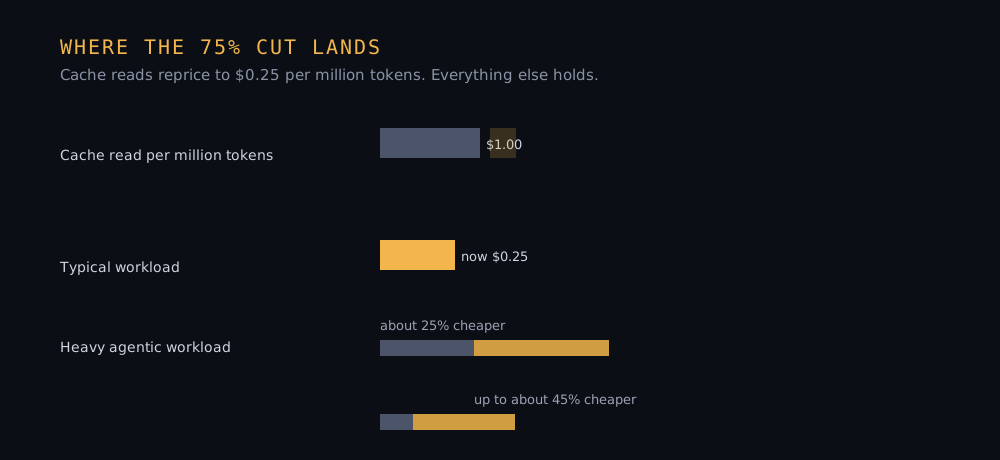
Anthropic cut cache read pricing by 75 percent, to $0.25 per million tokens. Typical token-billed workloads drop about 25 percent in cost, the company said, and highly agentic workloads could drop around 45 percent.
"Today Claude Fable 5.1 costs an estimated 25% less than Fable 5 for typical workloads," wherever usage bills by token, Anthropic said in its release.
Base prices stay at $10 per million input tokens and $50 per million output. The discount lives entirely in the cached layer that long-running agents lean on.
What the numbers say, and what they hide
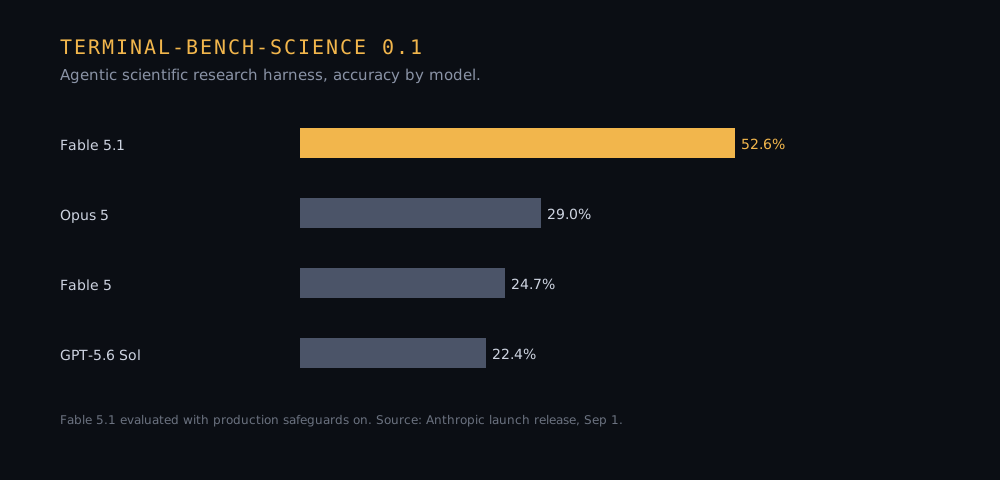
On agentic scientific research (Terminal-Bench-Science 0.1), Fable 5.1 scored 52.6 percent against 24.7 percent for Fable 5. Claude Opus 5 scored 29.0, and OpenAI's GPT-5.6 Sol scored 22.4 on the same setup.
On real terminal coding (Terminal-Bench 4.0), the self-published number moves from 42.0 to 55.8, with Mythos 5.1 at 60.9 before its heavier safeguard interventions.
Independent context supports the gap. Artificial Analysis tracks Fable 5.1 at 65.7 on its intelligence index, three points ahead of the next closest family.
An early-access user put the long-horizon case in writing.
"In internal benchmarks, Claude Fable 5.1 solves more of our coding problems than Fable 5 or Opus 5, and achieves state of the art on trading intuition," said Craig Falls, the head of quantitative research at Jane Street Capital.
"While prior models became hard to follow the longer they worked, Fable 5.1 remains readable over long, multi-step tasks," Falls said.
Millennium, the investment firm, reported in Anthropic's release that Fable 5.1 found the cause of a rare crash none of its engineers could explain after several years.
Under the surface, one condition matters more. On tasks where safeguards intervened, Anthropic scored Fable 5.1 a zero, and cyber or biology work got handed down to Opus models within the run. The new safeguards intervene less, 60 percent fewer times per coding session, but they still redirect whole lanes to different models.
How rivals are forced to respond
OpenAI's counterpunch arrived two days later: GPT-6 Astra launched September 3 in response to this scorecard, at higher benchmark claims that independent evaluators then partly deflated.
Google's Gemini 4 Argon opened a gated release on September 30 with a patch on a different axis, a one-million-token output limit.
For knowledge work, Anthropic pushed a second lock-in. Enterprise Frontier Safeguards (EFS) stores customer data in customer-controlled cloud infrastructure rather than Anthropic's own, so buyers keep zero data retention (nothing of yours stays with Anthropic) while safeguards still run.
EFS rolls out to enterprises "later this fall," the release said, so audit specifics now. Safeguards got looser over biology queries too: benign biology questions now trip them 85 percent less often.
Anthropic also hardened against distillation, the practice of rebuilding one model from another model's outputs, done industrially with fake accounts. New API accounts can no longer edit Claude's prior turns while keeping its reasoning transcript, a known extraction trick, off the table.
The unresolved edge sits in token prices anyway. $10 and $50 per million are expensive base rates, so every discount hinges on how much of each job actually hits cache.
I get the sense long-context agent builders will reprice first and everyone else will wait.
Source
← Previous
Anthropic books $35B from Lambda in Texas. The rent underneath is $1.86M per megawatt
Next →
The Justice Department picks a side in AI copyright: training is fair use, piracy is not
The Morning Recap
We sift the day. You make the calls.
The decision on every story, in your inbox before your first call.