Google opens Gemini 4 Argon to everyone. The fall's most-watched gated release ends its Fairwind gate
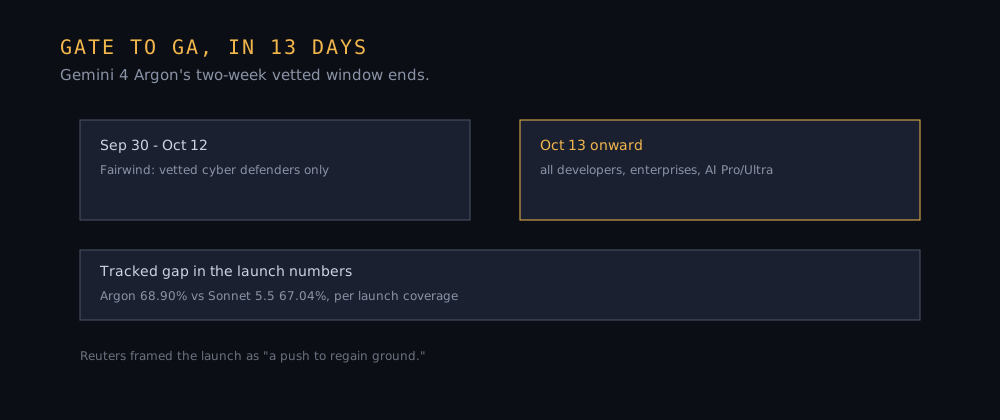
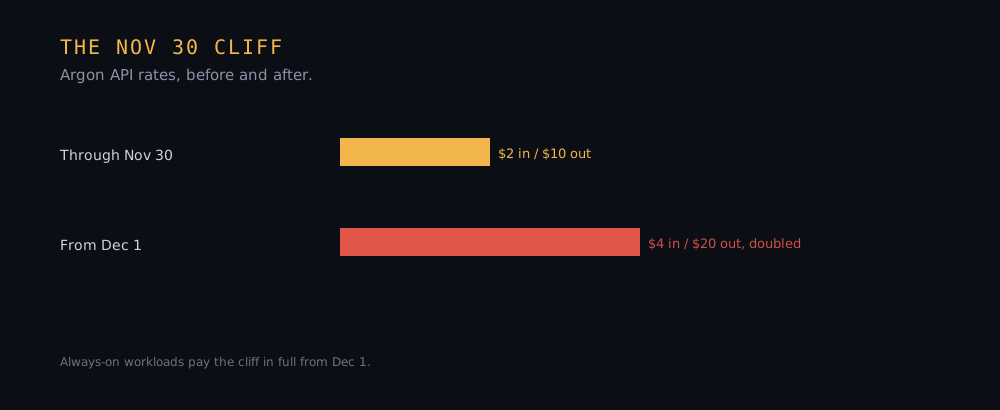
Google opened Gemini 4 Argon broadly on October 13, ending the September 30 gate that held it to vetted cyber defenders. Intro pricing of $2 and $10 per million tokens runs through November 30.
The decision it puts on your desk
Benchmark Argon against your production scorer this week, not the launch tables, because your two-week window closes November 30 on the $2 and $10 rates. Price the Nov 30 doubling into your budget before you commit, and re-run any deep-report or codebase-scale workloads that were gated by the 64,000-token cap.
Google's September launch moved to general availability Tuesday, and the pricing clock started at opening.
Argon is open to all developers, enterprises, and Google AI Pro and Ultra subscribers, with API pricing at $2 per million input and $10 per million output through November 30, then rising to $4 and $20.
The one million token output limit carries through unchanged, per the announcement.
The September gate held Argon to vetted cyber defenders first, its Fairwind path, and that vetted tier ran two weeks as the launch window.
How the launch was read
Reuters's own framing gives the competitive read: the launch is a "push to regain ground on OpenAI and Anthropic," from a Google line that has been slower out of the gate.
On one tracked benchmark, the gap shows: third-party tracking puts Argon at 68.90 percent against Claude Sonnet 5.5 at 67.04, per the launch coverage.
Reuters also cited context beyond benchmarks, including a DeepMind leadership change reported earlier, in framing the launch as Google's push, per the wire copy.
Under the hood, access opens where it matters. Scope: the Fairwind gate limited the launch audience, so a broad opening means every benchmark team can now run the model against any task and produce numbers without a sign-off.
Your own scoring matters more to buyers than the launch tables. The migration cost mostly centers on pricing after November 30, since a doubled rate turns any always-on workload into a real bill.
I get the sense the November 30 price cliff becomes the real decision line for production models.
The unresolved edge is the numbers beyond the two coverage quotes. Every launch-backed benchmark carries the same claim risk as any launch, so rerun the scores on your own tasks.
Source
← Previous
Meta ships Muse Wonder, its first frontier-class pair. The best version stays behind a subscription
Next →
Modal raises $750M at $15.75B after crossing $1B in run rate. Serverless GPUs are the layer growing fastest
The Morning Recap
We sift the day. You make the calls.
The decision on every story, in your inbox before your first call.