The Justice Department picks a side in AI copyright: training is fair use, piracy is not
The Justice Department filed a 20-page statement of interest backing OpenAI in the New York Times copyright case. Training on copyrighted text is fair use, the government said, and piracy is a separate question.
The decision it puts on your desk
Update your data acquisition policy before Judge Stein rules, not after. Document where every training file came from by October 1, because fair training plus pirated acquisition still produced a $1.5 billion payment in Bartz. If you sell content, close voluntary licences now: footnote 13 leaves them blessed, and a court win later raises your price.
The United States government intervened in AI copyright law on September 1, for the first time.
The Justice Department filed a 20-page statement of interest in the consolidated OpenAI copyright litigation in the Southern District of New York, the docket that includes The New York Times' suit against OpenAI and Microsoft.
A 28 section 517 statement of interest lets the government attend to its own interests in any pending federal case without asking the court's leave. The filing carries three Justice Department signatories.
They are associate attorney general Stanley E. Woodward Jr., assistant attorney general Brett Shumate, and senior counsel Michael Weisbuch.
The core claim, in the government's words: training a large language model (LLM, a system that predicts text) on copyrighted works is fair use.
"Rules of law that make it significantly more difficult to develop a robust AI industry in the United States therefore threaten national security," the filing said, quoting a government accountability report on military uses of AI.
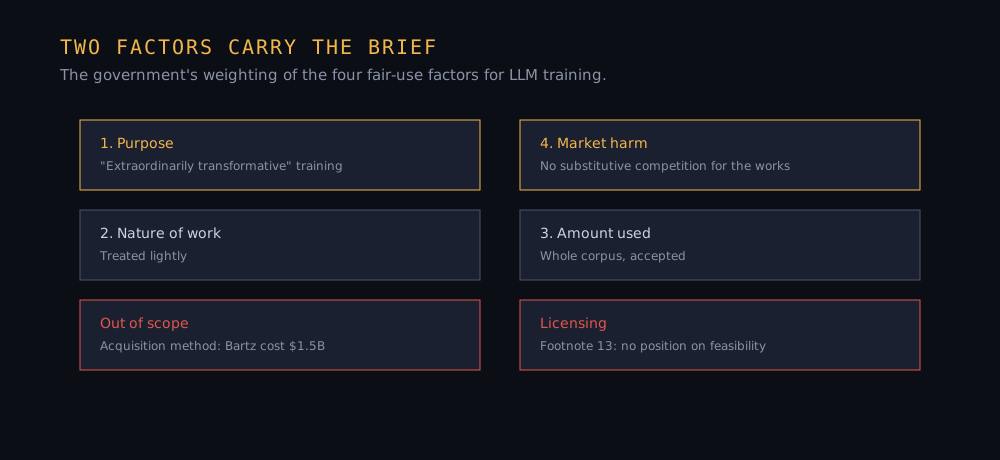
The argument rests on two of the four fair-use factors.
Purpose: the department calls training "extraordinarily transformative," a phrase it borrows from the two 2025 decisions that favored the industry. Copies serve to convert text into numeric patterns, it argues, rather than to republish articles.
Market harm: the relevant test is whether training creates "significant substitutive competition" for the works themselves, the government said, drawing on the 2015 ruling in Authors Guild v. Google. ChatGPT does not hand readers the Times' articles, so the substitution never happens.
The citations tell you who the brief is for
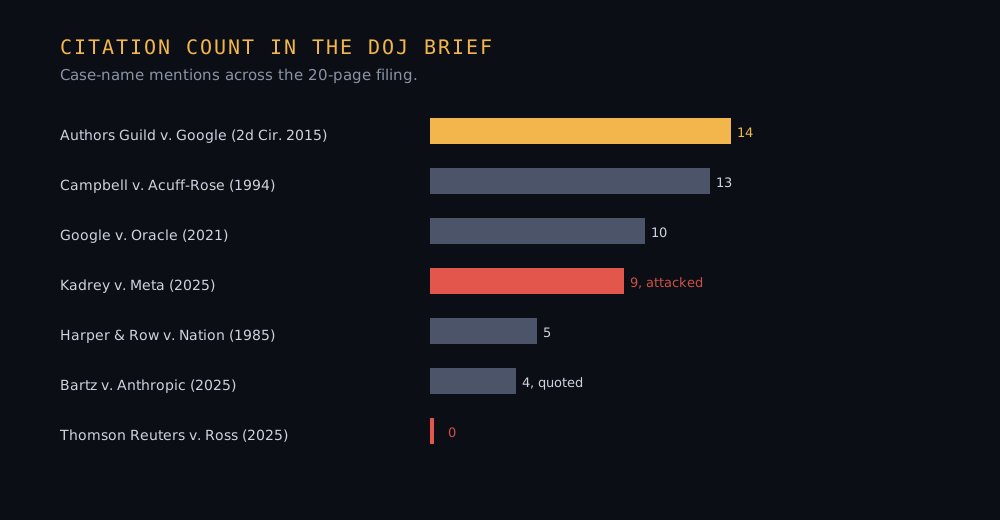
Stanford Tech Review counted every case mention in the filing.
Authors Guild v. Google gets 14 mentions, and it is binding precedent in Judge Sidney Stein's own circuit courtroom. Campbell v. Acuff-Rose gets 13. The 2021 Google v. Oracle ruling gets 10.
The omissions are the strategy.
Thomson Reuters v. Ross Intelligence, the February 2025 Delaware ruling that remains the only US decision to refuse fair use for AI training, gets zero mentions.
Kadrey v. Meta, a 2025 case Meta won, appears nine times almost entirely to attack its author's market-dilution idea. The brief calls that reasoning "contrary dicta" that "misapplies copyright principles to LLM training."
Interesting detail for your licensing plan: footnote 13 takes no position on whether a licensing regime is feasible, and the brief blesses the voluntary deals publishers signed for real-time and paywalled access. Licensing would also hurt competition, the government argued, because only the largest companies could afford the fees, which would act "primarily as large subsidies for old mainstream media companies."
The response came within a day
The Times took the opposite view.
"The administration is siding with a handful of trillion-dollar AI companies at the expense of the countless American creators whose work they stole," a Times spokesperson said in a statement reported by The Hollywood Reporter.
"AI companies simply need to pay fairly for the content that makes their products possible, as copyright law requires," the statement said, the outlet reported.
Two constraints keep this from being a green light, and both are already proven costs.
First: a statement of interest is advocacy, not authority. Judge Stein can ignore the filing, and whether the first judge to rule agrees is the open question.
Second: Bartz v. Anthropic proved the acquisition side can still cost real money. Anthropic paid $1.5 billion over pirated libraries even while its training method stood legal. The DOJ's blessing of training runs far short of a blessing for piracy.
The complaint had been amended eleven days before the government filed, the docket shows.
I get the sense the brief now functions as a national market signal: an acquirer of data can guess how the federal scale reads.
Source
← Previous
Anthropic doubles Fable's science scores and cuts cache reads by 75%. Long-horizon coders should re-baseline
Next →
OpenAI launches GPT-6 Astra: a 99.9% ARC-AGI-3 score, a Critical cyber rating, and one guardrail to watch
The Morning Recap
We sift the day. You make the calls.
The decision on every story, in your inbox before your first call.