DHS orders federal agencies to remove DeepSeek. The government market just split from the open ecosystem
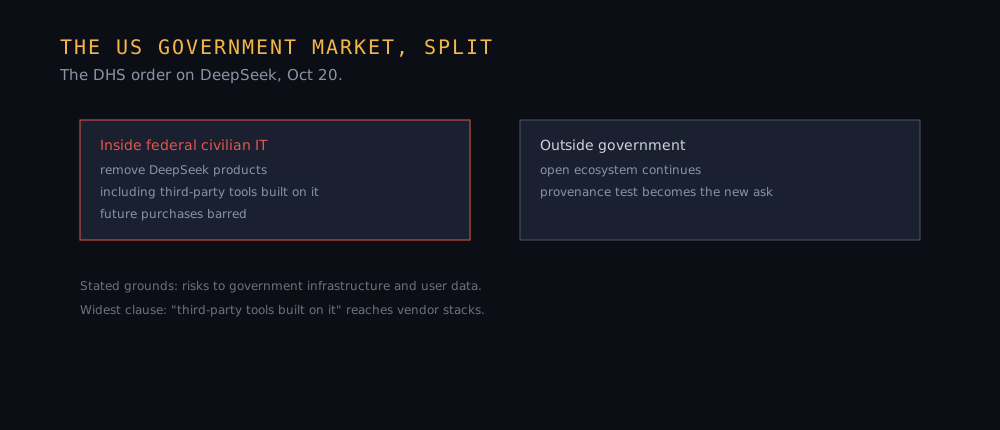
The Department of Homeland Security published a Federal Register order requiring all federal civilian agencies to remove DeepSeek products from their IT systems, including third-party tools built on it, and barring future purchases.
The decision it puts on your desk
Run a provenance audit on every model in your stack by October 31, whatever your market. List where every weight came from upstream. If any service chain touches DeepSeek and you sell to government agencies, plan the rewrite before the notice's removal date. If you sit on the procurement side, ask each vendor for a one-page provenance statement before renewal closes.
A Department of Homeland Security (DHS) order put DeepSeek out of the federal civilian market Monday, and the third-party clause is the wide part.
The notice in the Federal Register (the government's formal publication vehicle) requires removal of DeepSeek products from federal civilian agencies' IT systems "including third-party tools built on it," and bars future purchases. CNBC summarized the stated grounds: "citing risks to government infrastructure and user data."
The third-party clause matters more than the ban itself. Any federal tool whose pipeline touches DeepSeek, directly or through a vendor's stack, now carries a removal obligation, and every enterprise product that runs open Chinese models needed the same audit the day this published.
What the order prices
Follow the compliance cost to three layers.
Direct spend: DeepSeek-priced inference inside government work has to move. That is the cheap part: the replacement market carries comparable capability, and export rules had already crowded DeepSeek out of most US enterprise stacks.
Stack visibility: the second layer of cost is the audit. Every vendor selling into government now has to prove where its model came from, and that proof work runs through the procurement cycle.
Policy precedent: the order writes a federal standard for model provenance, a from-whom-and-where test other buyers copy, because the US government functions as the reference buyer.
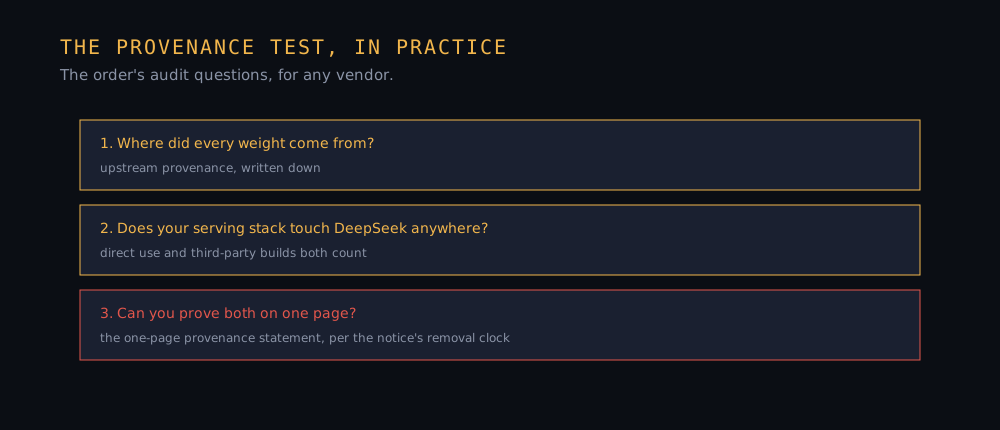
The unresolved edge is enforcement speed. Removal runs on the notice's own schedule rather than a review cycle, so agencies move when the calendar says.
I get the sense the order reads as a template outside government as well. The provenance question now names Chinese open labs as a security tier, and private buyers copy reference-buyer behavior.
Source
← Previous
OpenAI races to lock in a $30B raise above $1.4T, ahead of Anthropic's IPO
Next →
OpenAI puts GPT-6 on Google Cloud. The only cloud hosting Gemini, Claude, and GPT together is now Google's
The Morning Recap
We sift the day. You make the calls.
The decision on every story, in your inbox before your first call.