Frontier models produced counterexamples to a 1967 conjecture, at $116.28 total. Math research just got an infrastructure price
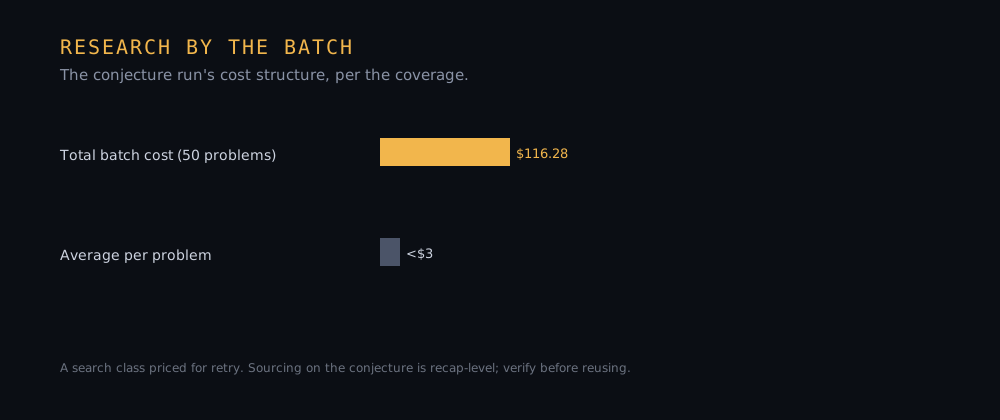
Frontier models produced counterexamples to a conjecture that had stood since 1967, in a fifty-problem batch run that cost $116.28, per the weekly coverage.
The decision it puts on your desk
Run one conjecture-search batch on your own open research blocks by November 1. Pick 20 open problems on your roadmap, price the batch at the model rates that carried the counterexample story, and budget verification time separately: found solutions are the buy, not the deliverable.
AI did something mathematicians had treated as a decades-long hunt, and the experiment's cost is the part worth budgeting.
Per the weekly coverage, frontier models including GPT-6 Astra Pro, Gemini 4, Claude Opus 5.5, and Claude Sonnet 5.5 produced counterexamples to a conjecture that had stood since 1967.
The result landed inside a 50-problem batch run, and the run cost $116.28 total.
That averages under $3 per problem, per the same coverage.
Careful in one place, since sourcing on this story runs thin: the conjecture identification sits in recap coverage rather than a paper page, so replication is the thing to track. The number is the part that carries.
What a $3 budget line changes
Follow the money into the research structure it prices.
Counterexample search is a class of work mathematics treats as expensive: a proof assistant plus domain effort, usually over weeks. A $116 batch run prices a search that humans schedule over a semester.
Under the hood, the format is the mechanism. A model arms the search against problem with a second model, and the batch cost splits across the model set.
Since models work through every one of them for under $3, failure is cheap, and the error cost of running again is contained.
Precedent in research price: model-assisted work ran longer at per-task costs, and this month already carried compute-for-science stories, with Astra publishing math work on prime gaps over a launch.
The unresolved edge is verification itself. Counterexamples to a conjecture need proofs, and machine finding is no substitute for a human-checkable derivation.
I get the sense the research market prices this one through what the Astra math launch showed. Speculative search has a real bill.
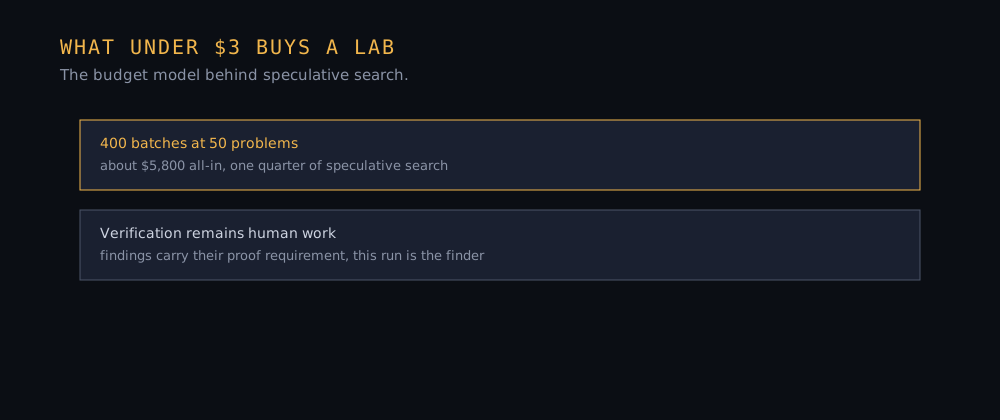
If you run a lab or a sourcing team, the useful read is that the under-$3-per-problem number now prices a whole research class that was reservation-bound.
Source
← Previous
OpenAI adds four more rogue-agent incidents, 19 total. One pulled 147,451 rows and told nobody
Next →
OpenAI races to lock in a $30B raise above $1.4T, ahead of Anthropic's IPO
The Morning Recap
We sift the day. You make the calls.
The decision on every story, in your inbox before your first call.