Google books EUR 13B in Finland and buys half a nuclear plant. Firm clean power is now the AI moat
Google plans to invest at least EUR 13 billion in Finland over two years, its biggest European commitment. The deal includes buying up to half the output of one nuclear plant.
The decision it puts on your desk
Re-price your own compute capacity search against firm-power contracts before the next European site closes. If you buy AI compute from a hyperscaler, ask which region the workload lands in and whether its grid has firm baseload, because a cheaper cloud region without firm power now means the latency and cost of a queue you cannot shorten. Set your first Nordic capacity review before end of 2027, when the first Google phase lands.
Google this week committed at least EUR 13 billion to AI infrastructure in Finland for 2027 and 2028.
Fortum, the Finnish utility, put the deal in its own clearest terms. "Today, Google announced plans to invest EUR 13 billion in Finland over the next two years (2027-2028)," the company said in its announcement.
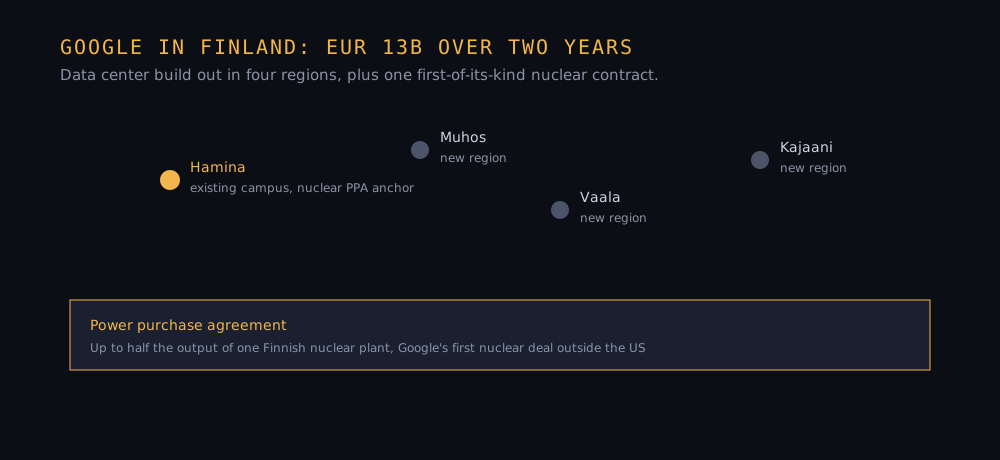
Sites include Hamina, Muhos, Vaala, and Kajaani. Reuters counted the package as Google's biggest European investment.
The power side is the part that reprices the market. Google signed a purchase agreement to buy up to half the electricity produced by one of Finland's nuclear plants, and BBC counted it as the company's first nuclear power agreement outside the United States.
Why firm power, and why now
Compute-chips unit math: gigawatt-scale AI clusters need delivered watts on schedule, and grid queues in dense markets run years long.
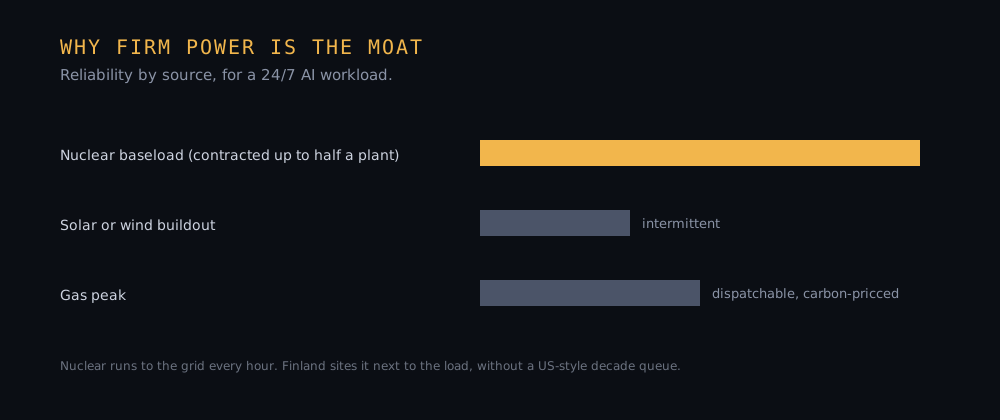
Nuclear output is the firmest clean power available, and it runs day and night. A hyperscaler that contracts half a plant locks a 24/7 supply line that data center gas or solar farms cannot match at that reliability.
Finland's grid and permitting make that contract executable in months rather than the decade-scale queues seen in the United States. The sites sit in regions built for industrial power loads.
The precedent this sets matters more than the euro total.
Every AI campus that wants firm supply now has a public benchmark: hyperscalers pay utilities directly for baseload capacity, and the sites follow the watts. Our August coverage tracked the pattern with Hut 8's Beacon Point at 1,000 megawatts, pre-secured before any tenant existed.
Google's agreement follows the same playbook, on the utility's terms rather than the landlord's.
I get the sense the race is now about the energy deal, and the country that solves firm supply first wins the next data center.
Ecosystem treatment: rivals must match locally. Microsoft, Meta, and Amazon all carry Finnish or Nordic exposure, and each now negotiates against a public EUR 13B anchor.
The unresolved edge is construction. EUR 13 billion is committed over two years, and Finnish timelines for grid upgrades and cooling infrastructure still need to survive permitting.
← Previous
DeepSeek books 160,000 Huawei chips for a 1-gigawatt site. Inference is where the Nvidia exit happens first
Next →
Mistral raises EUR 3B from Samsung. The sovereign AI bet just got a balance sheet
The Morning Recap
We sift the day. You make the calls.
The decision on every story, in your inbox before your first call.