Google flies a TPU prototype to orbit. The prototype test starts this week, and one year of data is the prize
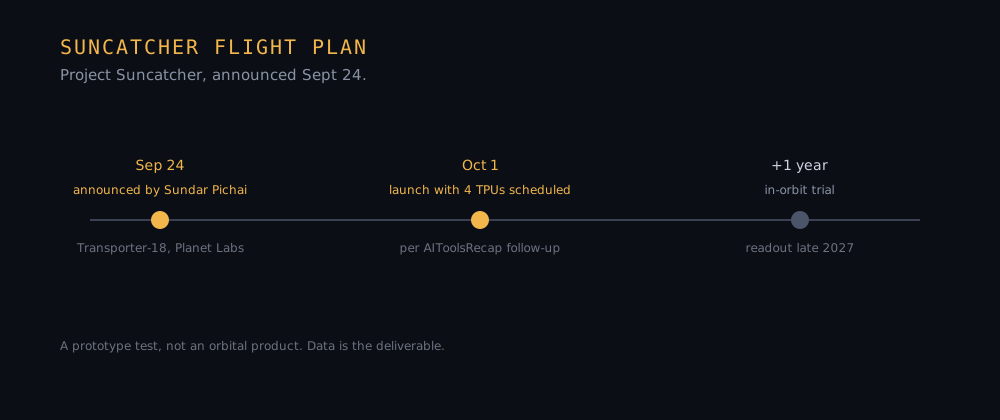
Google's Project Suncatcher will fly a TPU prototype to orbit on SpaceX's Transporter-18 mission with Planet Labs, announced Thursday, with four TPUs scheduled for October 1 under a year-long trial.
The decision it puts on your desk
Watch the actual launch window for your own AI hardware plans, not just the announcement cycle. If your team builds any satellite-linked compute, request the radiation and thermal readout from Suncatcher's one-year data before you commit hardware. If you price compute capacity, treat orbital compute as a research product for now, with no procurement decision before that data lands in late 2027.
Google confirmed its hardware is riding a rocket.
"Sundar Pichai said Google's Project Suncatcher will fly a TPU prototype on SpaceX's Transporter-18 mission with Planet Labs to test AI chips in orbit," trade reporting said.
The announcement came Thursday, and follow-up coverage set the schedule. "Google Project Suncatcher is scheduled to put four TPUs into orbit on a SpaceX launch on 1 October for a year-long trial," AIToolsRecap reported later.
The plan is short: the test begins this week, and the data runs for a year.
Why compute goes to space, briefly
A one-year trial is the whole test design in engineering terms. A chip that survives a full year in orbit carries data, and anything replacing what a terrestrial data center handles must show that data first.
One partner matters to the test in practical ways. Planet Labs carries its own imaging satellites, so the hardware rides a launch schedule that has become routine in commercial space rather than a dedicated mission.
Precedent sets what this announcement is not. A TPU prototype at flight is an experiment, before any are claimed.
The unresolved edge is the unproven read: whether accelerator-scale compute can survive a single commercial orbit-cycle, and whether the thermal and radiation results justify a second flight.
I get the sense the value of this announcement lies in the data calendar: a year of results in 2027 is the only term that matters.
Source
← Previous
The UN Security Council meets on AI today. Altman briefs, and China's biggest open-lab founder stays home
Next →
Microsoft calls it its biggest Copilot update to date. The change runs agent work for the long haul
The Morning Recap
We sift the day. You make the calls.
The decision on every story, in your inbox before your first call.