CuspAI raises $450M at $2.6B, launches AI Materials Foundry with NVIDIA, Meta, and 46 more
Cambridge-based CuspAI closed a $450M Series B co-led by Kleiner Perkins and NEA, with Jeff Bezos and the UK government among the investors. The two-year-old startup also launched the AI Materials Foundry, a 48+ partner coalition including NVIDIA, Meta, Samsung, Hyundai, Applied Materials, Tokyo Electron, and Lam Research. The mission: become the search engine for materials that do not yet exist. Geoffrey Hinton and Yann LeCun are on the advisory board. Total raised: $650M+.
The decision it puts on your desk
If you build in semiconductors, batteries, carbon capture, or advanced manufacturing, the materials bottleneck is your bottleneck. CuspAI's Foundry is now the largest coalition of industrial partners, labs, and data providers assembled around AI-driven materials discovery. Map one material constraint in your product roadmap this week. Check whether a Foundry partner already covers that problem space. If they do, reach out. If they do not, the coalition is still forming, and the window to be a partner rather than a beneficiary is open. For climate and deep tech founders: the substrate for the next decade of physical technology is being designed inside this coalition. You do not need to join it. You need to know what it is building, because that is what your hardware will be made of.
CuspAI closed a $450 million Series B on July 20, 2026, valuing the Cambridge-based startup at $2.6 billion. Kleiner Perkins and NEA co-led the round. Jeff Bezos invested personally through Bezos Expeditions. The UK government's Sovereign AI Venture Fund participated. Temasek, AMD Ventures, Lux Capital, Giant Ventures, StepStone, and Northzone all joined. Total raised across seed, Series A, and Series B now exceeds $650 million.
The money is not the story. The coalition is.
CuspAI simultaneously launched the AI Materials Foundry, a network of more than 48 technology companies, industrial manufacturers, research labs, and data providers. NVIDIA and Meta are the core technology partners. The industry roster includes Samsung, Hyundai Motor Group, Applied Materials, Tokyo Electron, Lam Research, Henkel, 3M, Fujifilm, Hitachi, SoftBank, and KIOXIA. Lab partners span imec, the University of Cambridge, Tyndall National Institute, AMOLF, and Singapore's A*STAR. Data partners include the Cambridge Crystallographic Data Centre and Wiley.
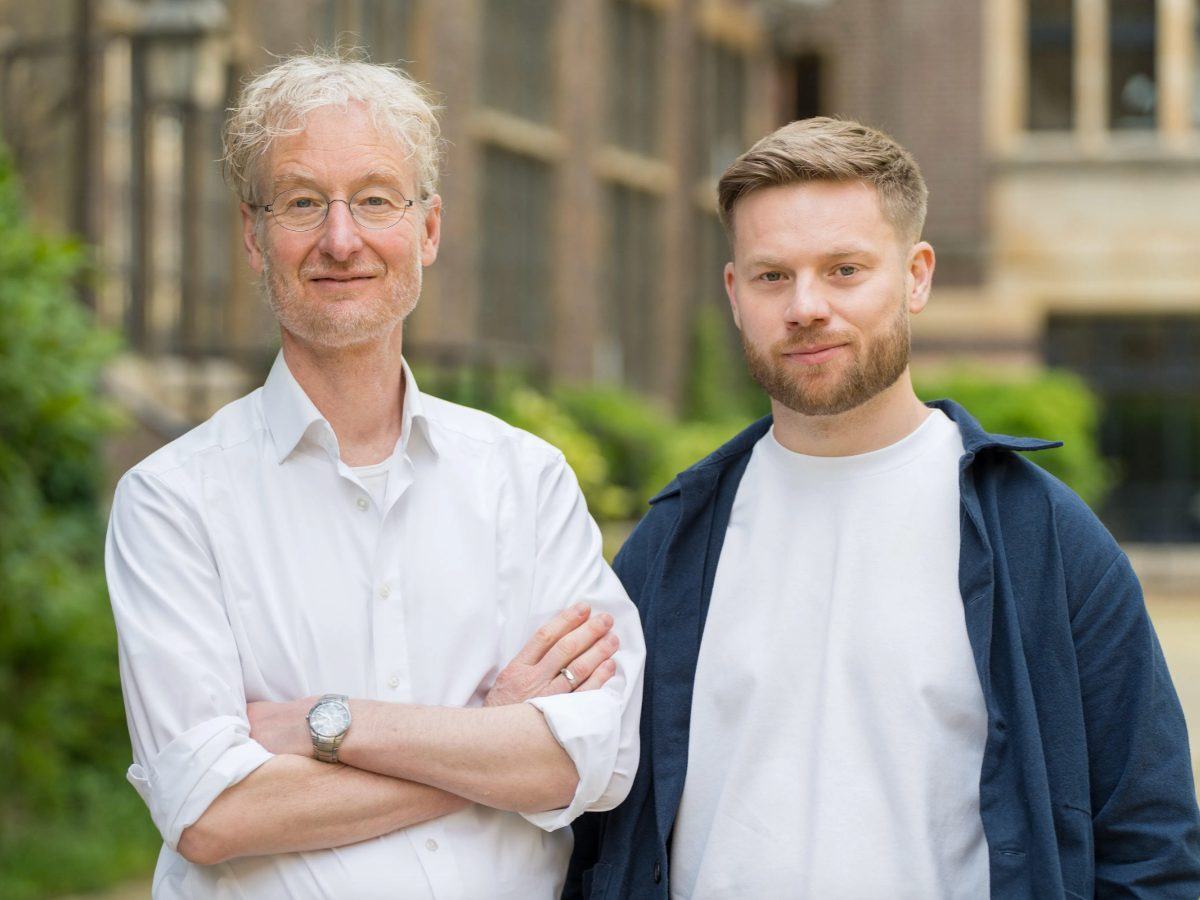
The mission statement from co-founders Dr Chad Edwards and Prof Max Welling is direct: "If we do not make progress fast, the next 50 years of industrial progress will be constrained by a single challenge: the world needs materials that do not yet exist."
The bottleneck they are solving
Every advance in semiconductors, batteries, carbon capture, and clean energy depends on discovering a material that does not yet exist. The next chip node. The next battery chemistry. The catalyst that makes green hydrogen cheaper than grey. The membrane that captures carbon at $50 per ton instead of $500.
The current discovery process takes a decade or more. A researcher proposes a candidate. A lab synthesizes it. The yield is low. The properties are wrong. They iterate. Each cycle costs months and millions. The average new material takes 10 to 20 years to go from lab discovery to commercial deployment.
CuspAI's thesis is that frontier AI can collapse that timeline to months. The model generates candidate materials, simulates their properties at high fidelity, and routes the best candidates to synthesis partners in the Foundry network for validation. The loop is the same one Karpathy ran on model optimization, applied to the periodic table. Define the target. Generate candidates. Simulate. Synthesize. Feed the result back. Run again.
What the Foundry actually is
The AI Materials Foundry is not a single lab. It is a federated network of industrial R&D facilities, academic labs, and data providers coordinated through CuspAI's AI layer. A semiconductor partner needs a new dielectric material. CuspAI's model generates candidates. A synthesis partner makes them. A characterization partner tests them. The data flows back into the model. The loop tightens.
The 48+ partners span the full stack. NVIDIA provides the compute infrastructure. Meta contributes open-source models through FAIR. Applied Materials, Tokyo Electron, and Lam Research bring semiconductor process expertise. Hyundai and Samsung bring manufacturing scale. imec and the University of Cambridge bring characterization capabilities. ICSD and Wiley bring the world's largest curated databases of known crystal structures and peer-reviewed materials science literature.
Kleiner Perkins partner Josh Coyne framed the wedge: "Most big leaps in technology come down to a material, and the next set, from cheaper carbon capture to semiconductors and cleaner water, is stuck waiting on materials nobody has discovered yet. CuspAI built a search engine that changes that."
The key phrase is "design for materials that can actually be built, not just ones a model can dream up." That is the distinction. AI-generated materials are cheap. AI-generated materials that can be synthesized at scale are the bottleneck. CuspAI's Foundry model closes that gap by routing candidates directly to partners who can make and test them.
The team and the backers
Chad Edwards and Max Welling founded CuspAI in 2024. Welling is one of the world's most cited AI researchers, a pioneer in variational inference, generative models, and equivariant neural networks. Edwards was the first person in his extended family to attend university. Together they have assembled what Welling's peers describe as the highest concentration of AI and materials science talent in one place.
The advisory board tells the caliber. Geoffrey Hinton, Nobel Laureate. Yann LeCun, Turing Award Laureate. Martin van den Brink, former President and CTO of ASML, the company that makes the machines that make every advanced chip. Abhi Talwalkar, board member at AMD and chairman of Lam Research. Kristin Persson, one of the world's leading computational materials scientists. John Giannandrea, former head of AI at Apple and Google, is helping build US operations.
The UK government invested through its Sovereign AI Venture Fund, making CuspAI the fourth company to receive that backing. Science and Technology Secretary Liz Kendall called it a bet on "breakthroughs that are set to grow our economy, protect the natural world and improve everyone's lives." The typical sovereign fund check runs £1 million to £10 million. The exact amount was not disclosed.
CuspAI is expanding internationally with a new Singapore office joining existing hubs in Cambridge, Amsterdam, Berlin, Tokyo, and the US.
The Bezos angle
Jeff Bezos invested personally, not through Amazon. Bezos Expeditions has been one of the most active individual investors in deep tech and AI: Anthropic, Figure AI, Perplexity, and now CuspAI. The pattern is consistent. Bezos is not betting on a specific model or application layer. He is betting on the infrastructure layers that all models and applications will depend on. Compute. Robotics. Search. And now, the physical materials that make all of it possible.
The catch
Three things this does not settle.
First, the coalition is a statement of intent, not a shipped product. Forty-eight logos on a page does not deliver a new battery material. The Foundry model works only if the partners actually synthesize, characterize, and feed data back into the loop. That coordination is the hard part. The AI is the easy part.
Second, the materials discovery timeline is structural, not technological. Even if CuspAI cuts discovery from 10 years to 10 months, the regulatory, safety, and supply-chain qualification for a new semiconductor material still takes years. A faster discovery engine accelerates the front of the pipeline. It does not shorten the back end.
Third, the concentration of talent is a double-edged signal. When Geoffrey Hinton, Yann LeCun, a former ASML CTO, and the chairman of Lam Research all advise the same two-year-old startup, the signal is not just that the company is good. It is that the problem is enormous and the existing institutions are not solving it fast enough.
What we are doing this week
We are not a materials science company. But we are a company that builds on compute infrastructure, and every chip that runs our workflows depends on materials someone discovered. We are mapping one constraint in our own supply chain that traces back to a materials bottleneck - likely the energy cost of inference, which depends on semiconductor efficiency, which depends on dielectric materials that CuspAI's Foundry partners are actively researching. If there is an overlap, we will reach out to a Foundry partner this quarter. If there is not, we will watch the first materials to exit the Foundry pipeline. The first one that ships will set the pace for every one that follows.
Source