Meta ships Muse Wonder, its first frontier-class pair. The best version stays behind a subscription
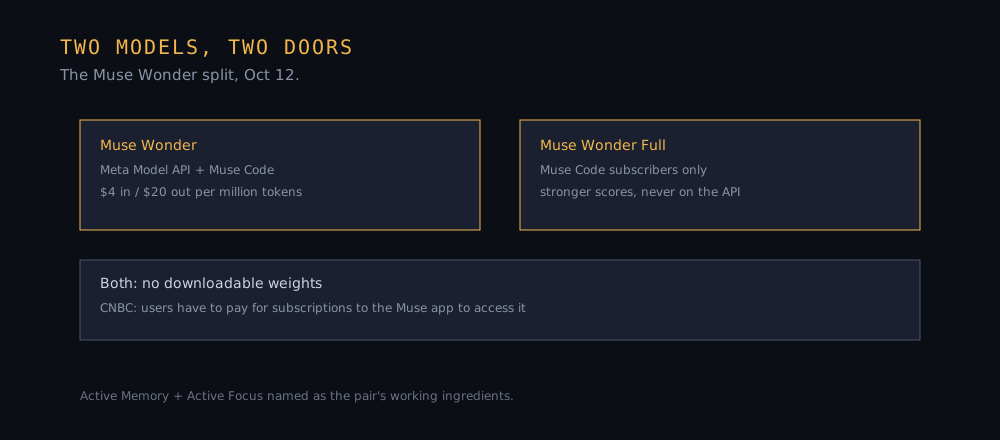
Meta's Superintelligence Labs released Muse Wonder and Muse Wonder Full on October 12, its first frontier-class models, with Wonder served through the Meta Model API at $4 per million input and $20 per million output.
The decision it puts on your desk
Pilot Muse Wonder on one customer-facing workflow by October 31, since Active Memory's persistence is the sell, not the benchmark. Price your memory retention against Meta's subscription before you commit, because the Full tier's silence also carries a release read: Meta kept the best score off the API deliberately.
Meta returned to the frontier tier on Monday, and the split across its two releases carries the strategy.
Muse Wonder is available through the Meta Model API and Muse Code. Muse Wonder Full runs the stronger results, and it stays available to Muse Code subscribers only, so the better model never touches the open market.
The company names its new ingredients directly: "Muse Wonder brings together Active Memory and Active Focus to keep track of what matters to you and work diligently toward what you want to accomplish," the launch post said.
Neither model has downloadable weights. Launch coverage places both inside the frontier band, with Wonder Full carrying the stronger scores of the two.
CNBC framed the monetization pitch: Meta introduced Muse Wonder, and "users have to pay for subscriptions to the Muse app to access it."
What Meta is really selling
Follow the money past the agent features.
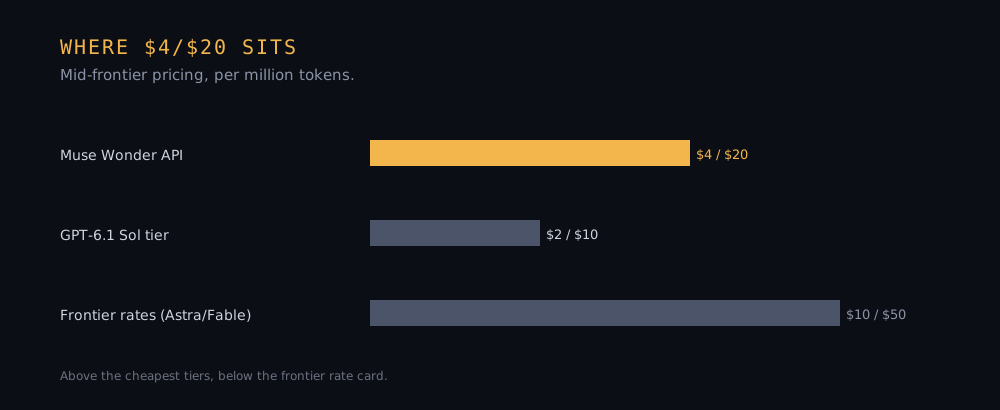
The API prices at $4 and $20 per million tokens, above the cheapest tiers OpenAI and Anthropic run, and below the frontier rates. Medium-frontier capability behind a paid product line is now Meta's seller.
Active Memory and Active Focus sit inside agent tasks as the working layer: the first keeps what matters across sessions, the second keeps attention on the task that matters.
Precedent check: Meta had released open weights in earlier generations, including models served through Meta's own relationships. The move now ties the better model to a closed subscription.
Migration cost sits in the identity layer. A model that remembers across sessions produces pages of persistent memory, so state handling, deletion policy, and the identity behind it are the buyer's questions rather than the model's.
The unresolved edge is independent scoring. Meta published its own claims here, and the launch details matter before you rebuild anything.
I get the sense Meta priced for monetization, since a subscription wall plus an API price both sit below the frontier rate card.
Source
← Previous
The Lancet puts AI beside nuclear war in its extinction tier. Public health just labeled the year's tech debate
Next →
Google opens Gemini 4 Argon to everyone. The fall's most-watched gated release ends its Fairwind gate
The Morning Recap
We sift the day. You make the calls.
The decision on every story, in your inbox before your first call.