SpaceX prices $44 billion of notes for Vera Rubin chips after demand tops the $40 billion bound deal
SpaceX priced about $44 billion of notes on Nov. 20 to buy Vera Rubin chips after demand beat the $40 billion deal set on Oct. 26.
The decision it puts on your desk
Price the next 12-month compute line against a trust that holds the chips and leases them back, and set a check for the week the trust files its buy list, not the day of the $44 billion print.
SpaceX priced about $44 billion of notes on Nov. 20 to buy Vera Rubin chips as Apollo and Goldman Sachs led the book through a trust that will hold the chips and lease them to the firm, after demand beat the $40 billion lease set on Oct. 26.
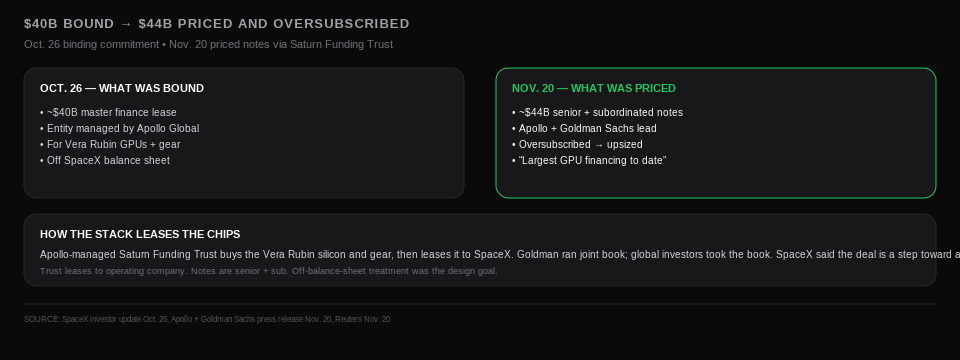
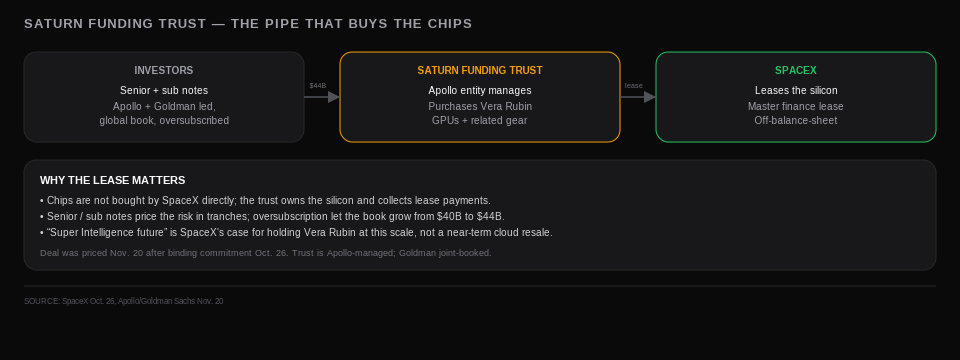
The notes are senior and sub paper that will fund a trust, Saturn Funding Trust, run by an Apollo entity. The trust will buy the Nvidia Vera Rubin chips and related gear and lease them to SpaceX. The firm said on Oct. 26 that the deal was a binding $40 billion master lease for the next generation of Vera Rubin chips, and Apollo and Goldman said on Nov. 20 that the priced notes were above the bound level and drew bids above the offer size.
From bound $40 billion to priced $44 billion
The extra $4 billion is the signal inside the number. SpaceX said on Oct. 26 that it had entered a binding $40 billion master lease for Vera Rubin chips, and the Nov. 20 book showed that price, not size, moved once the book opened. Apollo and Goldman Sachs said the notes were sold at about $44 billion as senior and sub tranches, with the book drawing bids well above the size on offer.
"Transaction was led by Apollo and Goldman Sachs alongside leading global investors," Apollo said, naming the two firms as leads on the priced notes. SpaceX said in its Oct. 26 investor update that the deal will fund the next-generation Vera Rubin chips as a step toward a "Super Intelligence future."
The priced book is larger than the bound lease, and the trust will own the chips. Saturn Funding Trust, run by Apollo, will buy the Vera Rubin chips and lease them to SpaceX. Goldman Sachs ran the joint book with Apollo. Reuters said the Nov. 20 pricing was led by Apollo and Goldman Sachs at about $44 billion in notes, with bids above the offer size.
Trust that holds the chips and the lease deal
The lease is the point that matters for the books, while the priced notes set the market price for that lease. A master lease lets the trust hold title to the chips and collect lease pay from the firm, rather than SpaceX buying the chips and carrying them as an asset. Senior and sub notes price the risk across layers, with the senior tranche holding the first claim.
"Transaction was led by Apollo and Goldman Sachs alongside leading global investors," Apollo said in its Nov. 20 statement. The statement called the deal the largest chip financing to date, with a full book after demand ran high. The deal was priced on Nov. 20 after the binding $40 billion set on Oct. 26, so the market saw a book, a price, and a close.
SpaceX had already set out the lease logic on Oct. 26 when it said the $40 billion master lease will fund the next-generation Vera Rubin chips. The Nov. 20 price confirmed the trust plan and the premium that investors put on the lease.
Market view on the $44 billion print
For the market, the print does two things at once. It sets a price on a lease that sits off the main books, at about $44 billion for Vera Rubin chips at scale, and it shows that large buyers will take both senior and sub risk when the trust holds the chips.
For supply, the signal is scale at a premium. The bound $40 billion already ranked as the largest chip financing by headline, and the $44 billion upsized that same headline after the book filled. A sold, full book for one firm's next-gen chips is a market on its own, and the same week brought other capacity signs across the stack. That size prices the chips as the scarce good and the lease as the way to move them.
One point stays open. The trust has not set a public buy calendar or a lease start plan, so the sold book is a pool today, not a spend clock. Until the trust files its buy list and lease dates, the $44 billion is a priced pool, not a plan to deliver.
Sources