Nvidia brings back Jensen Huang as chief on Nov. 23 and shares rise 31 percent
Nvidia brought back Jensen Huang as chief on Nov. 23, eleven days after he resigned. Shares moved up 31 percent after the board said United States officials saw no security risk.
The decision it puts on your desk
Keep any second-source chip plan you signed between Nov. 8 and Nov. 22, and price the next 90 days of model spend against two firms, not one. The board cut the single-person risk discount in a single day, but sworn talks from Dec. 1 to Dec. 3 and the review still price risk at the top. Use the next days to lock terms you can live with under either outcome.
Nvidia brought back Jensen Huang as chief on Nov. 23, eleven days after he resigned. Shares closed up 31 percent after the board said senior United States officials saw no national security risk.
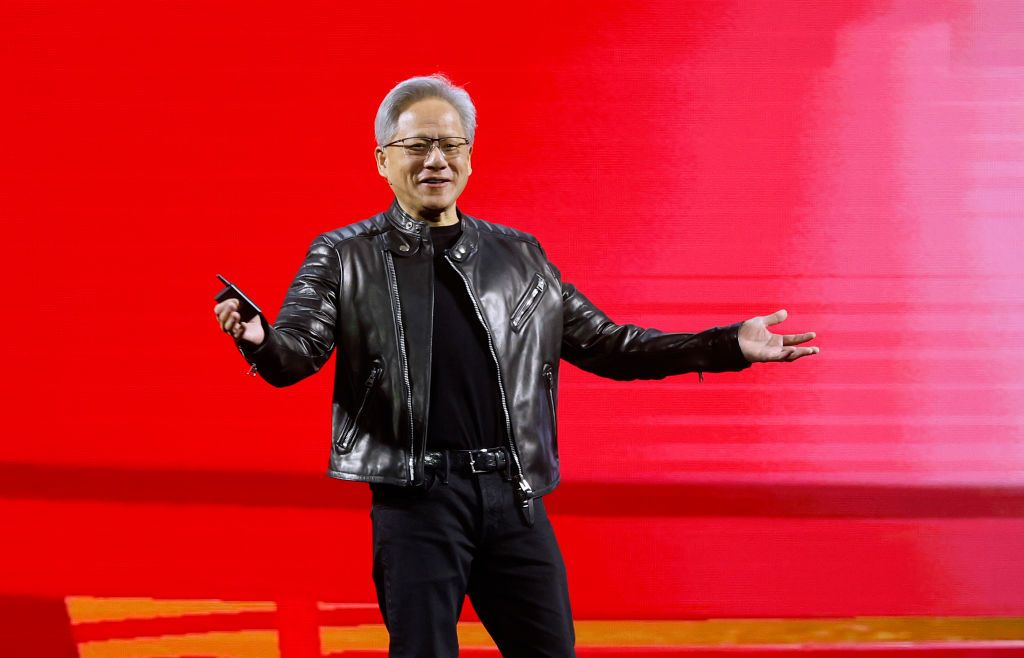
The board voted with no dissent to bring Huang back. He returns as president and chief and as a director. The change took effect at once and followed talks with Huang. Senior officials briefed the board late last week. They said no national security laws were broken. No secrets were shared, according to people with knowledge of the talks. Huang and board members first met on Nov. 22. They set the return on Nov. 23.
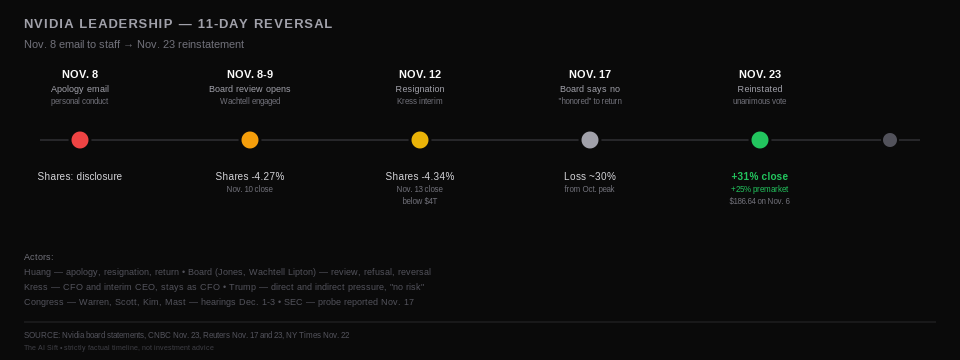
Eleven-day reversal
Huang started Nvidia with others in 1993 and led it for 33 years. He sent a note to staff on Nov. 8. He said he had acted in a way that hurt his family. The board said a foreign effort had targeted its chief from Nov. 8 to Nov. 9. It set up a panel of outside directors. It hired law firm Wachtell, Lipton, Rosen & Katz to run a review.
Huang resigned as president, chief and director on Nov. 12. The board named Colette Kress as acting chief. She kept the finance role.
Kress is Chief Financial Officer (CFO). The board began a search for a new top leader. It said work and the chip plan would continue. Huang said he would help the review.
On Nov. 17 the board said it did not plan to bring Huang back. It set up a national security panel. Director Suzanne Nora Johnson leads the panel. The firm also faced a report that a market regulator opened a check. The check looked at how the firm told investors what had happened. The SEC is the Securities and Exchange Commission. It oversees market disclosure. Huang broke his silence on Nov. 17. He said he would be honored to return if the board saw it as in the firm's interest. That statement set the stage for talks the next week.
The New York Times reported on Nov. 22 that Alice Huang had contact with an officer of China's spy agency from spring 2025 into fall 2026. MSS is the Ministry of State Security. Alice Huang is a Singapore-based business figure at the heart of the inquiry. She once held a senior role at cloud firm Megaspeed, citing people with knowledge of the case. Megaspeed has faced a review into whether it moved banned Nvidia chips to China in breach of export rules.
Board vote and government input
The board said on Nov. 23 it had received input from senior United States officials. It is sure the return poses no national security risk. It said the outside panel's review will run to its end. Kress will stay on as CFO under a filing with the SEC. Chair Harvey Jones said the board still sees Huang as the right person to lead.
"I am honored to return to NVIDIA and lead one of the most consequential technology companies in the world at the beginning of a new industrial revolution," Huang said in a statement. "I take this responsibility with the greatest humility and renewed commitment. I want to thank the NVIDIA Board for its confidence and deliberation through this process," he said.
President Donald Trump told CNBC on Nov. 23 he had spoken to the board directly and through others. CNBC is Consumer News and Business Channel. Trump said Huang "did nothing wrong." He said he spoke to Huang on Nov. 23 and asked him to promise to work hard. In a post on social media Trump said the board made the correct and proper choice. He said the United States needs Huang to lead the firm and the economy. He said the government sees no risk in the return and holds no proof of unlawful acts.
"The Board believes Jensen is the right person to lead NVIDIA, and that his reinstatement is in the best interests of our stockholders, employees, partners and customers," board chair Harvey Jones said. "We have every confidence in Jensen and look forward to working with him as he resumes his leadership of the Company," he said.
Market response and rival effects
Nvidia shares closed up 31 percent on Nov. 23. They had risen more than 25 percent before the open. The day ranked as the third-best on record for the stock. The gain erased roughly a third of the fall from the recent peak. Shares had shed nearly 33 percent from Nov. 8, when Huang disclosed the personal conduct, and closed at $186.64 on Nov. 6. Bernstein had cut its price goal to $200 from $400 on Nov. 13. Rivals had risen when Nvidia fell, with Advanced Micro Devices up 13.26 percent on Nov. 10.
The selloff since early November had two drivers at once. One was the personal governance shock. The other was a wider rethink of the artificial intelligence buildout and its debt load. AI is artificial intelligence. The board formed on Nov. 17 a national security panel to oversee export controls. The White House had said a day earlier it would further limit advanced chip sales. Lawmakers from both parties linked the firm's stance in Washington to its export record.
Elon Musk had lobbied for the return with investors Gavin Baker of Atreides Management and Brad Gerstner of Altimeter Capital. He said on X that the board's mistake has been corrected. Senator Elizabeth Warren said the reversal does not remove the need for answers on export controls. Senate Banking chair Tim Scott set further talks.
Open review and planned testimony
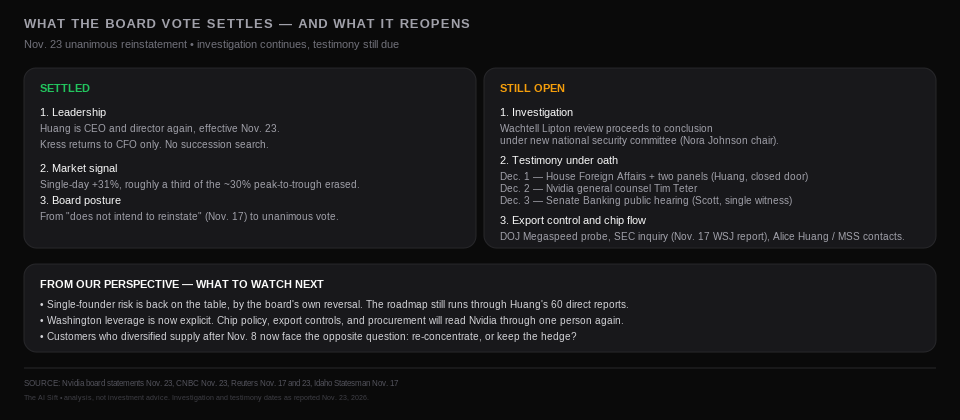
What the return settles is narrow. What it leaves open is material. The split defines the next month for Nvidia.
Leadership is settled, since Huang is chief and director again and Kress is CFO. The market signal is priced, with a single-day gain that ranks among the largest in the firm's history. Governance has flipped, from a no vote on a return on Nov. 17 to a yes with no dissent six days later, after briefings from government officials.
What stays open starts with the review itself. The outside panel, backed by Wachtell Lipton, will run to its end. Huang said he will help. The new national security and export controls panel now has formal oversight. A second item is sworn testimony. Huang is set for a closed record session with the House Foreign Affairs panel and two other panels on Dec. 1. General counsel Tim Teter is set for Dec. 2. A public Senate Banking hearing is set for Dec. 3. Its title is "Protecting America's AI Advantage: Oversight of U.S. Export Controls." Huang is the sole witness.
A third item is the chip flow record that drew scrutiny in the first place. It includes the Justice Department probe of Megaspeed. It includes the reported SEC inquiry into disclosure. It includes the story of Alice Huang's contacts with the MSS. It covers the same period in which Megaspeed bought large volumes of advanced Nvidia accelerators. An accelerator is a chip that trains and runs large models. The board said it has no reason to think secrets were shared. Federal review goes on and Congress prepares to test that claim on the record.
Nvidia outlook and risk repricing
The return ends the shock of the past two weeks and at once makes it stronger. Nvidia has now shown that its operating model still runs through one person. The same is true for its chip plan, its customer deals, and its ties in Washington. That person has about 60 direct reports and a 3.4 percent stake that can seat board members. That fact now frames every forward plan.
For the firm, three effects land at once. Ops regain a steady hand. The person who set the Vera Rubin cycle is back. GPU is graphics processing unit. The Vera Rubin GPU cycle and the large lease deals are back in the room where those pledges are priced. Washington sway is now out in the open. Chip rules for the next year will be read through one exec who has fought strict export curbs. He now returns with White House backing.
Customer risk is repriced as well. The same week the board changed course, large buyers were still pricing second-source plans they began after Nov. 8.
Rivals feel the mirror move. On Nov. 10 Advanced Micro Devices, Marvell and Broadcom all rose. That day showed a market that widened its vendor list when Nvidia's top job was open. The Nov. 23 return narrows that window. Vendors that gained sway during the gap now face a full-strength incumbent with full price and road map control. Firms that held back orders must pick whether to buy back in or keep the hedge they built in the past ten days.
Sources
https://www.cnbc.com/2026/11/23/nvidia-jensen-huang-ceo.html
https://www.cnbc.com/2026/11/23/trump-nvidia-jensen-huang.html
https://www.reuters.com/technology/nvidia-reinstates-jensen-huang-ceo-2026-11-23/
https://www.idahostatesman.com/news/business/article318114652.html
https://www.nytimes.com/2026/11/22/us/politics/alice-huang-china-spy-agency-nvidia.html