Anthropic closes at $93.5 billion as banks take full option on $83 shares
Anthropic closed at $93.5 billion on Nov. 20 as banks took the full option on $83 shares, with a $26 billion private sale of no-vote stock alongside.
The decision it puts on your desk
If the firm buys Claude access, lock the next 12-month rate on Claude within 14 days and price the next use case against the $83 print, not the $111.50 open, while keeping a second firm in the mix for the next buy. If the firm tracks public AI marks, treat $93.5 billion with $26 billion private as the deal shape that future AI sales will be judged against.
Anthropic closed at $93.5 billion on Nasdaq on Nov. 20 as banks took the full option on $83 shares, and the stock ended its first day at $97.17 after an early pop to $111.50. ANT (the stock code) began trading on Nasdaq on Nov. 19.
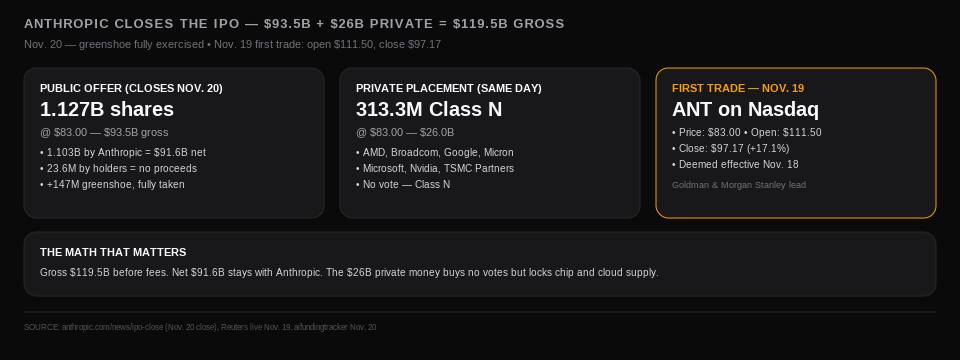
The firm said the sale closed at $83.00 per share for 1.127 billion Class A shares. Underwriters took the full 147.0 million-share option. It also closed a $26 billion private sale of 313.3 million Class N shares at the same price. Anthropic said about $91.6 billion stayed with the firm from the public leg, while holders kept the rest.
Close terms and cash to the firm
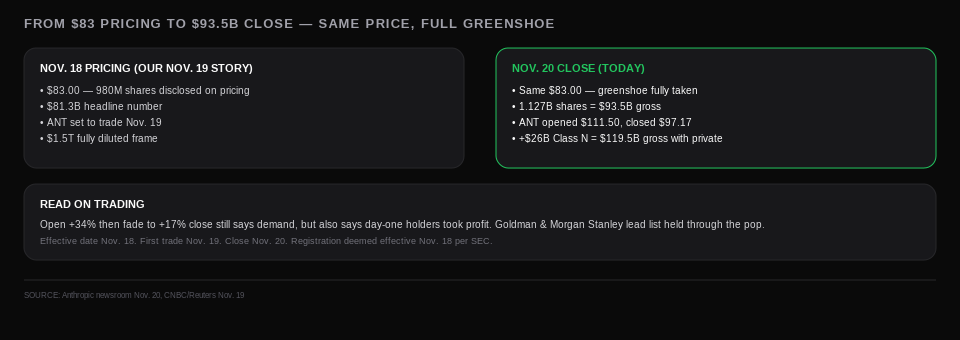
The headline moved from $81.3 billion at pricing on Nov. 18 to $93.5 billion at close on Nov. 20. The reason is simple. The same $83 price applied to more shares once the banks took the full option.
Anthropic said the public sale included 1.103 billion shares sold by the firm and 23.6 million sold by holders. The 147.0 million-share option was taken in full. At $83 the public gross is about $93.5 billion before fees. About $91.6 billion stayed with the firm after the holder sale. The registration was deemed effective on Nov. 18.
"A registration statement relating to these securities was declared effective by the SEC on Nov. 18," Anthropic said. SEC is Securities and Exchange Commission. The filing allowed the offer to price that night.
Goldman Sachs and Morgan Stanley led the sale, with about 15 other banks in the group. The private sale ran at the same $83. Anthropic said it sold 313.3 million Class N shares for about $26.0 billion. Buyers were Advanced Micro Devices (AMD), Broadcom, Google, Micron, Microsoft, Nvidia, and TSMC Partners. Those shares carry no votes, so the buyers funded the firm without gaining control. The private sale was not made under United States law. That law keeps the Class N apart from the public Class A. Funds across both legs were about $119.5 billion before fees. About $91.6 billion was net to the firm from the public leg.
First-day trade
Anthropic had priced at $83. That level had already pushed the deal into record ground. It then closed with the full option. The market read is narrow but clear. The trade on Nov. 19 showed strong demand but not euphoria.
Ant opened at $111.50. That is about 34 percent above $83. It closed at $97.17, up 17.1 percent on the day, wiping about half the early pop. "Shares opened at $111.50 and closed at $97.17," Reuters said in its live tape. CBS News also noted its close at $97.17 as a 17 percent first-day gain. The deal still stands as the largest United States IPO (initial public offering) by headline amount once banks took the full option.
The bank read also held. Goldman and Morgan Stanley had priced the deal at $83 on the evening of Nov. 18 for a Nov. 19 debut. The shares were priced and traded within a day of the effective date.
Private sale and funding setup
The private placement is where the deal meets the supply chain. At $83 per no-vote share, the seven buyers paid about $26.0 billion in total for 313.3 million shares. Anthropic said the sale was not made under United States law, so the class stays apart from the public shares.
The buyers are the same firms that sell chips and cloud space to the firm. The placement was set to close at the same time as the public offer, not after it. For the firm, the two legs add to $119.5 billion before fees. The net to the firm from the public leg alone is $91.6 billion. That figure is based on the 1.103 billion company shares.
That cash arrives as the firm pays a large compute bill. The filing case for the raise has tied the capital to pledges that run above $900 billion across years, with a one-year slice above $80 billion, so the raise funds future build rather than current profit. The firm, like the field, has posted mostly losses so far, and the capital is meant to carry the build.
One point stays open. The Nov. 20 filing states the close and the holder count. It does not set a fixed plan for how the net will be drawn or a schedule for the private funds. Until that lands, the gross is a closed deal count, not a spend plan.
Sources
← Previous
DeepSeek closes outside round of about $15 billion ahead of STAR filing
Next →
SpaceX prices $44 billion of notes for Vera Rubin chips after demand tops the $40 billion bound deal
The Morning Recap
We sift the day. You make the calls.
The decision on every story, in your inbox before your first call.