DeepSeek closes outside round of about $15 billion ahead of STAR filing
DeepSeek closed a second outside round of about $15 billion, with new holders taking 17.3 percent as the firm plans a STAR filing.
The decision it puts on your desk
Mark the STAR filing as the next dated step and price the next China deal against the $87 billion handle within 7 days. Keep a one-path plan if STAR prices above that mark and a two-path plan if it prices below, and set the review for the week the filing lands, not the day of this close.
DeepSeek closed a second outside round of about $15 billion on Nov. 20 as new holders took 17.3 percent and the firm set up a STAR Market filing.

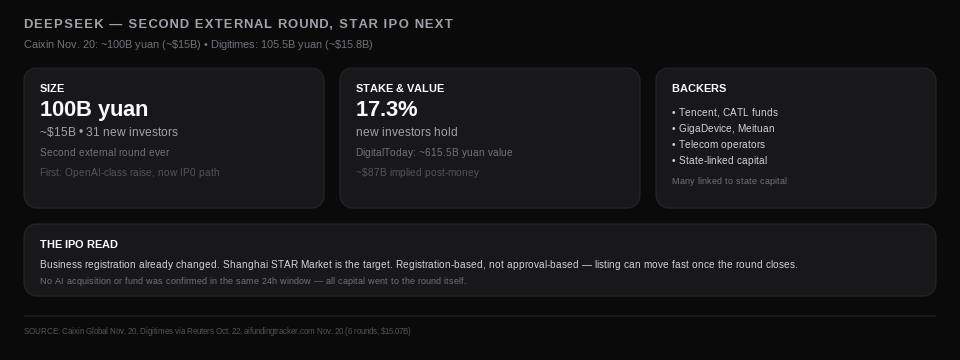
The registration change closed on Nov. 18, and a partnership that holds the new capital now owns the stake, Caixin said. The deal is the firm's second outside raise. Digitimes put the size at 105.5 billion yuan, about $15.8 billion. Bloomberg had flagged the same round on Oct. 22 with backers linked to Tencent and CATL, a maker of batteries.
Registration and holder base
The registration is the point that matters more than the headline number. STAR is the Science and Technology Innovation Board. It is a Shanghai market for tech firms. It uses a filing model, not an approval model, so a firm can move from papers to trading faster than on the main board once the sponsor and the exchange clear the file. A closed registration means the cap table is set for the filing. The new holders now sit on the books.
Caixin said the 31 new holders include funds linked to Tencent, CATL, chip maker GigaDevice, delivery firm Meituan, and telecom carriers. DigitalToday counted 31 names as well and put the post-money value at about 615.5 billion yuan, about $87 billion at current rates, citing state-linked backing across many names. That math implies the new holders paid about $15 billion for 17.3 percent. Bloomberg's October flag had already named CATL and Tencent as backers before the close, so the set was stable in late October.
"The round is now closed on paper and the new partnership holds 17.3 percent," Caixin said in its report on the registration change. "The 31 new investors are largely onshore and many are tied to state-linked funds," DigitalToday said in its tally of the holder base. No AI buy or fund was set in the same day, so the capital went to one deal. Aifundingtracker.com said the six qualifying rounds that day totaled about $15.07 billion, and DeepSeek made up more than 99 percent. The other five, including Everful at $48.5 million and Hoplite at $5.5 million, were an order smaller.
STAR path and listing setup
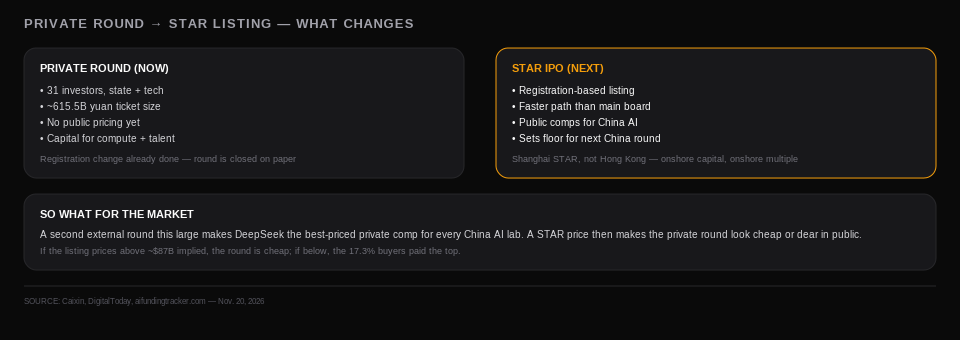
The next step is a planned filing on STAR. That path is where speed shows. Once the sponsor files, the exchange can move the deal to trading without the full approval gate that slows the main board. For a firm that just added 31 holders, a fast path matters. A public price will mark the private round as cheap or dear. If STAR prices above the implied $87 billion, the new holders bought low. If it prices below, they paid the top.
Bloomberg had already named the core backers in late October. Caixin said the round is now closed on file. The firm has not disclosed use of funds, and the market reads the cash as fuel for compute and for staff. Those are the two line items that set a model frontier. Caixin said the registration is done. DigitalToday said the value implied is about $87 billion. Neither number is a company filing.
Capital signal for China AI
For the market, the round does two things at once. It sets a private mark for every China AI firm at about $87 billion implied. It also sets the floor for the next public mark on STAR, where the price will be set onshore and in local currency. A wider holder base adds depth for the filing. It also ties the listing to the same money that funded it, which adds a floor but also a wall. If STAR prices below the implied value, the last private money will read as the high-water mark for China AI in 2026.
For global investors, the number sits next to the United States private marks this month. OpenAI closed $11 billion at $1.25 trillion on Nov. 6. Anthropic priced $81.3 billion at $83 on Nov. 18, with a fully diluted $1.5 trillion. DigitalToday said DeepSeek at $87 billion implied is a full order smaller, while Bloomberg said the buyer list is largely onshore. That split explains why the capital can be raised in parallel. The money is not chasing the same share.
One point stays open. The firm has not set a filing date or a price range for STAR. DigitalToday said the 615.5 billion yuan read is its own estimate, not a company file. Until the firm files, the $87 billion mark is a private handle, not a public price.
Sources
← Previous
Anthropic prices at $83 and raises $81.3 billion, the largest initial public offering on record
Next →
Anthropic closes at $93.5 billion as banks take full option on $83 shares
The Morning Recap
We sift the day. You make the calls.
The decision on every story, in your inbox before your first call.