Moonshot AI closed $3.5B at $35B. Series G is already live at $50B. Anthropic's IPO just got a new benchmark
Moonshot AI closed $3.5 billion at a $35 billion post-money valuation on July 29. Investor subscriptions exceeded the original target by more than three times. The company opened its Series G Pre-IPO round the same day at a $50 billion pre-money valuation. Revenue hit $300 million annualised. Kimi K3 beats Claude Opus 4.8 on coding. A Hong Kong IPO is expected by year-end.
The decision it puts on your desk
If you hold private shares or pre-IPO exposure to any US closed-model AI company, reprice your position against the Moonshot Series G benchmark by end of week. The Series F closed at $35 billion with three times the demand it could absorb. Series G launched the same day at $50 billion pre-money. This is no longer a pre-IPO market repricing. It is the real market voting with real money. For founders building on model APIs: the company that will undercut your COGS within 12 months just closed $3.5 billion it did not ask for and opened a round at $55 billion. Benchmark inference costs against self-hosted Kimi K3 this week. For investors: the Hong Kong IPO is the sector catalyst. Not a benchmark. Not a pre-IPO market. A live stock with audited financials. Price everything downstream of it.
Moonshot AI closed a $3.5 billion Series F at a $35 billion valuation on July 29. Investors wanted to put in over $10 billion. The round was three times oversubscribed.
The original plan was to raise $1 billion to $2 billion. The round was closed early to stop oversubscriptions. The Series G round, originally scheduled for August, was pulled forward. Moonshot distributed a shareholder resolution seeking Hong Kong IPO approval with a six-month outer bound. Revenue hit $300 million annualised in June. Kimi K3 benchmarks beat Anthropic's Claude Opus 4.8 on coding.

This is not a venture round. It is an IPO rehearsal.
The $35 billion number is post-money: $31.5 billion pre-money plus $3.5 billion in new cash. Investors who came in late paid the price set when the round opened in early July. The excess demand went into the raise size, not the share price. Founders and existing holders absorbed more dilution in exchange for a much larger balance sheet.
The re-rating shows up in the round Moonshot is already pitching. Series G at $50 billion pre-money is roughly 60 percent above the pre-money price the just-closed round was struck at. If the round lands, the post-money valuation would push past $55 billion. That puts Moonshot at roughly 6 percent of Anthropic's $965 billion last-round price, up from 3 percent at $30 billion.
The demand signal is the story. A round that closes at three times its target on a fixed price means the valuation was set before the market knew what it wanted to pay. The backlog of unplaced demand rolled straight into a Series G at a higher price. The buyers who missed the cut at $31.5 billion pre-money now have to decide whether to pay $50 billion or wait for the float.
Anthropic's $965 billion IPO is now priced against a $55 billion comp
Anthropic filed its confidential S-1 on June 1, raised $65 billion at $965 billion in May, and eyes December 2026 for listing. Its revenue run rate is roughly $47 billion. On every conventional metric, ARR, total capital raised, or margin profile, Anthropic dwarfs Moonshot.
The problem is not the size comparison. It is the direction of travel.
Moonshot's valuation went from $4.3 billion to $35 billion in seven months. Its revenue went from roughly zero to $300 million annualised in the same period. Its flagship model went from trailing Claude by a wide margin to beating it on coding benchmarks. The Series G at $50 billion pre-money implies the market expects the trajectory to continue through at least one more product cycle.
For Anthropic, this means the IPO will be priced against a live, fast-moving comp. Three more Kimi releases will land between now and the December roadshow. Each one that closes the capability gap further compresses the moat that the $965 billion price was built on. The pre-IPO market already priced this. $232 billion wiped from Anthropic's implied market cap in the four days after Kimi K3 dropped. The Series F close at $35 billion confirms the market was not overreacting.
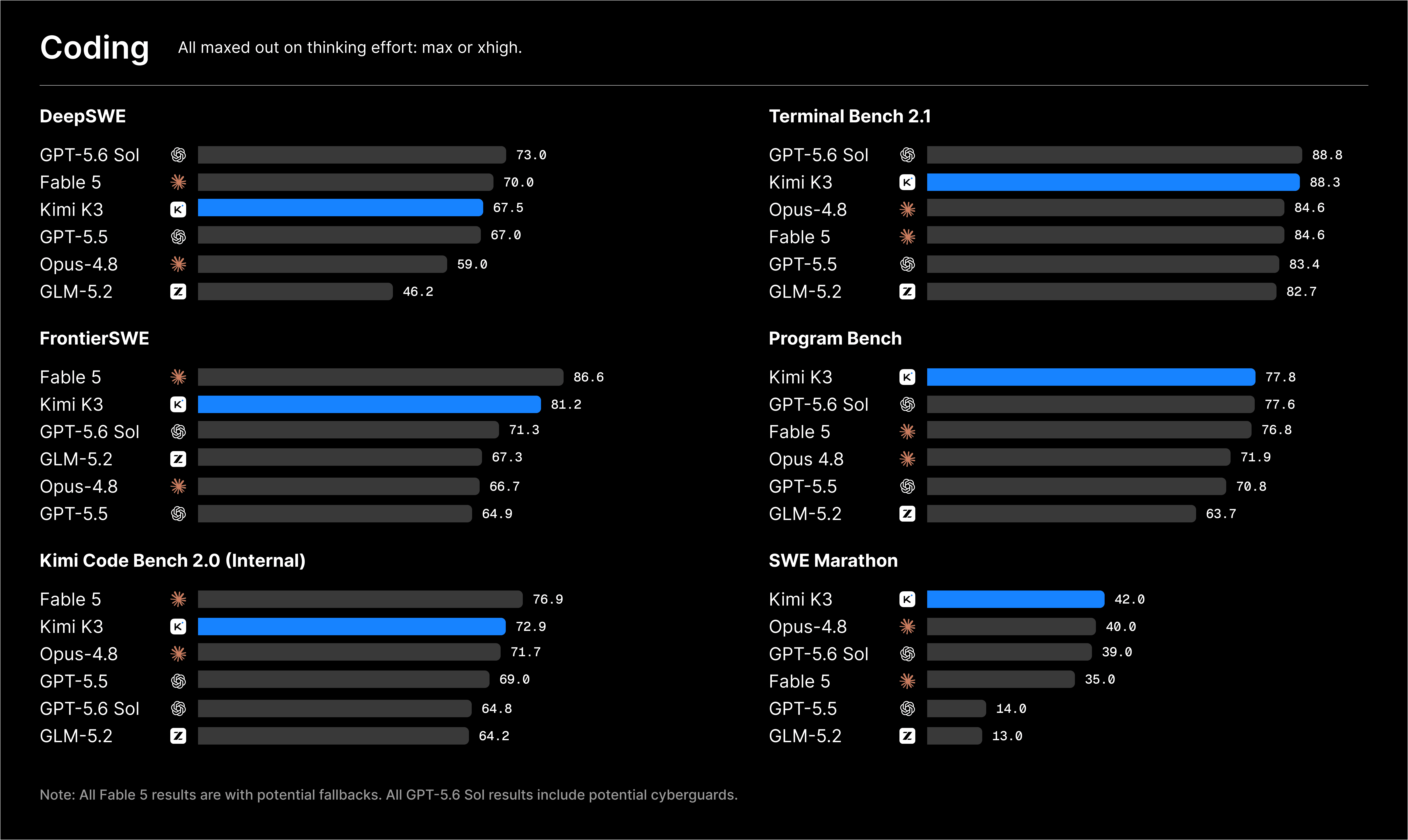
The structural question: does a $47 billion-ARR business with a shrinking technology lead command the same multiple the market priced in May, when the lead looked permanent. Moonshot's $55 billion round says the market has already moved the answer.
The OpenAI timeline buys time, not protection
OpenAI's IPO is further out, with the median forecast around March 2027. GPT-5.6 Sol still outperforms Kimi K3 on overall capability and hard reasoning benchmarks. That gap gives OpenAI breathing room Anthropic does not have.
The breathing room is narrowing. Moonshot's model cadence is roughly one release every six to eight weeks. If that cadence holds, six more releases will land before OpenAI's roadshow. Each release that closes the distance on reasoning or vision knocks a few points off the premium the market assigns to proprietary frontier models.
The $160 billion wipe in OpenAI's pre-IPO implied market cap after K3 dropped was a forward bet. The Series F oversubscription at $35 billion adds conviction to that bet. A Series G close at $55 billion would turn conviction into market consensus.
The China cost structure is why this is not a bubble
A UBS semiconductor team report published this year deconstructed Chinese AI economics. The numbers explain why Moonshot can close at $35 billion with $300 million in ARR and still attract $10 billion in demand.
Chinese model training costs are less than 10 percent of those of OpenAI and Anthropic. Average API prices are below 20 percent of comparable US products. Gross margins run roughly 20 to 40 percent, comparable to US peers. The low pricing is not cash-burn subsidy. It is a structural advantage built on smaller parameter counts, aggressive sparse-attention architectures, and electricity costs 44 percent lower than in US data center states.
Moonshot's models activate only three to 10 percent of total parameters per token, compared to 15 to 30 percent for US peers. The result is a model that costs substantially less to train and serve while delivering frontier-adjacent performance. The economics make the open-weight playbook work at scale, and the $3.5 billion Series F gives Moonshot the balance sheet to buy the compute it needs to keep the cadence running.
One constraint the euphoria obscures. Moonshot's compute supply has been the limiting variable since K2.5. Paying subscribers at roughly $7.40 per month hit service limits. APIs overloaded for months. The $3.5 billion raise buys hardware, but the bottleneck is physical. GPU capacity under export controls, not money. If the compute famine does not ease, the product momentum that justifies the Series G price breaks.
The Hong Kong IPO is the catalyst that re-rates the entire sector
Moonshot is restructuring to dismantle its offshore VIE structure for a Hong Kong listing under Chapter 18C rules. Zhipu AI and MiniMax have already listed in Hong Kong and delivered revenue results, giving public-market investors a precedent to price against. DeepSeek paused its own funding round while weighing a Shanghai listing for 2027.
A Moonshot IPO would be the first opportunity for public investors to take a direct position on the open-weight-vs-proprietary thesis. The Series G round at $55 billion would be the last private mark. The listing would be the first public one.
If Moonshot lists and the stock holds above the private-market price, the entire comp set shifts. Anthropic's $965 billion valuation would be re-measured against a live, publicly traded open-weight competitor, not just a pre-IPO multiple on IG. If Moonshot lists and the stock trades down, it validates the bear case that open-weight economics do not support public-market exits. Either way, the IPO is the first real pricing event for the thesis that has driven roughly $9.7 billion in disclosed funding into Kimi.
What this means for the other frontier labs
Moonshot's Series F reset the comp. The Series G will set the new ceiling.
For Anthropic: the IPO is the forcing function. The December 2026 target means six months of Kimi releases before the roadshow. The $965 billion round was priced against Claude being the best coding model, the best reasoning model, and the only frontier lab with a durable moat. Kimi K3 already challenges the first claim. The Series F oversubscription, $10 billion in demand for a company with $300 million in ARR, suggests investors think Moonshot challenges the remaining two.
For OpenAI: a March 2027 IPO means six more Moonshot release cycles between now and the roadshow. GPT-5.6 Sol still leads. The question is whether that lead holds through K4, K5, and K6. If K4 ships in Q4 2026 and beats Sol on two of three major coding suites, the IPO multiple compresses before the S-1 is filed.
For DeepSeek and the other AI Tigers: Moonshot is now worth 10 to 15 times its nearest Chinese competitor. A defensive raise from DeepSeek, Zhipu, or MiniMax is the expected response. If DeepSeek prices a round at $5 billion or $10 billion on the back of Moonshot's comp, the capital flow into Chinese open-weight labs accelerates. The cost-advantage narrative gets louder. The structural pressure on proprietary-model pricing intensifies.
The catch
Four things this does not settle.
First, the Series G round is in talks, not closed. The $35 billion Series F is done. The $50 billion pre-money is a price the company is willing to float in August 2026, weeks after closing its last round. Investors who pass on Series G can simply wait for the float.
Second, the revenue multiple confronts a public-market reality check. At $55 billion post-money against $300 million ARR, the multiple is north of 180 times. No public-market investor will underwrite that without audited financials and a clear path to profitability. The gap between a private-market valuation and what the Hong Kong exchange will support is the tension the IPO has to resolve.
Third, the compute famine is the existential variable. A $3.5 billion raise buys hardware. It does not guarantee access under US export controls. The model cadence depends on GPU supply. The product experience for paying subscribers depends on inference capacity. If either constraint bites, the revenue trajectory breaks.
Fourth, the policy escalation is underway. The Trump administration reactivated four choke points on Chinese AI models within 72 hours of K3's launch. A potential Entity List designation and NSA advisory are in motion. If Chinese open-weight access is restricted by regulatory fiat, the thesis that proprietary US labs face an existential pricing threat reverses partially.
Source
← Previous
IPO-bound Indian lender Fibe launches AI credit tool for consumers outside the formal banking system
Next →
Top scientists at OpenAI, Anthropic, Google and Meta ask U.S. for tools to pace AI development
The Morning Recap
We sift the day. You make the calls.
The decision on every story, in your inbox before your first call.